
There’s a certain kind of exhaustion that sleep alone doesn’t fix.
It’s the kind that follows you into bed after the day is technically over. Your body is tired, your eyes are heavy, and yet something inside you is still bracing. Your thoughts keep moving. Your chest stays a little tight. The room is quiet, but you are not. If you’ve ever found yourself lying in the dark feeling frustrated that rest should be simple but somehow isn’t, you’re not failing at sleep. You may just be carrying more activation than your system knows how to set down.
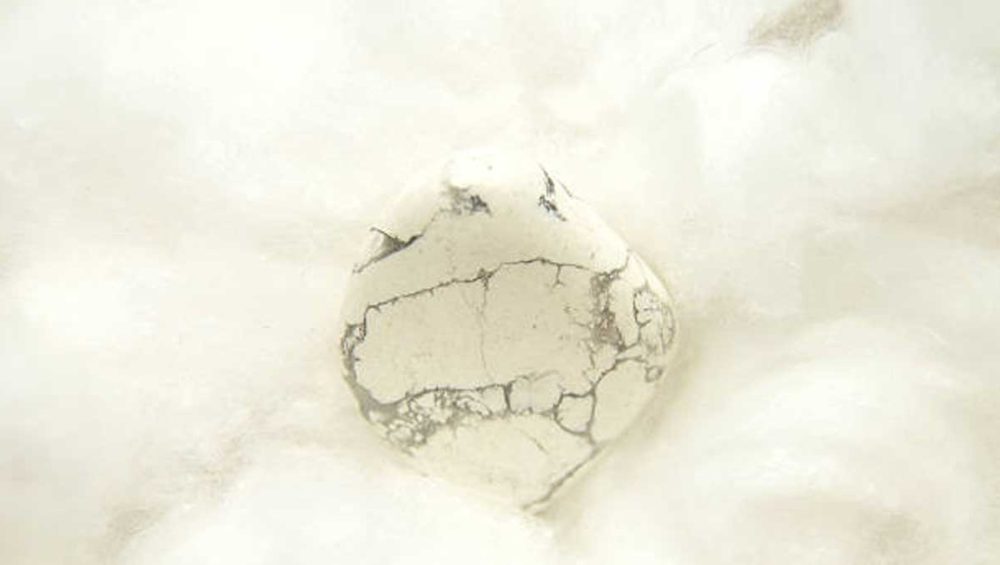
That’s part of why the search for gentler nighttime support matters so much. Many people are not looking for intensity at night. They are looking for softness. They want something that helps the mind stop gripping, the emotions stop echoing, and the nervous system stop scanning. Within the wider world of crystal healing, howlite is often chosen for exactly that reason. Its reputation is not built on stimulation or energetic force. It is associated with quieting, settling, and emotional ease.
Howlite for sleep can feel especially meaningful for people whose sleeplessness is tied to overthinking, emotional overflow, or subtle nighttime anxiety. It doesn’t have to be dramatic. Sometimes it shows up as replaying conversations when you wish you could switch off. Sometimes it feels like an unnamed unease that appears as soon as the lights go out. Sometimes it is the ache of being tired for days and still not feeling able to fully exhale. In those moments, what helps is often not more pressure to “do sleep correctly,” but a gentler environment around rest.
That gentler environment can include ritual, touch, breath, light, and intention. It can also include a stone whose energy is traditionally linked with calm. If you’re already drawn toward sleep support that feels soothing rather than forceful, howlite may fit naturally alongside emotional wellness foundations that prioritize safety, steadiness, and self-trust over performance.
Real rest usually doesn’t begin with control. It begins with enough inner permission to loosen your grip. For some people, howlite becomes part of that permission. It sits on the nightstand, under the pillow, or in the palm like a physical reminder that the goal is not to push yourself into unconsciousness. The goal is to support the quiet conditions where sleep can arrive on its own time.
Why Sleep Can Feel So Hard When You’re Already Exhausted
One of the most painful parts of sleep struggles is the confusion. You can be genuinely tired and still unable to settle. That feels contradictory until you remember that sleep is not only about fatigue. It is also about whether your nervous system feels safe enough to power down.
When stress, grief, emotional tension, overstimulation, or hypervigilance are still active in the body, nighttime can feel strangely exposed. The outside world is quieter, so the inside world gets louder. Thoughts that were manageable during the day begin looping. Sensations you ignored while busy become impossible to miss. Your body may interpret stillness not as relief, but as the moment it finally has space to process everything it has been holding.
This is why sleep hygiene alone does not always reach the core of the problem. You can reduce screen time, make tea, and dim the lights and still feel internally alert. That doesn’t mean your routine is pointless. It means rest often asks for more than behavior. It asks for regulation. It asks for support that honors the way stress lingers in the body, which is why practices related to nervous system regulation techniques can be so important when sleep feels fragile.
Howlite enters this picture as a calming companion rather than a cure. Many people are drawn to it because it symbolically and energetically supports the experience of slowing down. It can become part of a nighttime cue that tells your system, “You do not need to stay on guard.” That message matters, especially if your exhaustion comes with internal tension instead of softness.
In this sense, howlite for sleep is not really about perfection. It is about reducing friction. It is about making bedtime feel less like a battle and more like a transition. And when that transition is supported by breath, quiet sensory anchors, and compassionate pacing, even small shifts can begin to feel meaningful.
What Makes Howlite Feel Supportive at Night
Howlite is often described as a calming stone, but that description becomes more useful when you translate it into lived experience. It is associated with the softening of mental chatter, the easing of emotional intensity, and the kind of quiet awareness that does not demand anything from you. For people who reach bedtime feeling mentally crowded, that matters.
Its energy is often talked about in relation to patience, stillness, and gentler processing. That makes it different from stones that feel highly activating or expansive. Howlite does not tend to carry the emotional volume of a stone meant to energize, protect, or intensify spiritual work. Instead, it is often chosen when the need is simple: less noise, less pressure, less internal motion. The deeper themes behind howlite meaning align naturally with nighttime support because they center on calm perception rather than intensity.
For some people, howlite feels helpful because it seems to interrupt the spiral of repetitive thought. For others, it acts more like a grounding object—something cool, smooth, and steady to hold while the body unwinds. Even if you approach crystal work symbolically, that symbolic function still matters. Ritual objects can help the mind shift states. They can mark a boundary between “I am still carrying the day” and “I am beginning to release it.”
Howlite is also commonly linked with upper energy centers, which is part of why discussions around howlite chakras often connect it to mental quiet and spiritual calm. If your nighttime restlessness shows up as overthinking rather than physical agitation, that association may feel especially relevant. Rather than pushing your awareness outward, howlite is often used to make inner space feel gentler and less crowded.
When placed near the bed or held during a brief wind-down practice, howlite can become a cue for your body to begin the descent into rest. Not instantly. Not mechanically. But with repetition, tenderness, and trust.
How to Use Howlite for Sleep in a Gentle Bedtime Ritual
The most supportive bedtime rituals are usually the ones you can actually keep. They do not need to be elaborate. They do not need to be aesthetically perfect. They only need to feel safe enough, simple enough, and calming enough that your body begins to recognize them as a bridge toward rest.
A gentle howlite ritual might start ten minutes before bed. You dim the lights. You put your phone down. You take the stone in your hand and notice its texture. Instead of asking it to “make” you sleep, you let it become a focal point for quieting. You breathe more slowly than usual. You let your shoulders drop. You stop demanding immediate results. This is where howlite often works best—not in urgency, but in repetition.
You might place it under your pillow, on your chest during a few slow breaths, or beside your bed where you can see it as you settle in. It pairs well with supportive nighttime rhythms found in daily self-care rituals, because the point is not performance. The point is helping your body associate bedtime with steadiness rather than stress.
If your evenings feel emotionally charged, you may also find it helpful to combine howlite with practices that reconnect you to the body. This could mean a warm shower, a few minutes of stillness, or breath-led support rooted in mindfulness for anxiety. If your mind gets louder when the world gets quieter, giving it one soft place to rest can be surprisingly powerful.
And if nighttime feels unsafe because your system has been overstimulated all day, pairing your howlite ritual with grounding rituals for emotional safety can help create an experience of containment. Instead of trying to leap from activation into sleep, you build a small bridge. You let the body arrive gradually. You let the night feel kinder than the day that came before it.
Howlite, Overthinking, and the Emotional Weight You Carry to Bed
Many sleep issues are not only physical. They are emotional in disguise. Bedtime becomes the hour when everything you postponed returns. The feeling you swallowed earlier. The conversation you didn’t finish processing. The grief that stayed quiet while you were busy. The fear that was manageable during daylight but becomes louder in the dark. If you’ve ever noticed that your body feels more emotional at night, you are not imagining it. Without distraction, what is unresolved often rises.
This is one reason howlite for sleep can feel so resonant. It is often chosen not just for insomnia in the abstract, but for sleep that is disrupted by thinking, feeling, remembering, anticipating. It supports people who are tired in the body but crowded in the mind. That kind of sleeplessness needs compassion, not scolding.
Howlite may be especially comforting when restlessness comes from carrying too much unprocessed internal material. In that sense, it pairs naturally with practices that make emotional life feel more breathable, including journaling prompts for emotional stability and how to reset your nervous system after stress. The stone itself may not do the emotional work for you, but it can hold the tone of the space where that work becomes gentler.
Sometimes what keeps people awake is not panic, but subtle vigilance—the sense that something still needs tending before they can rest. In those moments, even a small ritual object can help move the mind out of management mode. The stone becomes a reminder that not every feeling has to be solved tonight. Not every thought needs to be followed. Some things can be felt, acknowledged, and set down until morning.
That emotional permission is often what bedtime has been missing.
Howlite Compared With Other Crystals for Sleep and Rest
Not every sleep crystal supports the same kind of need. Some are chosen for dream work. Some are chosen for spiritual depth. Some are chosen for protection, grounding, or emotional cleansing. Howlite is distinct because its reputation centers so strongly on quieting mental activity and softening overstimulation. If your main nighttime struggle is a mind that won’t stop moving, howlite often makes intuitive sense.
That does not mean it is the only option. It means it has a clear role. When you look at wider categories like crystals by intention, you start to see why different stones fit different forms of sleeplessness. A person who needs deep grounding may gravitate elsewhere. A person who wants more dream recall may choose differently. A person whose nights are defined by racing thoughts and subtle internal tension may feel especially drawn to howlite.
It can also be helpful to compare it with stones already associated with nighttime practice. amethyst for sleep and rest rituals carries a more intuitive, spiritual tone, while black tourmaline for sleep may feel more protective and grounding. Howlite, by contrast, often feels quieter and less forceful than either one. It doesn’t ask you to go deep. It asks you to soften.
If you want to build a small nighttime crystal practice, howlite can also fit beautifully among supports like sleep & circadian basics and crystals for meditation. That combination works because it respects both energy and rhythm. The body benefits from cues, and the mind benefits from repetition. Together, they help sleep feel less random and more invited.
FAQ: Common Questions About Howlite for Sleep
Does howlite really help with sleep?
Howlite is not a medical sleep treatment, but many people use it as a calming support when bedtime feels mentally or emotionally noisy. Its traditional associations with stillness, patience, and reduced mental chatter make it especially appealing for people who struggle with racing thoughts at night. In practice, it often works best as part of a gentle bedtime ritual rather than as a stand-alone fix.
Where should I place howlite when I sleep?
You can place howlite under your pillow, beside your bed, or hold it for a few minutes before sleep. The best placement is the one that feels soothing and easy to maintain. Some people prefer keeping it near the body, while others simply like having it visible on the nightstand as part of a calming nighttime atmosphere.
Can howlite help with anxiety at bedtime?
It may feel supportive if your bedtime anxiety shows up as looping thoughts, emotional restlessness, or trouble winding down after an overstimulating day. Howlite is commonly chosen for its gentle, quieting energy, which is why it fits well alongside practices connected to emotional grounding and extended exhale breathing. The goal is not to overpower your anxiety, but to give your system softer conditions for settling.
Can I combine howlite with other crystals for nighttime use?
Yes. Many people combine howlite with other sleep-supportive stones depending on what kind of rest they need. If you want a more emotionally quiet bedtime, howlite may be enough on its own. If you want a more layered ritual, you might eventually explore pairings that support dream recall, grounding, or intuitive calm. Some people naturally expand toward articles like how to remember dreams with crystals as their nighttime practice becomes more personal.
How often should I use howlite for sleep?
Consistency usually matters more than intensity. Using howlite regularly, even for a few quiet minutes each night, can help create a familiar cue that your body associates with winding down. Like any ritual support, it tends to become more meaningful through repetition. The calmer and more predictable the practice feels, the more naturally it can support rest.
Is howlite better for sleep, dreams, or emotional calm?
Its strongest reputation is usually tied to emotional calm and mental quiet, which is why it is often chosen for sleep support in the first place. While some people may include it in dream practices, it is generally more associated with soothing the mind than intensifying dream work. If your main need is less mental noise at night, howlite is often a very fitting choice.
Conclusion
Sleep can feel deeply personal when it becomes difficult. It touches vulnerability, safety, trust, and the private ways we carry stress after everyone else has gone to bed. That is why a gentle sleep ritual can matter so much. It is not just about getting unconscious faster. It is about changing the emotional tone of the night.
Howlite for sleep speaks to that softer need. It is not aggressive. It is not performative. It does not ask you to force your way into rest. Instead, it supports the quieter work of unwinding—of letting the mind become less crowded, the body less braced, and the night less adversarial. For people who feel exhausted but still internally alert, that shift can be profound.
Whether you use howlite under your pillow, in your palm, or as part of a simple evening ritual, what matters most is the feeling it helps create. Not magic in the dramatic sense, but permission. Permission to stop solving. Permission to stop scanning. Permission to let rest be something you receive rather than something you chase.
If that is the kind of support your nights have been missing, howlite may become more than a beautiful stone. It may become one small, steady part of a bedtime experience that finally feels kind to your nervous system.

Where softness, self-awareness, and emotional healing are allowed to coexist. Through reflective writing, grounding rituals, and intentional beauty, Sparrow Trades offers gentle support for sensitive souls learning to reconnect with themselves.