

There are times when protection is less about building walls and more about feeling steady enough to remain yourself. You may not be facing anything you can point to or name. You may simply feel exposed, emotionally stretched, or more affected by the atmosphere around you than you would like. In those moments, the idea of carrying something that represents safety can feel surprisingly comforting.
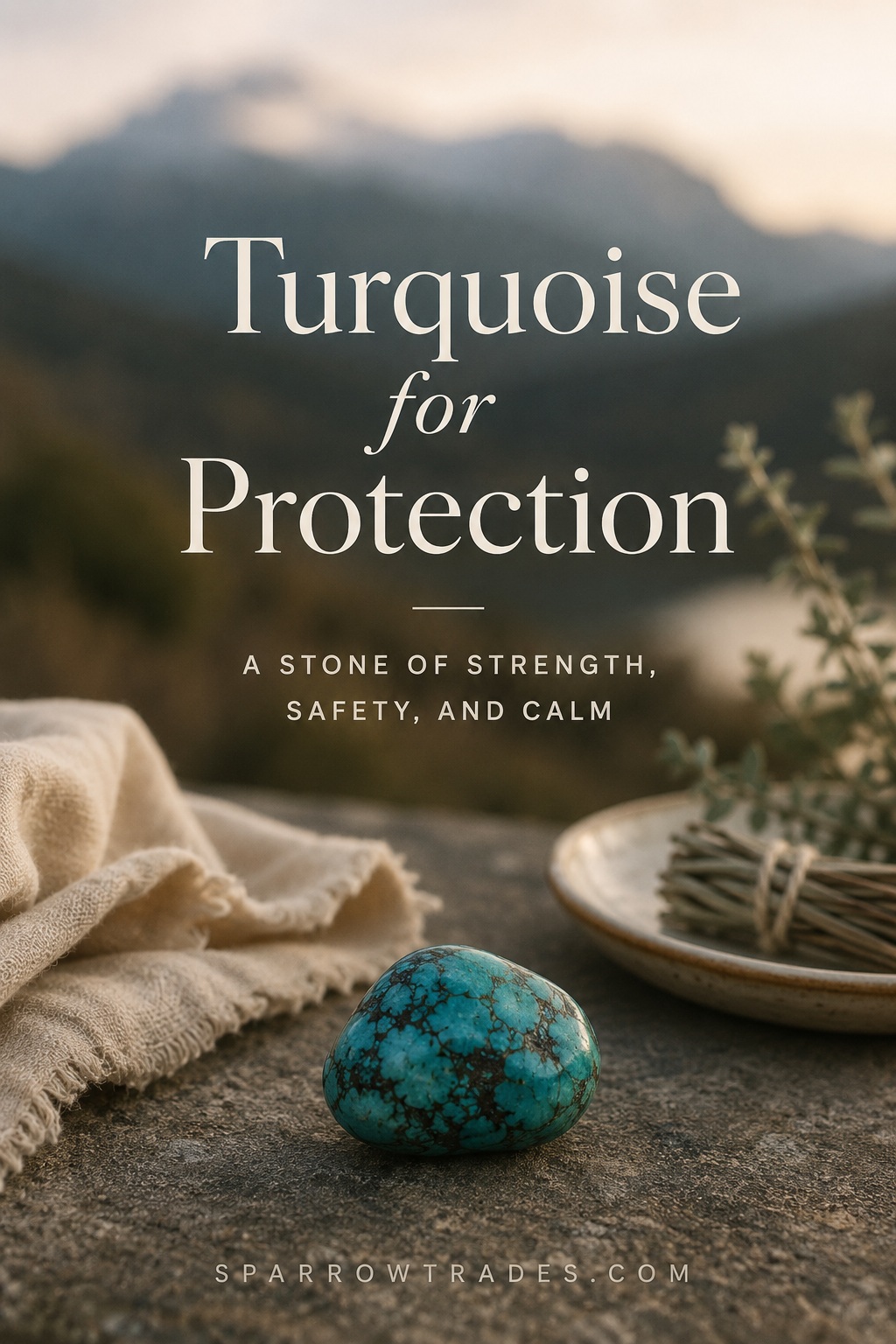
For centuries, turquoise has carried associations with protection, good fortune, connection, and spiritual significance across different cultures. Its vivid blue-green color has appeared in jewelry, ceremonial objects, amulets, and personal adornment, giving the stone a history that reaches far beyond the modern crystal cabinet.
That history is part of what makes turquoise for protection so compelling today. The stone does not need to become a magical shield for its symbolism to matter. Sometimes an object becomes meaningful because it reminds you of an intention you do not want to lose when life becomes noisy: stay grounded, speak honestly, notice what belongs to you, and remember that you are allowed to protect your peace.
For people drawn to the spiritual side of gemstones, turquoise is often described as a protective stone with a gentler quality than the dark, grounding stones commonly associated with energetic defense. Rather than evoking armor, turquoise can feel more like an open sky—spacious, clear, and quietly reassuring.
There is an important distinction here. Spiritual traditions and crystal practices may describe turquoise as protective, but there is no scientific evidence that a gemstone can physically block danger, absorb harmful energy, or prevent illness or misfortune. Its value is better understood through history, symbolism, personal ritual, and the emotional meaning we give to the things we carry with us.
And that does not necessarily make the experience less meaningful. A stone worn at your wrist, held before a difficult conversation, or kept nearby during a stressful season can become a tangible reminder of something deeply human: the desire to move through the world feeling safe without disappearing inside yourself.
Why Is Turquoise Considered a Protection Stone?
Turquoise has been valued for thousands of years, appearing in cultures across regions that include ancient Egypt, Persia, Tibet, China, and the Americas. The exact beliefs surrounding it have varied widely, and those traditions should not be flattened into one universal “turquoise meaning.” Still, protection is one of the themes that repeatedly became associated with the stone.
Historically, turquoise was sometimes worn or carried as an amulet. It has been associated with travelers, warriors, rulers, ceremonial traditions, and sacred adornment. In some traditions, its striking color connected it symbolically with the sky, water, life, blessing, or spiritual protection. In others, turquoise jewelry carried social, cultural, artistic, or ceremonial significance that cannot be reduced to modern crystal-healing language.
Modern spiritual practices have carried some of these protective associations forward. Turquoise may be described as supporting energetic boundaries, encouraging calm, or helping a person communicate from a more centered place. Its wider turquoise spiritual meaning and emotional healing also connects the stone with truth, self-expression, emotional balance, and a sense of inner steadiness.
This gives turquoise a distinctive place among stones associated with protection. Its symbolism is not only about keeping something unwanted away. It can also represent preserving what matters within you—your voice, your equilibrium, your sense of direction, and your ability to stay connected to yourself when the environment around you feels unsettled.
What Does Turquoise Protect You From?
In spiritual and folkloric traditions, turquoise has been associated with protection from misfortune, harmful influences, negative energy, and danger during travel. Modern crystal practices sometimes extend those ideas to emotional overwhelm, draining interactions, or environments that feel energetically uncomfortable.
These are beliefs and symbolic interpretations, not established physical effects of the stone. Turquoise cannot guarantee safety or substitute for practical boundaries, medical care, situational awareness, or other forms of real-world protection.
Where the symbolism can become personally useful is in the pause it creates. Imagine entering a conversation in which you normally abandon your own needs to keep the peace. You notice the turquoise bracelet on your wrist. It does not control the other person or remove the tension. But perhaps it reminds you why you put it on that morning: I can stay kind without giving everything away.
That is a different understanding of protection. It is not supernatural certainty. It is an intentional object helping bring your attention back to a value or boundary when stress might otherwise pull you away from it.
For someone who feels emotionally porous, protection may mean recognizing when an interaction is becoming too much. For someone rebuilding confidence, it may mean speaking more honestly. For someone going through change, it may simply mean having a familiar object that represents steadiness. The protective meaning becomes personal because the need for protection is personal, too.
Turquoise and the Feeling of Emotional Protection
Physical safety and emotional safety are not the same thing, yet our bodies can respond strongly when we feel criticized, exposed, pressured, or overwhelmed. Shoulders tighten. Breathing becomes shallow. Thoughts speed up. You may find yourself explaining too much, agreeing too quickly, or struggling to hear your own instincts beneath everyone else’s expectations.
A gemstone cannot regulate your nervous system for you. But a meaningful object can participate in a grounding ritual. Touching a familiar stone, noticing its cool surface, or simply seeing its color can become a cue to slow down and reconnect with the present moment.
This is where symbolic protection can become less abstract. Instead of asking turquoise to remove every uncomfortable feeling, you can allow it to represent the way you want to meet those feelings. Perhaps the intention is calm. Perhaps it is discernment. Perhaps it is remembering that discomfort does not always require an immediate response.
Choosing crystals by intention can work this way more broadly. The meaning assigned to a stone becomes a focal point for something you are trying to cultivate or remember. The stone is not doing the emotional work in your place; it is giving that work a physical symbol.
That difference keeps a spiritual practice supportive rather than fear-based. You do not need to become afraid that leaving your turquoise at home makes you vulnerable. The deeper source of protection remains your judgment, your boundaries, your awareness, and the choices available to you.
How to Use Turquoise for Protection
There is no single correct way to use turquoise for protection. If you are drawn to the stone, the most meaningful practice is usually one simple enough to become part of ordinary life rather than something you feel pressured to perform perfectly.
You might hold turquoise for a few quiet moments before entering a stressful environment and decide what you want the stone to represent. Instead of asking for vague protection from everything negative, make the intention specific to your actual experience: I want to remember that I can pause before answering. Or, I want to stay connected to what I know is true.
You might keep turquoise somewhere you naturally encounter it—a desk, bedside table, meditation space, or small dish near the door. Seeing it can become a gentle cue to check in with yourself. How does your body feel? Are you carrying tension from something that happened earlier? Is there anything you need before moving into the next part of your day?
You can also carry a small stone in a pocket or bag. The point is not that proximity creates an invisible protective barrier. The value is that something tangible can interrupt an automatic emotional pattern. Feeling the stone in your pocket can remind you of an intention before you react from stress, fear, or habit.
This is especially useful when protection is understood not as withdrawal from life, but as maintaining enough inner steadiness to participate in it without continually overriding yourself.
Wearing Turquoise as Protective Jewelry
Jewelry may be one of the most natural ways to carry the symbolism of turquoise because it moves through the day with you. A necklace, bracelet, ring, or pair of earrings can hold personal meaning while still simply being something beautiful you enjoy wearing.
The long relationship between adornment and symbolism is part of protective jewelry meaning. People have worn objects representing faith, remembrance, belonging, love, status, luck, protection, and identity across cultures and generations. The emotional significance of jewelry often comes from what it represents to the person wearing it.
Turquoise can serve that role without requiring you to believe that the jewelry itself controls what happens around you. You might wear it during travel because of its historic association with travelers. You might choose it before a difficult conversation because its modern spiritual symbolism often emphasizes truth and expression. Or perhaps it marks a period when you are learning to protect your energy without becoming closed off.
If turquoise already holds that kind of meaning for you, turquoise jewelry can turn the intention into something wearable. The piece itself does not need to announce what it represents. Its significance can remain entirely yours.
That privacy can be part of what makes symbolic jewelry powerful. To everyone else, it may simply be a blue-green stone. To you, it may mean: Come back to yourself.
Turquoise Compared With Other Protective Stones
Not every stone associated with protection carries the same symbolism. Turquoise is often connected with protection alongside communication, spiritual connection, travel, and emotional balance. Other stones are interpreted through very different traditions.
Black tourmaline for protection is commonly associated in modern crystal practice with grounding and shielding from unwanted energy. Its symbolism tends to feel earthy, anchoring, and boundary-oriented. Turquoise often feels more open and expressive by comparison.
Neither is objectively “more protective.” There is no scientific measure by which one gemstone can be shown to provide greater energetic protection than another. The meaningful distinction is what each symbolizes and which symbolism fits what you are trying to support in yourself.
If your idea of protection is feeling rooted and less affected by a chaotic environment, you may gravitate toward darker grounding stones. If protection means staying calm enough to communicate honestly and remain connected to your own voice, turquoise may resonate more strongly.
Some people will naturally wonder about turquoise vs. black tourmaline for protection. That comparison is less about declaring a winner than recognizing that “protection” can describe different emotional and symbolic needs.
Let Protection Mean More Than Armor
It is easy to imagine protection as hardness: thicker walls, stronger defenses, less vulnerability. Sometimes those defenses are necessary. But not every season of life asks you to become harder.
Sometimes protection means noticing sooner when you are overwhelmed. It means giving yourself permission to leave a conversation that has become harmful, or waiting before replying when your body is flooded with emotion. It can mean trusting the discomfort that tells you something is wrong while also learning that not every uncomfortable feeling signals danger.
Turquoise offers a gentler metaphor. Its protective symbolism can coexist with openness, expression, beauty, and connection. You can protect yourself and still remain emotionally available. You can have boundaries without turning every boundary into a barricade.
If turquoise becomes part of that practice, let it remind you of your own capacity rather than convincing you that safety lives inside a stone. The object can carry the symbol. You carry the choice.
Frequently Asked Questions About Turquoise for Protection
Is turquoise really a protection stone?
Turquoise has a long history of protective symbolism and has been worn or carried as an amulet in different cultural and spiritual traditions. Modern crystal practices also commonly describe turquoise as a protective stone. These associations are meaningful historically and symbolically, but there is no scientific evidence that turquoise creates a physical or energetic barrier against danger. It can instead be used as a personal symbol of safety, steadiness, intention, or emotional boundaries.
What kind of protection is turquoise associated with?
Traditional and modern beliefs have associated turquoise with protection during travel, protection from misfortune or harmful influences, and spiritual or energetic protection. Contemporary interpretations may also connect it with emotional steadiness and maintaining your sense of self in stressful environments. These meanings vary among traditions, so turquoise should not be treated as having one universal protective meaning.
Can I wear turquoise every day for protection?
Yes, turquoise can be worn regularly if you enjoy it and the particular piece is suitable for everyday wear. Wearing it can provide a consistent reminder of whatever protection means to you, such as staying calm, honoring a boundary, or speaking honestly. Because turquoise can be relatively porous and sensitive to chemicals, oils, cosmetics, and prolonged moisture, appropriate gemstone care is also important.
Does turquoise protect against negative energy?
Some spiritual and crystal traditions believe turquoise offers protection from negative energy or unwanted influences. This is a spiritual belief rather than a scientifically demonstrated property of the stone. If the idea resonates with you, turquoise can still serve as a tangible reminder to notice how environments and interactions affect you and to respond with healthy boundaries or grounding practices when needed.
Where should I keep turquoise for protection?
You can keep turquoise wherever its symbolism will be personally meaningful. Some people wear it as jewelry, carry a small stone, or place it near a desk, bedside area, entryway, or personal reflection space. There is no scientifically established placement that makes turquoise more protective. Choose a location that allows the stone to function as a natural reminder of the intention you have connected with it.
A Quiet Reminder You Can Carry With You
The appeal of turquoise for protection may begin with an ancient stone, but it often leads somewhere much more personal. What are you trying to protect? Your peace? Your ability to speak honestly? Your emotional energy? The part of yourself that becomes difficult to hear when everyone else’s needs become loud?
Turquoise cannot promise that nothing painful will reach you. No stone can make that promise. Life still asks for judgment, boundaries, courage, practical safety, and sometimes the support of other people.
But symbols can accompany us while we practice those things.
A turquoise stone in your palm can become a moment of stillness before you walk through a door. A bracelet can remind you not to answer immediately when you need time to think. A necklace can carry a private intention through a difficult season. None of those experiences require the stone to possess supernatural power in order to matter.
Perhaps that is the gentlest way to understand turquoise as a protective stone. Protection does not always mean shutting the world out. Sometimes it means staying connected to yourself while you move through it.
And if turquoise reminds you to do that—to breathe, notice, choose, and return to your own center—then the meaning you carry may be every bit as important as the stone itself.

Where softness, self-awareness, and emotional healing are allowed to coexist. Through reflective writing, grounding rituals, and intentional beauty, Sparrow Trades offers gentle support for sensitive souls learning to reconnect with themselves.