
There comes a point in many empath healing journeys where exhaustion no longer feels temporary. It settles into the body quietly. You wake up tired before the day even begins. Conversations that once felt manageable now leave your chest heavy for hours afterward. Even small disappointments feel emotionally loud. You start questioning whether you are “too sensitive,” too emotionally open, or simply incapable of coping with the world the way other people seem to.
For many empaths, healing does not begin with some dramatic breakthrough. It begins with realizing that survival mode has become your normal.
You may have spent years trying to hold emotional space for everyone around you while slowly abandoning your own nervous system in the process. Maybe you became the person others leaned on because you could sense what they needed before they said a word. Maybe you learned early in life that being emotionally aware kept conflict from escalating. Or maybe your sensitivity became a form of protection in unpredictable environments where reading emotional shifts quickly helped you stay safe.
Over time, this can create a painful kind of emotional confusion. You become deeply connected to other people’s feelings while growing disconnected from your own body. Rest starts to feel unfamiliar. Emotional stillness feels unsafe. Even moments of peace can feel temporary because your nervous system has been conditioned to anticipate emotional pressure.
That is why healing for empaths is not simply about becoming “less sensitive.” It is about learning how to feel without drowning. It is about rebuilding safety inside your own emotional world.
Many people who identify strongly with empath identity carry years of emotional overstimulation without realizing how deeply it has affected their nervous system. The body remembers chronic emotional vigilance even when the mind tries to minimize it.
You might notice this showing up as emotional exhaustion after social interaction, difficulty separating your feelings from someone else’s pain, chronic overthinking, or an almost constant sense of emotional tension beneath the surface. Some empaths become hyper-independent because relying on others feels emotionally unsafe. Others become trapped in cycles of over-giving because they fear disappointing people if they finally begin protecting their energy.
Healing starts when you stop treating your sensitivity like a personal failure.
Your emotional depth is not the problem. The absence of emotional safety is.
Real healing often begins through small, stabilizing experiences rather than massive transformations. Moments where your body finally realizes it does not need to stay braced all the time. Moments where you allow yourself to pause instead of absorbing. Moments where you stop abandoning your own emotional needs to maintain connection with everyone else.
This is why so much empath recovery is tied to nervous system regulation techniques rather than purely mindset work. Healing cannot happen consistently while your body still believes emotional overwhelm is unavoidable.
The truth is that many empaths are not broken. They are emotionally overloaded, chronically overstimulated, and disconnected from internal safety after years of emotional survival.
And healing is possible.

When Emotional Sensitivity Turns Into Chronic Exhaustion
Many empaths do not recognize burnout immediately because emotional exhaustion often develops slowly. At first, it may simply feel like increased irritability, emotional heaviness, or needing more time alone after being around people. But eventually the nervous system begins signaling something deeper.
You may start feeling emotionally responsible for everyone around you. Other people’s moods shape your internal state. Conflict lingers in your body long after conversations end. Rest stops feeling restorative because your mind remains emotionally activated even in quiet environments.
This is often where when empathy becomes emotional exhaustion begins taking hold.
Empaths frequently normalize emotional overextension because caring deeply has become tied to identity. You may believe that constantly holding space for others is proof that you are compassionate, emotionally mature, or loving enough. But emotional self-abandonment eventually creates resentment, fatigue, numbness, and emotional fragmentation.
The nervous system cannot remain open to constant emotional input without consequences.
Many people experiencing empath burnout are also unknowingly carrying unresolved emotional hypervigilance. Their bodies remain alert to emotional shifts in the environment because unpredictability once felt dangerous. This can make relationships exhausting because your nervous system never fully relaxes around other people.
You might constantly scan conversations for tension. You may overanalyze facial expressions or tone changes. Even silence can feel emotionally charged.
Over time, emotional absorption becomes automatic.
This is why many empaths eventually begin searching for ways to stop absorbing other people's emotions after years of carrying emotional weight that was never theirs to hold.
The difficult part is that emotional exhaustion often creates shame. You may feel guilty for needing distance. Guilty for becoming emotionally unavailable. Guilty for no longer having the same capacity you once did.
But needing rest does not make you uncaring.
It means your nervous system is asking for recovery.
Many emotionally sensitive people were never taught how to maintain energetic separation while still remaining compassionate. Instead, they learned emotional merging. Feeling everything. Carrying everything. Fixing everything.
Healing requires unlearning the belief that your worth depends on emotional self-sacrifice.
Sometimes the most compassionate thing an empath can do is stop abandoning themselves in order to emotionally rescue everyone else.
Healing Begins When Your Nervous System Feels Safe Again
A lot of empath healing advice focuses only on mindset or spirituality while ignoring the body completely. But emotional sensitivity is deeply connected to nervous system regulation.
If your body has spent years in emotional survival mode, healing cannot happen through positive thinking alone.
The nervous system needs evidence that safety exists now.
This is why many empaths feel drawn toward grounding, breathwork, sensory regulation, and slow emotional processing. These practices help the body exit chronic emotional vigilance.
For many people, healing begins through emotional grounding practices that reconnect them with physical presence instead of constant emotional scanning.
Grounding is not about becoming emotionally numb. It is about creating enough internal stability that emotions no longer feel consuming.
You may notice that when your nervous system feels overwhelmed, your emotional sensitivity intensifies. Small stressors suddenly feel enormous. Other people’s energy becomes harder to separate from your own. Decision-making becomes emotionally exhausting.
This is why grounding boundaries for empaths can feel life-changing for emotionally sensitive people who have spent years living in emotional overexposure.
Healing often requires slowing down enough to notice what your body has been trying to communicate all along.
Sometimes exhaustion is not laziness.
Sometimes emotional shutdown is not failure.
Sometimes irritability is not cruelty.
Sometimes your nervous system is simply overwhelmed.
Many empaths discover that their emotional overwhelm decreases when they begin incorporating somatic self-soothing practices into daily life. Gentle nervous system regulation creates emotional spaciousness. It teaches the body that emotions can move through without becoming catastrophic.
This process often feels unfamiliar at first.
People who grew up emotionally overstimulated sometimes associate calm with vulnerability. Quiet feels uncomfortable because the nervous system became accustomed to constant emotional activation.
Healing requires patience with this transition.
Your body may need time to trust peace again.
And that trust is rebuilt through consistency rather than force.
Small moments matter.
Breathing slower.
Leaving conversations earlier.
Saying no without overexplaining.
Resting before emotional collapse.
Letting yourself pause when overwhelmed instead of pushing through.
These are not selfish acts.
They are nervous system repair.
Emotional Boundaries Are Part of Healing, Not Rejection
Many empaths struggle with boundaries because they confuse emotional access with love.
You may have learned that being available at all times made people feel safe. Maybe you became the emotional caretaker in relationships. Maybe you feared disappointing people if you finally admitted how emotionally drained you felt.
But healing for empaths requires understanding that emotional openness without boundaries eventually becomes emotional depletion.
This is where emotional boundaries become essential.
Boundaries are not walls.
They are nervous system protection.
They allow emotionally sensitive people to remain compassionate without collapsing under constant emotional exposure.
Many empaths feel intense guilt when they begin creating limits. You may worry that protecting your energy makes you selfish, cold, or emotionally unavailable. But often that guilt comes from years of conditioning that taught you your emotional value depended on how much pain you could carry.
Healing requires redefining love in a healthier way.
Love should not require chronic self-erasure.
This is why so many people eventually begin learning about setting emotional boundaries after years of emotional burnout.
Boundaries help your nervous system distinguish between connection and emotional enmeshment.
Without boundaries, emotionally sensitive people often absorb conflict that does not belong to them. They internalize other people’s moods. They over-function emotionally while neglecting their own needs.
Eventually this creates deep emotional exhaustion.
Some empaths also struggle with identifying which emotions are actually theirs because emotional absorption has become automatic over time. This is why practices connected to how to tell if an emotion is yours or someone else's can feel deeply validating during recovery.
Boundaries are not about becoming emotionally disconnected.
They are about staying connected to yourself while remaining connected to others.
The healthiest relationships allow emotional sensitivity to exist without demanding emotional self-destruction.
And healing often begins the moment you stop apologizing for needing emotional safety.
Healing Emotional Invalidation as an Empath
Many empaths carry wounds that formed long before they understood emotional sensitivity.
Some grew up in environments where their emotions were dismissed, mocked, minimized, or treated as inconvenient. Others were repeatedly told they were “too emotional,” “too dramatic,” or “too sensitive.” Over time, this can create deep emotional self-doubt.
You stop trusting your own inner experience.
You question your intuition.
You suppress your emotional needs to avoid rejection.
This is why healing for empaths often overlaps with healing after being emotionally invalidated rather than simply emotional burnout.
Many emotionally sensitive people learned to disconnect from themselves in order to maintain connection with others.
The nervous system adapts to emotional environments that feel unsafe.
You may begin monitoring other people’s emotional reactions constantly. You may become hyperaware of emotional shifts while simultaneously losing connection to your own emotional truth.
Eventually this creates exhaustion because your emotional energy is always flowing outward.
For some empaths, chronic invalidation also leads to difficulty trusting their own perceptions. This can become even more painful in emotionally manipulative relationships where gaslighting and trust erosion slowly destabilize emotional self-trust.
Healing requires rebuilding that trust carefully.
Not through forcing confidence.
But through repeated experiences of listening to yourself without immediate self-abandonment.
Many people find that learning to trust your emotions again becomes one of the most important parts of empath recovery.
Your emotions are not weaknesses that need punishment.
They are information.
Signals.
Protective responses.
Needs.
The goal is not to become emotionally detached from yourself.
The goal is to develop enough internal safety that emotions no longer feel threatening.
This is also why many empaths benefit from journaling for nervous system safety during healing. Writing can help emotionally sensitive people reconnect with internal experiences they spent years suppressing.
Your healing may require grieving the years you spent dismissing yourself just to remain emotionally acceptable to other people.
And that grief deserves compassion too.
Rebuilding Emotional Stability Without Losing Your Sensitivity
One of the biggest fears many empaths carry is the belief that healing will somehow make them emotionally cold.
After years of emotional overwhelm, some people begin fantasizing about shutting their feelings off completely. They become so exhausted by emotional absorption that numbness starts sounding peaceful.
But healing is not emotional shutdown.
Healing is emotional regulation.
There is a difference.
Emotional numbness disconnects you from yourself.
Emotional stability reconnects you to yourself.
This is why empath healing is not about becoming less caring. It is about developing enough internal safety that compassion no longer destroys your nervous system.
Many emotionally sensitive people eventually realize that chronic overwhelm has made it difficult to fully enjoy their own lives. Joy becomes muted because emotional exhaustion consumes so much internal energy.
This is often where practices connected to empath nervous system overwhelm recovery become deeply important.
The body needs opportunities to recover from prolonged emotional strain.
That recovery may involve slower living.
More solitude.
More intentional relationships.
More grounding.
More emotional honesty.
For many empaths, healing also means accepting that sensitivity itself is not something that needs fixing.
Sensitivity becomes painful primarily when it exists without emotional safety, regulation, boundaries, or self-trust.
As healing deepens, you may notice subtle changes.
You recover faster after emotionally difficult interactions.
You stop overexplaining your boundaries.
You become less reactive to emotional chaos around you.
You notice your body earlier when overwhelm begins.
You stop forcing yourself to tolerate environments that drain your nervous system.
This is not becoming distant.
It is becoming emotionally anchored.
Some people find that practices like mindfulness for anxiety or trauma-informed grounding practices help create more emotional spaciousness during recovery.
The healing process is rarely linear.
Some days your nervous system will feel calm and regulated.
Other days emotional overwhelm may return unexpectedly.
That does not mean healing is failing.
It means your body is still learning that safety can exist consistently now.
And every time you choose rest, boundaries, grounding, or emotional honesty instead of self-abandonment, you reinforce that safety a little more.
FAQs About Healing for Empaths
Why do empaths become emotionally exhausted so easily?
Many empaths spend years emotionally monitoring other people, absorbing tension, and suppressing their own emotional needs. Over time, this creates chronic nervous system activation. Emotional exhaustion often develops because the body never fully exits emotional vigilance.
For some people, emotional sensitivity also formed as an adaptive survival response in emotionally unpredictable environments. The nervous system learned to stay highly aware of emotional shifts to maintain safety.
Healing often involves reducing chronic emotional overstimulation while rebuilding internal stability through grounding, rest, emotional boundaries, and nervous system regulation.
Can empaths heal without losing their sensitivity?
Yes. Healing is not about becoming emotionally numb.
Many empaths fear that emotional regulation will make them disconnected or uncaring, but healthy regulation actually allows sensitivity to exist more safely. The goal is not to stop feeling deeply. The goal is to stop feeling emotionally consumed all the time.
As healing progresses, many people discover they can remain compassionate without constantly absorbing emotional pain from others.
Why do empaths struggle with boundaries?
Many emotionally sensitive people were conditioned to associate emotional availability with love, safety, or acceptance. Saying no may trigger guilt because boundaries were previously treated as rejection.
Empaths also tend to notice emotional discomfort quickly, which can make them overextend themselves to prevent conflict or disappointment.
Healthy boundaries help create emotional separation between caring about someone and carrying responsibility for their emotional state.
What helps an empath nervous system calm down?
Gentle regulation practices are often more effective than forcing emotional control.
This can include breathwork, grounding, slowing sensory input, journaling, spending time in quiet environments, reducing emotional overstimulation, and reconnecting with bodily awareness.
Practices like grounding after emotional overload or conscious breathing for nervous system regulation can help emotionally sensitive people feel more emotionally anchored over time.
Why do empaths absorb other people’s emotions?
Emotional absorption often develops through chronic emotional attunement. Many empaths become highly aware of emotional energy, body language, tension, and mood shifts in their environment.
Without emotional boundaries or nervous system regulation, this awareness can turn into emotional merging.
Over time, it may become difficult to distinguish between your own feelings and someone else’s emotional state.
Healing involves strengthening emotional self-awareness while reducing chronic emotional overidentification with others.
How long does healing for empaths take?
Healing is deeply individual.
For many empaths, recovery is less about reaching a final destination and more about creating ongoing emotional safety. Some wounds heal quickly once boundaries and nervous system support are introduced. Other patterns require time because the body has spent years adapting to emotional overload.
Progress is often gradual.
You may notice smaller signs first.
More emotional clarity.
Less guilt around rest.
Faster recovery after overwhelm.
Greater ability to stay connected to yourself during emotionally intense situations.
These shifts matter.
Conclusion
Healing for empaths is rarely about becoming a different person.
It is about finally learning how to stay connected to yourself while living in a world that often overwhelms sensitive nervous systems.
For many emotionally sensitive people, survival once depended on emotional hyperawareness. You learned to anticipate emotional shifts quickly. You learned to absorb tension before conflict escalated. You learned to prioritize other people’s emotions while quietly abandoning your own.
Eventually, that survival strategy becomes exhausting.
The body cannot carry constant emotional vigilance forever.
Healing begins when you stop treating your exhaustion like weakness.
Your nervous system deserves rest.
Your emotions deserve safety.
Your sensitivity deserves compassion.
And you deserve relationships that do not require emotional self-erasure to maintain connection.
As you heal, you may notice that your emotional world begins feeling less chaotic. Not because you stopped caring, but because you stopped abandoning yourself inside your caring.
That shift changes everything.
You become more emotionally present without becoming emotionally consumed.
More compassionate without collapsing.
More grounded without disconnecting from your sensitivity.
More aware of your needs without apologizing for them.
Healing is not becoming less empathic.
It is becoming emotionally safe enough to remain yourself.
And sometimes that safety begins with something very small.
Resting when your body asks.
Leaving emotionally draining environments sooner.
Choosing people who respect your boundaries.
Trusting your emotional signals.
Allowing yourself to matter too.
That is where healing often begins.
Quietly.
Gently.
One nervous-system-safe moment at a time.
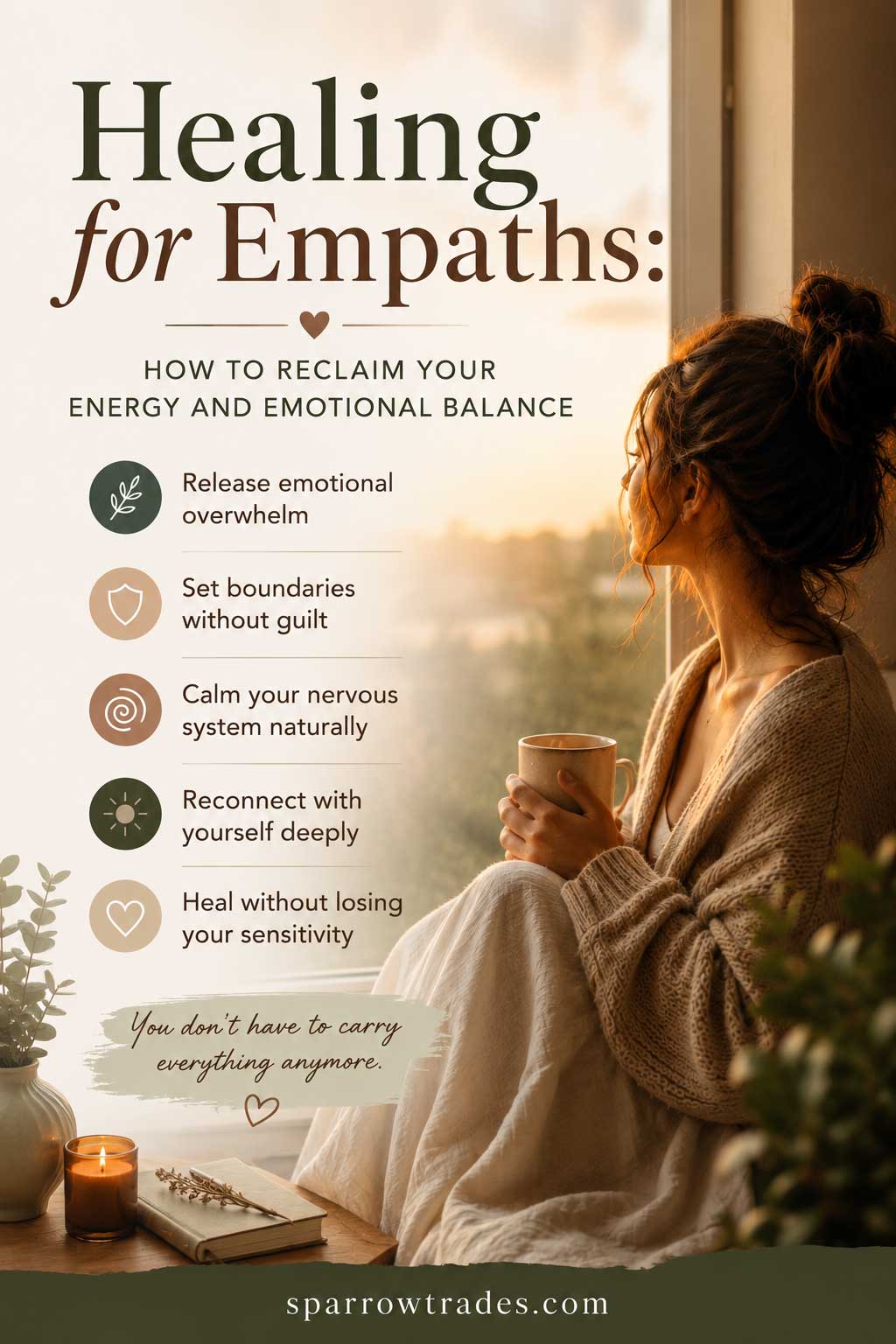

Where softness, self-awareness, and emotional healing are allowed to coexist. Through reflective writing, grounding rituals, and intentional beauty, Sparrow Trades offers gentle support for sensitive souls learning to reconnect with themselves.