
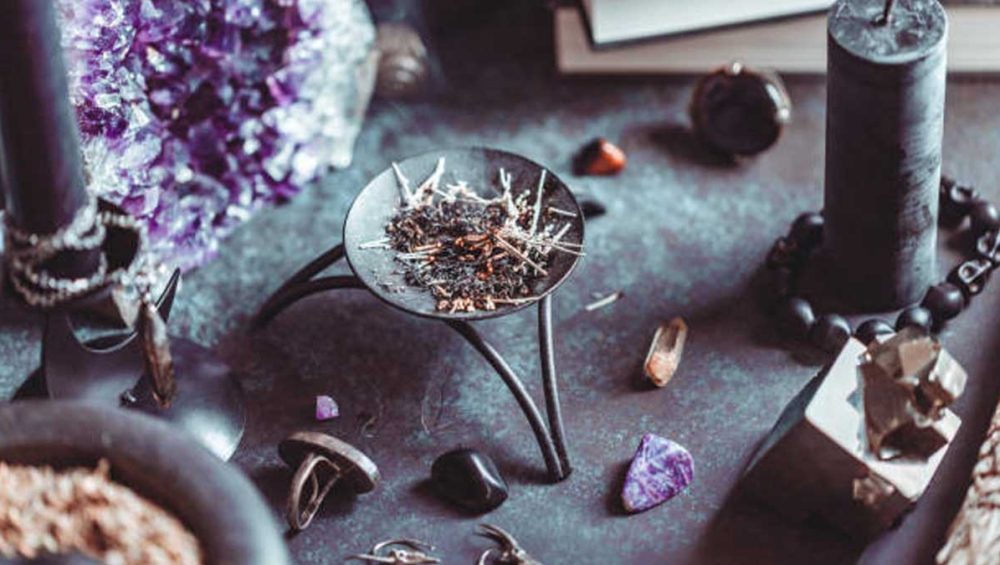
There’s a moment I’ve heard described again and again—sometimes whispered like a confession, sometimes laughed off like it’s “too much”—when someone picks up amethyst and their whole body softens. Not because they’ve decided it should. Not because they’re trying to be spiritual. It’s more like the system recognizes something before the mind can label it. A tiny exhale. A loosening behind the eyes. A sense that you’re allowed to come back inside yourself.
If you’ve lived through seasons where your nervous system learned to stay braced—waiting for the next shift in tone, the next demand, the next moment you’d need to protect your energy—then you know what it means when relief arrives without asking permission. That’s one reason amethyst becomes a lifelong ally for so many practitioners: it doesn’t just “do” magic. It holds you while you do it.
In witchcraft, amethyst is often worked with for protection, intuition, cleansing, and spiritual clarity—but not in a way that forces outcomes. Its energy doesn’t feel like a shove. It feels like a steady hand on your shoulder, the kind that says: slow down, listen, come back to what’s real. And for anyone whose spiritual life has ever felt like it asked them to override their body, that steadiness matters.
Amethyst witchcraft is especially powerful when your goal isn’t intensity, but safety. When you’re trying to build a practice that can hold grief, sensitivity, healing, and truth without sending you into overwhelm. When you want protection that doesn’t turn into armor. When you want intuition that feels grounded rather than spiraling. When you want to cleanse and clear without making your spirit feel like a project.
It also helps to understand amethyst beyond the aesthetic story of “purple crystal.” Its deeper symbolism and energetic themes—what makes it feel like sanctuary to some people—become clearer when you explore amethyst’s spiritual identity through amethyst crystal meaning.
What follows is not a rigid set of instructions or a one-size-fits-all ritual script. It’s a way of working with amethyst that stays trauma-informed and nervous-system-aware: a practice that honors consent, pacing, and embodied truth. If you’ve ever been pulled toward amethyst during a time you couldn’t quite explain, that’s not something to dismiss. Sometimes your body is the first part of you that knows what kind of magic you need.
Why amethyst feels like a container, not a catalyst
Some stones feel like a match. They light things up. They amplify. They push. Amethyst tends to do something different: it creates a container where what’s already present can be seen without being flooded by it. That distinction matters in witchcraft, because magic doesn’t happen in a vacuum—it happens inside a person, inside a body, inside a life with history.
When someone has lived through emotional intrusion, chronic stress, or relational instability, the body often develops a protective pattern: scan, brace, anticipate. Spiritual work can accidentally mimic that same pattern if it’s built around intensity or urgency. That’s why amethyst is a favorite for practitioners who want protection and intuition without dysregulation. It supports a kind of clarity that doesn’t require you to harden.
If you want a stable foundation for how crystals are understood in a broader energetic framework, it helps to ground your practice in crystal healing guide—not as a clinical rulebook, but as a way to keep your magic coherent, safe, and emotionally honest.
Amethyst also plays a unique role in discernment. It doesn’t just “open” intuition—it helps you tell the difference between intuition and anxiety, between spiritual sensing and trauma memory. That’s not glamorous, but it’s profoundly protective. Many people come to witchcraft seeking power, then realize what they truly needed was steadiness. Amethyst supports that shift without shame.
And when you want to understand the stone at its roots—its story, care, and energetic character as a cornerstone gemstone—this work strengthens when it’s anchored in amethyst.
Protection without armor: amethyst as nervous-system safety magic
Protection magic often gets framed as defense: shields up, walls built, threats blocked. But for many people, the deepest kind of protection is the ability to stay present. To remain in your life without feeling porous. To hold your boundaries without having to disappear. To move through the world without your nervous system interpreting everything as danger.
Amethyst supports that kind of protection because it doesn’t demand aggression. It encourages regulation. In practice, this might look like placing amethyst in your ritual space as a reminder to keep your breath slow, your inner attention gentle, your sensing rooted in reality. It can help you notice when your body starts to tighten or your thoughts start to race—and to pause before you escalate your own fear.
If your protection work is connected to emotional safety, you may find it natural to pair amethyst with grounding rituals for emotional safety—not to “fix” yourself, but to stay resourced as you practice.
For trauma-aware practitioners, the question is often: what kind of magic can my body tolerate? A ritual that leaves you shaky isn’t necessarily deep—it may just be too fast. Amethyst helps slow the pace so the work can integrate. If you’ve ever felt spiritually “open” and then emotionally wrecked, you already understand why pacing is part of protection.
It can also be helpful to contextualize protection work within a more sensitive, consent-based approach to spiritual grounding, especially if your system tends to swing between openness and shutdown. That’s where trauma-informed grounding practices can support the deeper aim: protection that feels like relief, not vigilance.
Amethyst for intuition: clarity, discernment, and quiet seeing
Intuition is often treated like a dramatic gift—visions, certainty, instant answers. But for many people, real intuition is quieter: a steady inner “no,” a soft pull toward truth, a felt sense that something isn’t aligned. Amethyst helps create the inner silence where that kind of knowing can be heard.
This is especially important for people who have been gaslit, minimized, or trained to second-guess themselves. If your history includes being told your perception was wrong, intuition can feel scary—not because you lack it, but because trusting it has consequences. Amethyst doesn’t bully you into certainty. It supports the slow rebuilding of self-trust.
If you work with energy systems, you may notice amethyst resonates naturally with the upper centers—especially the subtle “inner sight” that lives beyond anxious thinking. Pairing intuition work with third eye chakra activation practices can deepen that clarity without turning it into a performance.
In amethyst witchcraft, discernment is often the real spell. You might sit with amethyst before making a decision, not to “predict the future,” but to notice what happens in your body when you imagine each path. Do your shoulders lift? Does your stomach tighten? Does your breath become shallow? That’s information. In a trauma-aware practice, the body’s signals are part of your divination.
When you want to deepen intuition without overstimulation, a supportive frame for applied energy work can come through crystal healing practices—the kind of gentle, repeatable ritual structure that doesn’t require constant reinvention.
Ritual uses: cleansing, resting, and creating a sacred rhythm
Amethyst is often treated like a stone you can work endlessly. But many practitioners eventually learn a nervous-system truth: even spiritual tools need rest. If you use amethyst for protection, emotional processing, or heavy ritual cycles, it can start to feel “quiet” or “distant.” That isn’t failure. It may simply be saturation.
One of the most respectful ways to practice amethyst witchcraft is to build rhythm: cleanse, use, rest, return. This mirrors what the body needs, too. You don’t heal by pushing. You heal by cycling between activation and safety. Crystal care can reflect that same wisdom.
If you prefer gentle methods that avoid water—especially when your practice is sensitive, minimalist, or travel-based— crystal cleansing without water offers a supportive path that won’t feel harsh or overly technical.
Another common tension is “How much cleansing is enough?” Too little can feel stagnant; too much can become compulsive. If you’ve ever noticed your spiritual routines turning into anxiety management, you’re not alone. A grounded, pacing-based approach can be supported by how often to cleanse crystals—especially if your system needs permission to do less without feeling irresponsible.
Rest is part of the magic. Some practitioners create a “resting space” for their stones—a soft cloth, a quiet shelf, a place that feels like sleep. That practice becomes clearer through resting crystals intentionally, especially when you want crystal work to support regulation rather than demand.
And when you’re unsure whether your amethyst is asking for a pause, it can help to learn the felt cues through signs your crystal needs rest—not as a rigid checklist, but as a way to attune to subtle shifts.
Spellwork with amethyst: intention, containment, and ethical power
Amethyst spellwork tends to thrive when the intention is clear and the pacing is kind. It’s not the stone you reach for when you want to dominate a situation or force a person’s will. It’s the stone you reach for when your magic is rooted in integrity: protection, truth, release, clarity, spiritual boundaries.
One of the simplest ways to work with amethyst is to let it “hold” your intention over time. Instead of doing one dramatic ritual, you return to the stone repeatedly—touching it before sleep, placing it by your journal, sitting with it when you feel energetically porous. That repetition becomes a kind of spell: a ritual of self-return.
Amethyst also pairs well with structured spell containers like grids, particularly when your intention is coherence rather than amplification. If your practice includes patterning energy across space, crystal grids can support that work in a way that feels intentional rather than chaotic.
For practitioners who want to integrate this magic into daily life, wearing amethyst can be less about “protection jewelry” and more about continuity—carrying the same energetic reminder through the day that you established in ritual. This becomes especially resonant when approached through amethyst jewelry with intention, where intention is treated as relationship, not aesthetic.
If you want your witchcraft to remain anchored in real life, it can help to remember that the body is part of the altar. Breath, posture, sensory cues—these are spell components, too. And sometimes the most ethical power is the kind that refuses to override your own limits.
Wearing amethyst as practice: emotional seasons and gentle spiritual continuity
There are days when ritual space feels available, and days when it doesn’t. Some seasons of life require simplicity—not because you’re less devoted, but because your capacity is elsewhere. Wearing amethyst can become a way of staying connected to your practice without forcing yourself to “perform” spirituality when you’re tired, grieving, overstimulated, or simply human.
For many people, amethyst jewelry becomes a bridge: not a shortcut to magic, but a reminder of the kind of energy you want to live inside. When you put it on, you’re not declaring perfection. You’re choosing a tone. A softness. A boundary. A return to clarity.
If bracelets resonate for you—especially as a tactile, grounding cue—you might explore the emotional-spiritual framing of amethyst bracelets for spiritual connection, where wearing becomes a form of quiet devotion rather than display.
And when you’re ready to connect that personal practice to the pieces themselves—without losing emotional depth—one natural home for that pathway is amethyst jewelry.
Witchcraft doesn’t have to be loud to be real. Sometimes it’s one small choice repeated: protecting your attention, honoring your energy, letting your nervous system feel safe enough to tell you the truth.
Frequently asked questions about amethyst witchcraft
Is amethyst witchcraft safe if I’m sensitive or easily overwhelmed?
It can be one of the gentlest paths into magical practice because amethyst tends to support calm, containment, and clarity rather than intensity. If you’re sensitive, the most protective move is pacing: shorter rituals, more grounding, and permission to stop when your body signals “enough.”
Can amethyst be used for protection spells?
Yes, especially when your definition of protection includes emotional safety and energetic regulation. Amethyst often supports protection by helping you stay clear and steady, rather than by creating a hard, defensive barrier.
How do I cleanse amethyst if I don’t want intense ritual routines?
Gentle cleansing is often best for amethyst, especially if you’re building a practice that doesn’t trigger perfectionism or anxiety. Choose methods that feel soothing, consistent, and easy to return to—because sustainability is part of the magic.
Does amethyst help with intuition, or can it make anxiety worse?
Amethyst is often used to support intuition with discernment. If anxiety is already high, any spiritual practice can feel louder than it is. The key is to ground first, then listen—letting intuition arrive as a calm knowing rather than a rush.
Can I wear amethyst during rituals instead of placing it on an altar?
Yes. Wearing amethyst can create a sense of continuity and safety, especially if you’re doing emotional or protective work. For some practitioners, wearing the stone helps them stay embodied and present throughout the ritual.
What if amethyst feels “too calm” and I want stronger spell energy?
Sometimes “too calm” is actually your system resisting rest. If you’re used to intensity, steadiness can feel unfamiliar. You can still do powerful work with amethyst—especially for boundaries, clarity, and protection—but it tends to unfold through consistency rather than force.
Conclusion
Amethyst witchcraft is not the kind of magic that demands you be bigger than your life. It doesn’t require you to override your body, rush your healing, or prove your spirituality with intensity. It invites something quieter—and, for many people, far more transformative: a practice that can hold you.
If you’ve ever tried to use spiritual work to escape your feelings, amethyst may gently redirect you back toward truth. If you’ve ever used protection magic like armor, it may show you how to create safety without hardening. If you’ve ever distrusted your intuition because you were taught to doubt yourself, it may help you rebuild discernment one calm moment at a time.
There is a kind of power that doesn’t shout. It steadies. It clears. It protects by helping you stay inside yourself. Amethyst has been trusted for generations because it supports that kind of power—the kind that doesn’t leave you depleted after the ritual is done.
In the end, amethyst isn’t just a stone you use. It’s a relationship you build. And when your practice is nervous-system-aware, consent-based, and emotionally honest, that relationship can become one of the safest places your magic lives.

Where softness, self-awareness, and emotional healing are allowed to coexist. Through reflective writing, grounding rituals, and intentional beauty, Sparrow Trades offers gentle support for sensitive souls learning to reconnect with themselves.