
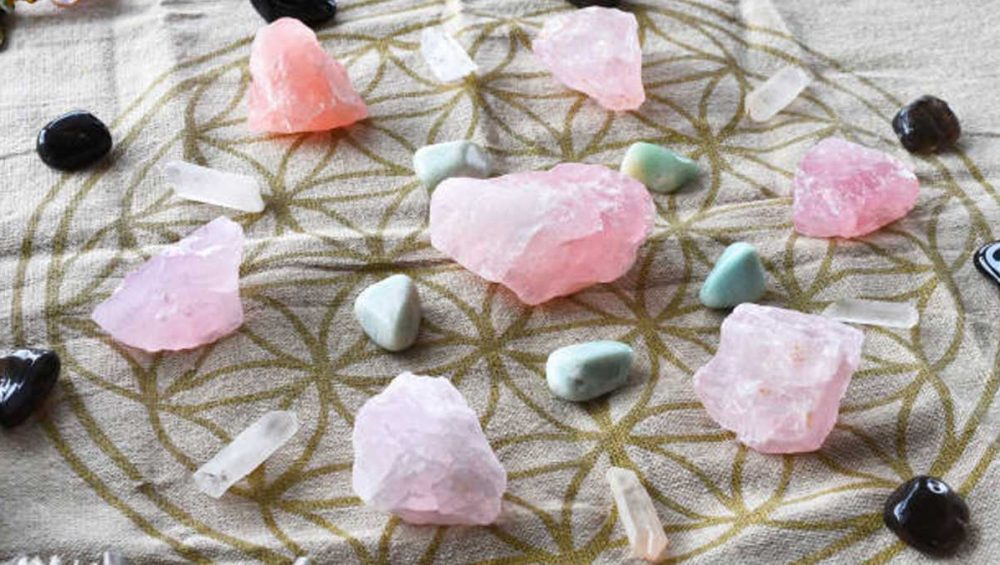
If you’ve ever felt drawn to arrange your crystals “just so”—in a circle on your nightstand, in a line along your windowsill, or in a quiet pattern on the floor—you’re not alone. A lot of people come to crystal grids the same way they come to breathwork or journaling: not as a hobby, but as a response. A response to feeling scattered. A response to carrying too much. A response to the longing for something steady when life has been anything but.
Crystal grids can look like art. They can feel like prayer. They can be deeply personal, especially if you’ve spent years living in survival mode—where your nervous system learns to scan for danger before it can feel desire. In that state, even “self-care” can feel like another thing to get right. Crystal grids offer a different kind of support: a gentle structure that says, “You don’t have to hold all of this by yourself.”
So, what are crystal grids?
A crystal grid is an intentional arrangement of crystals placed in a pattern to support a specific intention—like grounding, clarity, protection, emotional healing, or manifestation. The grid becomes a container: something you build with your hands to help your mind and body settle into a single direction. It’s not about forcing an outcome. It’s about creating a consistent energetic reminder that you’re allowed to want something, and you’re allowed to support yourself while you move toward it.
Some people treat crystal grids as energetic technology. Others treat them as ritual. Both approaches can be true. But the most important piece isn’t the trend or the terminology—it’s the lived experience of what happens when you create a small, safe space that reflects your inner world back to you.
And here’s the trauma-informed part that matters: a crystal grid shouldn’t demand performance from you. It shouldn’t become another thing you “fail” at. The grid is there to meet you where you are—tender, exhausted, hopeful, skeptical, curious, numb, or all of the above.
In this guide, you’ll learn what crystal grids are, how they work in practical terms, how to build one without turning it into a rigid checklist, and how to choose crystals and patterns that actually match your emotional needs. You’ll also get a nervous-system-aware way to think about “activation,” “maintenance,” and when it’s time to let a grid rest.
Because your energy isn’t a machine. It’s a living, responsive part of you. And your rituals should feel like support—not pressure.
What Are Crystal Grids, Really?
At the most basic level, a crystal grid is a purposeful layout of crystals arranged to amplify and stabilize an intention. The pattern acts like a map: it gives your energy somewhere to land. The stones act like anchors: they help you hold a frequency—calm, confidence, protection, focus—without clenching around it.
But “basic level” doesn’t always capture why this practice resonates so deeply.
When you’re overwhelmed, your thoughts can feel like open browser tabs—too many, too loud, all demanding attention. A grid gives you a focal point. It turns a swirling internal experience into something external you can see. That alone can be regulating. Your eyes track the pattern. Your breath naturally slows. Your body receives the message: “There is structure here. There is order here. There is meaning here.”
A crystal grid typically includes:
- A clear intention (one sentence, not a whole life plan)
- A center stone (the “anchor” of the grid’s purpose)
- Supporting stones arranged around it (to strengthen and balance the intention)
- A pattern (often symmetrical, often inspired by sacred geometry, but not required)
- Optional activation (a ritual action that marks the grid as “on,” like tracing lines or speaking your intention aloud)
Think of a grid like a small altar for one specific need. Not a display. Not a decoration. A need.
And because needs can be tender, grids tend to be tender too. You might build a grid when you feel emotionally raw and you need a softer landing. You might build one when you feel disconnected from your own desires and you want to remember what you’re reaching for. You might build one when you’re rebuilding trust—inside your body, inside your life—and you want a daily reminder that you’re allowed to be supported.
A grid isn’t magic in the sense of bypassing reality. It’s magic in the sense of returning you to yourself. Over and over again, in small doable ways.
How Do Crystal Grids Work?
How crystal grids “work” depends on what you believe about energy, symbolism, and intention. Some people experience it as energetic amplification. Others experience it as nervous-system regulation through ritual and focus. Many people experience both—and you don’t have to pick a side to benefit.
Here are three grounded ways to understand how crystal grids work:
1) Focus creates coherence
When you name a clear intention and build a grid around it, you reduce internal noise. You’re not trying to heal everything at once. You’re choosing one direction. That choice is powerful, especially if your history taught you to ignore your needs or second-guess your desires.
A grid works like a visual mantra. Each time you see it, you remember: “This is what matters right now.” That repetition can gently reshape your attention—and attention shapes experience.
2) Ritual tells your body you are safe enough to begin
Trauma doesn’t just live in memory; it lives in the body’s expectations. If your nervous system is used to bracing, it can feel unsafe to relax—even when nothing is actively wrong. Ritual can help because it creates predictability. Same steps. Same space. Same gentle cadence.
Building a grid is a slow, tactile process. You touch stones. You arrange them. You pause. You breathe. You make choices. Those choices are a form of agency, and agency is one of the most healing sensations a body can feel.
3) Symbolism communicates with the deeper mind
Even if you’re skeptical about metaphysics, symbolism still matters. Humans respond to meaning. When you choose stones and place them intentionally, you are speaking to the part of you that doesn’t respond to logic alone—the part that responds to imagery, sensation, and repetition.
A grid can become a relational object: something you return to when you forget yourself. Not because you’re broken, but because you’re human.
And if you do believe crystals carry energetic signatures, the grid becomes a way of layering those signatures—like harmonies in music—so the overall “field” of the grid supports a chosen emotional state.
The healthiest way to approach this is simple: a crystal grid is supportive, not controlling. It doesn’t replace action. It doesn’t replace therapy. It doesn’t replace boundaries. But it can absolutely become a steady companion while you do the real work of living.
How to Make a Crystal Grid Without Overthinking It
If you’ve ever tried to start a new practice and immediately felt pressure to do it “right,” you’ll want a softer approach here. Crystal grids don’t need perfection. They need presence.
Step 1: Choose one honest intention
One sentence. Not a list.
Try:
- “I want to feel steady in my body.”
- “I want to soften the fear that I’m always behind.”
- “I want to protect my peace while I heal.”
- “I want clarity about what’s mine and what isn’t.”
If your nervous system is activated, keep the intention gentle. A body in fight-or-flight doesn’t respond well to aggressive goals. Your grid can be a bridge, not a demand.
Step 2: Pick a center stone
The center stone is the heart of the grid. Choose something that matches the emotional tone of your intention.
If you want calm, choose a stone that feels calming to you. If you want clarity, choose something that feels clear. If you want protection, choose something that feels sturdy. You don’t need the “perfect” crystal—you need one your body trusts.
Step 3: Choose supporting stones (3–8 is plenty)
Supporting stones should reinforce the intention, or provide balance.
A helpful way to think about this is:
- One stone for the main theme (the center)
- One or two stones for emotional support (softening, soothing, self-compassion)
- One or two stones for strength (boundaries, grounded confidence)
- One stone for clarity (truth, focus, direction)
That’s it. You’re not building a museum exhibit. You’re building a feeling.
Step 4: Choose a layout
You can use sacred geometry patterns if you love them, but you can also keep it extremely simple:
- Circle: wholeness, gentle containment
- Triangle: momentum, confidence, forward movement
- Square: stability, grounded safety, boundaries
- Star-like shape: protection, guidance, visibility
- Intuitive symmetry: balance, nervous-system ease
If your mind tends to spiral into perfectionism, choose a simple shape and let it be enough. In some seasons, you may want a deeper dive into patterning, and when you do, a gentle entry point can be sacred geometry in crystal grids that stays rooted in emotional clarity rather than performance.
Step 5: Place the stones slowly
This is where the healing often happens.
As you place each stone, you can silently name what it represents:
- “Safety.”
- “Rest.”
- “Clarity.”
- “Protection.”
- “Self-trust.”
If naming feels too exposed, just breathe. Your body still receives the message.
Step 6: Activate the grid in a way that fits your temperament
Some people like to trace energetic lines between stones with a wand, a finger, or a piece of crystal. Some speak their intention aloud. Some simply close their eyes and take three slow breaths.
Activation is not about proving anything. It’s about marking a threshold: “This is intentional. This matters.” If you want options that feel consent-based and steady, crystal grid activation rituals can give you language that stays soft instead of performative.
If you’ve had experiences where spirituality felt coercive, keep activation gentle and consent-based. Your grid is yours.
Choosing Crystals for Crystal Grids Based on Emotional Need
A common mistake is choosing crystals based only on what’s trending or what you “should” use. A trauma-informed approach asks a different question:
What does my nervous system need to feel supported right now?
Here are a few emotionally grounded categories to guide selection:
Grounding and steadiness
Choose stones that feel weighty, stabilizing, and supportive—especially if you feel floaty, anxious, scattered, or overstimulated. For a wider foundation that meets you in the day-to-day, grounding with crystals daily practices can help you build consistency without intensity.
These are helpful when your mind won’t stop running or your body feels “not quite here.” When you want the deeper “why” beneath the practice, grounding can help you name what your body has been asking for.
Emotional soothing and self-compassion
Choose stones that feel soft, comforting, and heart-safe—especially if you’re grieving, tender, easily triggered, or trying to rebuild self-trust. Sometimes that support begins with crystal healing practices that feel doable even on the days you’re barely holding it together.
These are helpful when you’re learning to be gentle with yourself instead of forcing yourself.
Clarity and truth
Choose stones that feel clean, clear, and honest—especially if you feel confused, foggy, or emotionally tangled. Many people reach for clear quartz as a steadying centerpiece, and when you want to understand what you’re working with, clear quartz meaning can help you choose with intention instead of guesswork.
These are helpful when you’re trying to hear your own voice again.
Protection and boundaries
Choose stones that feel strong and containing—especially if you absorb other people’s energy, struggle with porous boundaries, or are navigating hard relationships. If protection is part of your grid’s purpose, black tourmaline for protection can support that intention without pushing you into fear-based energy.
These are helpful when you need your field to feel like it belongs to you.
Intention and manifestation
Choose stones that feel bright, motivating, and forward-moving—especially if you feel stuck, discouraged, or afraid to hope. When you want to keep your goals gentle and sustainable, gentle intention-setting practices can help you hold desire without pressure.
These are helpful when you want to take aligned action without burning out.
And one more truth that matters: the “best” stones are the ones your body responds to. If you hold a crystal and feel your shoulders drop, that’s information. If you feel tense or unsettled, that’s also information. Let the grid be a conversation, not a performance. If you’re exploring the practice from the ground up, crystal healing can help you hold the bigger context without losing your personal truth.
Crystal Grid Care: How Long to Keep One, When to Rest It, and What to Do if It Feels “Off”
Crystal grids are living rituals. They change as you change.
How long should you keep a grid up?
There’s no universal rule. Some people keep grids up for a day. Some keep them for a lunar cycle. Some keep them until the intention feels complete.
A nervous-system-aware approach is to check in weekly:
- Do I feel supported when I look at this?
- Does it still feel aligned with what I need?
- Does it feel heavy, stale, or emotionally noisy?
If the grid still feels like a calm anchor, keep it.
What if the grid starts to feel “off”?
Sometimes a grid feels off because you’ve outgrown the intention. Sometimes it feels off because your body is signaling overload. Sometimes it feels off because something about the arrangement is too intense for your current capacity.
Try this:
- Remove one stone and see if your body softens.
- Simplify the layout.
- Change the intention to something gentler and more present-tense.
- Move the grid to a quieter location.
If you’ve been in hypervigilance, an “intense” grid can feel like pressure. Your goal is support, not stimulation. For a steadier baseline that protects your capacity, grounding safety guide can help you keep your practices supportive instead of activating.
When should you rest or dismantle a grid?
A grid wants rest when:
- You avoid looking at it.
- You feel irritated or emotionally flooded near it.
- You feel like it represents a promise you can’t keep.
- You feel relief when you imagine taking it down.
Dismantling can be a closure ritual:
- Thank the grid for what it held.
- Cleanse or reset the stones in a way that feels safe for your practice.
- Put them away with care.
- Take one breath and notice what your body feels.
Closure is powerful. It tells your nervous system: “We can complete things gently.” If you prefer options that don’t rely on water, crystal cleansing without water can support your reset in a calmer, safer way.
And when you’re tending grids over time, you may find comfort in rhythms that feel predictable; how often to cleanse crystals can help you find a cadence that supports you instead of stressing you.
FAQ: Crystal Grids Meaning, Use, and Common Questions
What is the purpose of a crystal grid?
The purpose of a crystal grid is to hold and amplify a specific intention through an intentional arrangement of crystals. For many people, the grid becomes a steady emotional anchor—something you can return to when you feel scattered, overwhelmed, or disconnected from yourself. It can support healing, grounding, clarity, protection, or manifestation, but it works best when the intention is honest and specific. Rather than trying to “fix” everything, a grid helps you focus on one area of support and create a consistent reminder that your needs matter.
Do crystal grids have to use sacred geometry?
No. Sacred geometry patterns can be beautiful and meaningful, but they are not required for a grid to be effective. The most important “geometry” is the felt sense of coherence—does the layout help you feel steadier, clearer, calmer, or more supported? If sacred geometry helps you feel connected and intentional, use it. If it triggers perfectionism or pressure, choose a simple shape like a circle or square, or create a symmetrical pattern that feels soothing to your eyes and nervous system. The grid should support you, not test you.
How do you activate a crystal grid?
Activation is any intentional action that marks the grid as “on.” Some people activate by tracing energetic lines between stones with a finger or a crystal, others speak their intention out loud, and others simply breathe and focus on the center stone. The best activation method is the one that feels consent-based and emotionally safe. If you’ve had experiences where spiritual practices felt coercive, keep activation simple: one gentle sentence, one deep breath, one moment of presence. The power is in the clarity, not in the theatrics.
What crystals are best for a crystal grid?
The best crystals for a grid are the ones that match your intention and feel supportive to your body. A grounding grid might include heavier, stabilizing stones; a soothing grid might include softer, heart-centered stones; a clarity grid might include stones that feel clean and focused. But the real key is resonance—when you hold a crystal, do you feel a little more settled, a little more safe, a little more clear? Let your nervous system be part of the decision. You don’t need a “perfect” lineup. You need a combination that helps you feel held.
Can you make a crystal grid with only a few stones?
Absolutely. A crystal grid can be powerful with as few as four stones: one center stone and three supporting stones arranged around it. In fact, simpler grids are often more sustainable, especially if you’re sensitive, overwhelmed, or rebuilding trust with your own intuition. Too many stones can feel like too much input—like visual noise—when what you really need is calm structure. If you’re new to grids, start small and let the practice grow naturally.
How often should you change or dismantle a crystal grid?
Change or dismantle a grid when it no longer feels supportive. Some people update their grids weekly or monthly, but it doesn’t need a strict schedule. A trauma-informed approach is to listen for emotional signals: if the grid starts to feel heavy, pressuring, stale, or irritating, it may be time to simplify, reset, or take it down. Dismantling isn’t failure—it’s completion. It’s your nervous system learning that you can start something, receive support, and end it gently when it’s no longer aligned.
Conclusion
Crystal grids are not about doing spirituality “right.” They’re about creating a small, visible, tangible space where your intention can breathe. They are a way of saying: “This matters to me,” without forcing yourself to figure everything out at once.
If your life has taught you to stay braced, to stay ready, to stay on guard, a grid can become a quiet retraining tool. Not because it erases what you’ve been through, but because it offers your body a different kind of repetition: the repetition of choice, of gentleness, of returning. Each time you place a stone, you practice agency. Each time you look at the pattern, you practice coherence. Each time you dismantle the grid with care, you practice healthy closure.
And you’re allowed to keep it simple. You’re allowed to build a grid that’s more about emotional safety than manifestation. You’re allowed to use your own lived experience as the authority here. The most powerful grid is the one that helps you come home to yourself—slowly, steadily, without pressure.
When you’re ready, you can build a grid as a promise to your future self: not a promise that everything will be perfect, but a promise that you will keep showing up with care. One stone at a time. If you want a steady foundation to return to as your practice grows, crystal healing guide can hold the larger map while you keep your rituals human-sized.
And if your grid becomes part of a personal sacred space, you may find yourself drawn to stones that keep the atmosphere clear and honest; selenite and the crown chakra can support that kind of clarity without intensity, and if you prefer wearing that support through your day, selenite jewelry can be a gentle way to stay connected to what you’ve set in motion.

Where softness, self-awareness, and emotional healing are allowed to coexist. Through reflective writing, grounding rituals, and intentional beauty, Sparrow Trades offers gentle support for sensitive souls learning to reconnect with themselves.