
There are moments when being an empath stops feeling like a gift and starts feeling like exhaustion wearing a human face.
You walk into a room and immediately feel tension before anyone speaks. Someone else’s sadness settles into your chest like it belongs there. A difficult conversation stays in your nervous system long after everyone else has moved on. Even scrolling online can leave you emotionally heavy without fully understanding why.
For many sensitive people, mindfulness is introduced as a way to “stay calm” or “be more present.” But traditional mindfulness advice can sometimes feel strangely disconnected from the lived reality of emotional absorption. Sitting quietly with your thoughts is not always soothing when your body already feels flooded by emotional input that does not entirely belong to you.
That is why mindfulness for empaths needs a gentler framework.
It is not about becoming emotionally detached. It is not about numbing your sensitivity or pretending you are unaffected by the world around you. It is about learning how to stay connected to yourself while still remaining compassionate toward others.
Many empaths grow up unconsciously learning to monitor emotional environments for safety. They become hyperaware of tone shifts, body language, silence, disappointment, tension, or emotional withdrawal. Over time, the nervous system begins treating emotional scanning as survival. The body stays alert even during ordinary interactions.
That constant awareness can quietly create emotional fatigue.
Sometimes you do not realize how overwhelmed you are until you finally reach solitude and collapse emotionally. Sometimes you mistake emotional overload for personal failure. Sometimes you become so accustomed to carrying everyone else’s emotional energy that your own feelings become difficult to identify.
This is where mindful awareness begins to change things.
Not through force.
Not through perfection.
But through slow reconnection.
Mindfulness allows empaths to notice emotional experiences without immediately merging with them. It creates a pause between feeling and absorbing. A pause between witnessing and carrying. A pause between compassion and self-erasure.
That pause matters more than most people realize.
Many emotionally sensitive people are quietly searching for emotional wellness foundations because they are exhausted from living in constant emotional overexposure. They do not necessarily need harder boundaries first. Often, they need safety inside their own bodies again.
Mindfulness can become part of that safety.
Not as a performance.
Not as a spiritual identity.
But as a way of returning to yourself after years of emotionally disappearing into everyone else.
Why Empaths Often Struggle With Traditional Mindfulness
A lot of mindfulness advice unintentionally assumes that the nervous system already feels relatively safe.
For empaths, that is not always true.
When your body has spent years absorbing emotional tension, conflict, disappointment, grief, or emotional unpredictability, stillness itself can feel emotionally loud. Silence can become overwhelming because it removes distraction and exposes how much emotional buildup is already sitting underneath the surface.
This is why some empaths feel frustrated when meditation practices leave them feeling overstimulated instead of peaceful.
Their nervous system is not failing.
It is overloaded.
Many sensitive people unconsciously move through life in a heightened state of emotional vigilance. They track moods automatically. They soften themselves around emotionally reactive people. They overexplain to prevent conflict. They emotionally anticipate everyone else’s needs before checking in with themselves.
Over time, this can create deep disconnection from personal emotional awareness.
Instead of noticing “What am I feeling?” the nervous system asks:
“What is everyone else feeling right now?”
That survival pattern is deeply exhausting.
For many empaths, mindfulness becomes more supportive when it is grounded in body awareness instead of performance-based stillness. Gentle sensory awareness often works better than trying to force mental silence.
This is why practices connected to somatic self-soothing practices can feel far more emotionally accessible than rigid meditation expectations.
The body usually needs reassurance before the mind can truly soften.
Mindfulness for empaths is often less about emptying the mind and more about slowly rebuilding internal safety. It becomes a process of noticing:
- where tension lives
- when emotional absorption begins
- how overstimulation feels in the body
- when emotional fatigue starts replacing compassion
That awareness can quietly change everything.
Because once you begin recognizing emotional overload earlier, you no longer have to wait until burnout to care for yourself.
Sensitive people frequently blame themselves for emotional exhaustion when the deeper issue is emotional overexposure without recovery. Articles centered around empath nervous system overwhelm recovery often resonate so deeply because they finally explain why rest alone sometimes does not fully restore emotional balance.
The nervous system needs emotional decompression too.
Mindfulness becomes powerful when it stops asking empaths to become less sensitive and instead helps them become less emotionally fused with everything around them.

The Difference Between Feeling and Absorbing
Empaths are often taught to believe that deep compassion means carrying emotional pain.
It does not.
There is a profound difference between witnessing emotion and internalizing it.
Many sensitive people never learned where that line exists.
You can care deeply about someone without taking responsibility for regulating their emotional state. You can sit beside grief without drowning inside it. You can recognize someone’s anxiety without unconsciously turning it into your own nervous system activation.
But if you grew up in emotionally unpredictable environments, emotional merging may feel automatic.
Children who adapt by becoming emotionally hyperaware often develop the belief that emotional safety depends on monitoring other people constantly. They learn to anticipate mood shifts before conflict happens. They become emotional caretakers long before they understand what emotional boundaries even are.
That is why practices connected to understanding emotional boundaries can feel emotionally transformative for empaths. Boundaries are not emotional rejection. They are nervous-system protection.
Mindfulness helps sensitive people notice the moment emotional absorption begins.
That moment is often subtle.
You stop observing someone’s stress and start carrying it physically. Your breathing changes. Your shoulders tighten. Your thoughts become emotionally tangled. You lose connection to your own emotional center.
The body usually recognizes emotional absorption before the conscious mind does.
This is where grounding becomes essential.
Practices rooted in grounding practices help empaths reconnect with physical presence instead of remaining trapped in emotional fusion. The goal is not emotional numbness. The goal is emotional separation without emotional disconnection.
That distinction matters deeply.
Mindfulness for empaths is not about becoming cold or detached from others. It is about learning how to remain emotionally compassionate without abandoning yourself in the process.
Sometimes the most healing realization is discovering that compassion does not require self-erasure.
Sometimes mindfulness begins the moment you realize:
“I can feel this without becoming this.”
Gentle Mindfulness Practices That Actually Help Empaths
Empaths often need mindfulness practices that feel emotionally regulating instead of emotionally demanding.
Gentleness matters.
The nervous system rarely heals through force.
One of the most supportive shifts sensitive people can make is moving away from achievement-based mindfulness. You do not need perfect concentration. You do not need spiritual perfection. You do not need to “clear your mind.”
You only need small moments of returning to yourself.
Sometimes mindfulness begins with noticing your breathing before responding to emotionally overwhelming conversations. Sometimes it looks like pausing after social interaction to ask yourself what emotions actually belong to you. Sometimes it is as simple as feeling your feet against the floor while your nervous system settles.
Small grounding moments accumulate.
This is why emotionally sensitive readers are often drawn toward 5-minute grounding rituals that fit naturally into emotionally overstimulating days instead of requiring ideal conditions.
Mindfulness becomes sustainable when it integrates into real life.
Breathwork can also be deeply supportive for empaths, especially when emotional overwhelm feels physical. Gentle regulation techniques connected to conscious breathing nervous system regulation help create internal slowing without emotional suppression.
For many empaths, emotional overwhelm is not just psychological.
It is physiological.
The heart races. Muscles tighten. Thoughts scatter. The nervous system moves into protection mode before the mind fully understands what is happening.
Mindfulness practices that include the body often work better because they help restore nervous-system safety first.
This is also why vagus nerve exercises can feel surprisingly calming for sensitive people who spend long periods emotionally activated without realizing it.
Journaling can become another form of mindful emotional separation. When emotions are externalized onto paper, empaths often recognize how much emotional noise they have been unconsciously carrying.
Many people quietly discover emotional clarity through journaling for nervous system safety because it creates a private space where feelings can exist without needing immediate emotional caretaking.
Mindfulness does not need to look impressive to be healing.
Sometimes it is simply the decision to stop abandoning yourself emotionally every time someone else is struggling.
Mindfulness Helps Empaths Rebuild Emotional Self-Trust
Many empaths do not struggle because they feel deeply.
They struggle because they stopped trusting their own emotional center.
When you spend years adapting to other people’s emotional needs, your internal awareness can become blurred. You second-guess your instincts. You question whether your feelings are valid. You become emotionally responsive to everyone except yourself.
This often creates emotional confusion.
Sensitive people sometimes absorb emotions so quickly that they lose track of what is theirs entirely. They may leave interactions feeling emotionally heavy without understanding why. They may mistake emotional exhaustion for empathy itself.
That is why resources centered around how to tell if an emotion is yours or someone else's resonate so deeply with emotionally overwhelmed readers. Naming emotional ownership changes the nervous system experience completely.
Mindfulness strengthens emotional self-trust by slowing reactions enough for awareness to return.
Instead of instantly absorbing emotional tension, you begin noticing:
- what triggered your body
- what emotion surfaced first
- whether the feeling intensified after contact with someone else
- whether your exhaustion came from emotional caretaking
Those small moments of noticing help rebuild internal clarity.
This is especially important for empaths who grew up around emotional invalidation, manipulation, or chronic unpredictability. Emotional hyperawareness often develops as a protective adaptation. Over time, self-trust weakens because emotional attention constantly moves outward instead of inward.
Mindfulness gently reverses that pattern.
Practices rooted in daily emotional check-in prompts help emotionally sensitive people reconnect with their own emotional baseline before external emotional energy reshapes it.
Over time, mindfulness helps empaths recognize something important:
Feeling deeply is not the problem.
Losing yourself inside everyone else’s feelings is.
That awareness can begin rebuilding emotional steadiness in ways that feel surprisingly freeing.
FAQ: Mindfulness for Empaths
Can mindfulness help empaths stop absorbing other people’s emotions?
Mindfulness can help empaths notice emotional absorption earlier, which creates more emotional separation and nervous-system awareness. It does not remove sensitivity, but it helps sensitive people recognize when emotional merging is beginning instead of unconsciously carrying other people’s emotional states all day.
Many empaths find emotional relief through practices connected to stop absorbing other people's emotions because they finally learn the difference between compassion and emotional overidentification.
Why does meditation sometimes make empaths feel overwhelmed?
Some empaths enter stillness already carrying emotional overstimulation. Silence can temporarily increase awareness of emotional tension that was previously hidden beneath distraction or constant emotional scanning.
This does not mean mindfulness is wrong for you. It often means your nervous system needs gentler regulation approaches first, especially practices rooted in grounding, breathwork, or body awareness.
Supportive approaches connected to grounding after emotional overload can feel more emotionally accessible during periods of intense overwhelm.
What type of mindfulness works best for empaths?
Gentle mindfulness practices that involve the body usually feel safer and more sustainable for sensitive nervous systems. Slow breathing, grounding exercises, mindful walking, sensory awareness, and emotional check-ins are often more supportive than rigid concentration-based meditation practices.
Many empaths also feel emotionally supported through energetic self-care for empaths because those practices acknowledge emotional sensitivity without treating it like dysfunction.
Can mindfulness reduce empath burnout?
Mindfulness can help reduce empath burnout because it interrupts chronic emotional overexposure. Sensitive people often remain emotionally activated long after interactions end. Mindfulness creates moments where the nervous system can return to itself instead of remaining emotionally fused with outside stress.
Readers navigating chronic emotional fatigue often connect deeply with nervous system regulation techniques because emotional exhaustion is frequently physiological as much as emotional.
Why do empaths struggle with emotional boundaries?
Many empaths learned emotional hyperawareness as a survival response. They became emotionally attentive to maintain connection, reduce conflict, or anticipate emotional instability. Over time, emotional closeness became confused with emotional responsibility.
Mindfulness helps restore internal awareness so boundaries feel less like rejection and more like emotional safety.
Sensitive readers often begin rebuilding that safety through grounding boundaries for empaths because grounding helps the nervous system separate presence from emotional fusion.
Is mindfulness supposed to make you emotionally detached?
No. Healthy mindfulness does not remove empathy or compassion. It helps create enough emotional space to stay connected to yourself while remaining emotionally present with others.
Mindfulness for empaths is ultimately about emotional clarity, not emotional numbness.
Sometimes the deepest healing comes from realizing you no longer have to disappear emotionally in order to care deeply.
Returning to Yourself Without Closing Your Heart
Empaths often spend years believing emotional exhaustion is simply the cost of caring deeply.
But caring deeply should not require chronic emotional depletion.
Sensitivity is not weakness. Emotional awareness is not failure. The problem is rarely that empaths feel too much. More often, the problem is that they were never taught how to stay emotionally connected to themselves while feeling the world around them.
Mindfulness slowly changes that relationship.
Not overnight.
Not perfectly.
But gently.
It teaches sensitive people how to remain present without absorbing everything they witness. It creates moments where the nervous system no longer has to scan constantly for emotional danger. It helps the body recognize that compassion and self-abandonment are not the same thing.
Over time, mindfulness becomes less about “managing emotions” and more about returning home internally.
That return can feel unfamiliar at first.
Many empaths are so accustomed to emotional outwardness that inward awareness feels strangely quiet. But eventually, that quiet stops feeling empty and starts feeling safe.
This is where emotional self-trust begins rebuilding.
This is where your own feelings become visible again.
And this is where mindfulness stops being a performance and becomes something much more human:
a gentle way of staying connected to yourself while still keeping your heart open to others.
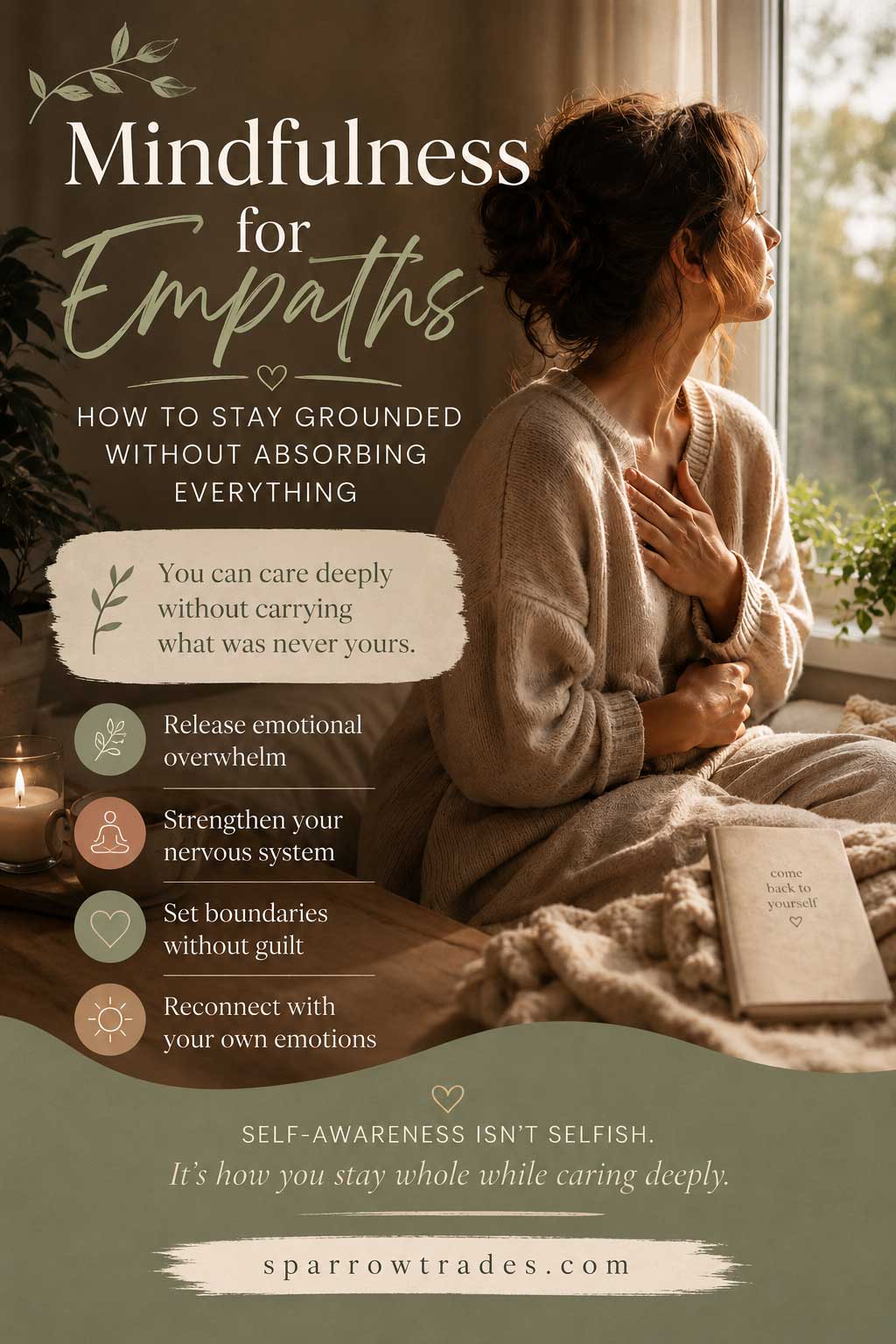

Where softness, self-awareness, and emotional healing are allowed to coexist. Through reflective writing, grounding rituals, and intentional beauty, Sparrow Trades offers gentle support for sensitive souls learning to reconnect with themselves.