

There are moments when anxiety does not feel like fear at all.
It feels like walking into a room and immediately sensing tension before anyone speaks. It feels like carrying a conversation home inside your body long after it ended. It feels like lying awake replaying someone else’s sadness while your own nervous system quietly spirals underneath it.
For many empaths, anxiety does not begin as panic. It begins as accumulation.
Small emotional impressions gather slowly throughout the day until the body no longer knows what belongs to it and what was absorbed from everyone else. The nervous system starts scanning constantly. The chest tightens before social gatherings. Rest becomes difficult because emotional vigilance never fully turns off.
People often describe empaths as deeply compassionate, emotionally intuitive, or spiritually sensitive. But underneath those descriptions is usually a body carrying far more stimulation than it was ever taught how to process.
Sometimes anxiety develops because sensitivity was never protected.
A child who learned to monitor moods for emotional safety may grow into an adult who instinctively tracks emotional shifts everywhere they go. Over time, this can create a constant state of internal alertness where the body becomes conditioned to anticipate emotional instability before it arrives.
That is why so many emotionally sensitive people eventually find themselves searching for nervous system regulation techniques without realizing their anxiety may not be “too much emotion,” but too much unprocessed emotional input living inside the body at once.
Many empaths spend years believing they are fragile when they are actually overstimulated.
The body was never meant to absorb every emotional atmosphere it encounters without recovery time. Yet emotionally sensitive people often become disconnected from their own needs because they are focused so heavily on everyone else’s emotional state. The nervous system stays outwardly oriented. The body stays vigilant. Emotional exhaustion slowly becomes normal.
This is why anxiety in empaths often feels different from ordinary stress.
It can feel emotional, physical, energetic, relational, and deeply somatic all at the same time. Some people experience racing thoughts. Others experience heaviness, shutdown, fatigue, dissociation, emotional flooding, or unexplained tension that never fully leaves their muscles.
And when sensitivity is misunderstood by others, anxiety deepens further.
Many empaths were taught they were “too sensitive,” dramatic, irrational, or emotionally intense long before they understood how deeply they were perceiving the world around them. Over time, emotional self-trust erodes. The body stops feeling safe to experience emotion naturally.
That is often where anxiety quietly takes root.
Not because sensitivity is broken, but because sensitivity without grounding can become overwhelming.
Many people eventually begin searching for emotional wellness foundations after years of trying to push through emotional overwhelm alone. What they are usually seeking is not emotional perfection, but nervous-system safety.
And safety changes everything.
Why Anxiety Feels Different for Empaths
For empaths, anxiety often feels less like fear and more like emotional saturation.
The body becomes crowded with tension that never fully settles. A conversation that seemed harmless to someone else may replay internally for hours. A crowded environment can leave the nervous system exhausted without any obvious explanation. Even emotionally subtle situations can create deep internal strain because emotionally sensitive people tend to process far more emotional information beneath the surface.
This is why empath anxiety can feel confusing.
Many empaths are not only reacting to their own emotional experiences. They are unconsciously reacting to emotional atmospheres, relational tension, body language, suppressed emotions, social overstimulation, and energetic unpredictability all at once.
The nervous system eventually stops distinguishing between external emotional input and personal emotional reality.
That is why emotionally sensitive people often begin searching for how to tell if an emotion is yours or someone else's after years of carrying emotions they never consciously chose to absorb.
Over time, this emotional merging creates chronic internal hypervigilance.
The body learns to stay alert in anticipation of emotional shifts. Rest becomes difficult because the nervous system no longer trusts stillness. Some empaths become emotionally exhausted after social interaction without understanding why. Others feel guilty for needing space because they were conditioned to prioritize emotional availability over personal regulation.
Eventually, emotional sensitivity becomes tangled with survival patterns.
Many empaths learned early in life that emotional awareness kept them safe. They became experts at reading tone changes, facial expressions, silence, disappointment, emotional withdrawal, or conflict before it escalated. But when emotional monitoring becomes constant, the nervous system rarely experiences true rest.
That is often when when empathy becomes emotional exhaustion begins unfolding quietly beneath daily life.
The body starts carrying too much emotional weight for too long.
And because emotionally sensitive people are often compassionate toward others, they may ignore their own depletion until anxiety becomes impossible to dismiss.
The Hidden Relationship Between Emotional Absorption and Nervous System Overload
Many empaths are not anxious because they are weak.
They are anxious because their nervous systems rarely get the chance to recover.
Emotional absorption is exhausting for the body. Even when someone appears calm externally, the nervous system may still be processing emotional tension internally for hours afterward. Sensitive people often absorb emotional energy through proximity, emotional caregiving, conflict exposure, overstimulation, and unconscious relational pressure.
The body experiences all of this as input.
Without regulation, emotional accumulation slowly becomes physiological overwhelm.
This is why many empaths eventually begin searching for empath nervous system overwhelm recovery after realizing exhaustion is no longer temporary. The nervous system simply never learned how to release emotional buildup safely.
Many emotionally sensitive people also struggle with emotional boundaries because empathy itself feels morally tied to emotional availability.
Saying no can feel cruel. Pulling away can feel selfish. Protecting energy can feel like abandoning others emotionally.
But the nervous system cannot sustain constant emotional openness without consequence.
Eventually the body begins signaling overload through anxiety, irritability, shutdown, chronic fatigue, emotional numbness, panic, overstimulation, or dissociation.
That is why grounding boundaries for empaths become essential for emotional health. Boundaries are not emotional rejection. They are nervous-system protection.
The body needs moments where emotional input decreases enough for internal safety to return.
Many empaths never experienced this consistently growing up.
Instead, they learned emotional attunement before they learned self-attunement. Other people’s needs became louder than their own internal signals. Over time, emotional self-abandonment becomes normalized.
This is often where chronic anxiety quietly grows.
Not from sensitivity itself, but from years of emotional overextension without restoration.
And because many sensitive people are highly self-aware, they often blame themselves for their anxiety rather than recognizing how overwhelmed their nervous systems truly are.
Why Empaths Often Struggle to Feel Emotionally Safe
For many empaths, emotional safety has never felt stable.
Even in calm environments, the nervous system may still anticipate emotional unpredictability. The body stays partially braced, waiting for tension, disappointment, rejection, conflict, or emotional withdrawal before any of it actually happens.
This is one reason anxiety becomes so physically exhausting for emotionally sensitive people.
The nervous system is not only reacting to present stress. It is reacting to remembered emotional conditions that taught the body to remain alert.
Many empaths grew up in environments where emotional consistency felt uncertain. Some became emotional caretakers early in life. Others learned to suppress their own emotions to avoid becoming a burden. Over time, emotional hyperawareness became deeply connected to survival.
That is why so many sensitive people later struggle with learning to trust your emotions again after years of emotional self-doubt and nervous-system overload.
When emotional sensitivity is repeatedly invalidated, the body stops feeling safe inside itself.
Some people disconnect emotionally. Others overanalyze every interaction. Many swing between emotional overwhelm and emotional numbness because the nervous system no longer knows how to regulate naturally.
This is also why emotionally sensitive people often need somatic self-soothing practices rather than purely cognitive coping strategies. Anxiety in empaths is frequently stored physically, not just mentally.
The body may need grounding before the mind can feel calm.
Simple experiences like silence, slower breathing, soft textures, emotional solitude, or physical stillness can sometimes feel more regulating than endless emotional analysis. The nervous system begins healing when the body finally experiences enough safety to stop anticipating emotional overwhelm constantly.
This process can feel unfamiliar at first.
Many empaths are so accustomed to emotional intensity that calm initially feels uncomfortable. The body may interpret stillness as vulnerability because hypervigilance became emotionally familiar.
But safety is not supposed to feel exhausting.
And emotional sensitivity does not need to disappear for anxiety to soften.
Gentle Ways Empaths Can Begin Regulating Anxiety
Healing anxiety as an empath is rarely about becoming less sensitive.
It is usually about becoming less emotionally overloaded.
The nervous system needs experiences of safety, pacing, grounding, and emotional separation in order to stop living in constant internal activation. Small daily regulation practices often matter more than dramatic emotional breakthroughs.
Many sensitive people find relief through conscious breathing nervous system regulation because slow breathing signals safety directly to the body. Anxiety often accelerates breathing unconsciously, which keeps the nervous system feeling threatened even when external danger is absent.
Grounding also becomes essential.
Not as spiritual performance or forced positivity, but as a way to reconnect emotionally with the present moment. Many empaths eventually discover that grounding after emotional overload feels less like self-improvement and more like emotional recovery.
The body begins feeling less crowded internally.
Emotionally sensitive people also benefit from reducing unnecessary emotional input whenever possible. Constant exposure to conflict-driven media, emotionally demanding relationships, overstimulating environments, or nonstop emotional caretaking can quietly keep the nervous system dysregulated.
That is why some people later begin prioritizing digital energy hygiene for empaths without fully realizing how much emotional overstimulation technology can create.
Journaling can help too, especially when emotions feel tangled together internally.
Many empaths struggle to identify their own emotional needs because external emotions have been prioritized for so long. Practices like journaling for nervous system safety can slowly help rebuild emotional clarity and internal differentiation.
Most importantly, healing anxiety as an empath requires self-compassion.
The body is not failing because it became overwhelmed.
It adapted.
And healing often begins the moment emotionally sensitive people stop treating themselves like a problem that needs fixing.
FAQ About Anxiety and Empaths
Can being an empath cause anxiety?
Being emotionally sensitive does not automatically cause anxiety, but chronic emotional absorption can overwhelm the nervous system over time. Many empaths spend years carrying emotional tension, overstimulation, and hypervigilance without realizing how deeply their bodies are affected by constant emotional input.
Why do empaths feel emotionally exhausted so quickly?
Emotionally sensitive people often process more emotional information beneath the surface than others realize. Social tension, emotional caregiving, conflict, overstimulation, and emotional unpredictability can all drain the nervous system quickly, especially when emotional boundaries are weak or inconsistent.
How do empaths stop absorbing other people’s emotions?
Healing usually begins with emotional differentiation and nervous-system regulation. Many sensitive people slowly develop more internal clarity through practices like how to stop absorbing other people's emotions alongside grounding, rest, solitude, and emotional pacing.
The goal is not emotional numbness. It is emotional separation.
Why does anxiety feel physical for empaths?
Anxiety is often deeply somatic for emotionally sensitive people. Emotional overload can create muscle tension, fatigue, chest tightness, digestive issues, emotional flooding, overstimulation, dissociation, or exhaustion because the body is processing emotional stress physiologically.
This is why many people eventually seek trauma-informed grounding practices that help the body feel emotionally safe again instead of relying only on mental coping strategies.
Do empaths struggle with emotional boundaries?
Very often.
Many empaths associate emotional openness with compassion, which can make boundaries feel uncomfortable or emotionally selfish. But without healthy emotional separation, the nervous system eventually becomes overloaded.
That is why emotional sensitivity often improves when people begin building emotional shielding without dissociation that protect emotional energy without disconnecting from empathy itself.
Can empaths heal anxiety without becoming less sensitive?
Yes.
Healing usually does not require emotional numbness or shutting down empathy. Most emotionally sensitive people feel better when their nervous systems become more regulated, grounded, emotionally differentiated, and supported consistently.
Sensitivity itself is not the problem.
Chronic overwhelm is.
Conclusion
Many empaths spend years believing anxiety means something is wrong with them.
But often, the body is responding exactly as an overwhelmed nervous system would respond after carrying too much emotional stimulation for too long.
Sensitivity becomes painful when there is no recovery.
When emotional input never slows down, the nervous system eventually begins living in survival mode. Anxiety grows quietly through emotional accumulation, hypervigilance, emotional caretaking, overstimulation, and the absence of true emotional rest.
That does not mean empathy is broken.
It means the body needs safety.
Many emotionally sensitive people slowly begin healing when they stop trying to become less emotional and instead begin creating conditions where their nervous systems can finally exhale. Sometimes that healing begins through mindfulness for anxiety. Sometimes through daily emotional check-in prompts. Sometimes through quieter practices like extended exhale breathing or emotional grounding that slowly help the body feel present again.
Healing rarely happens all at once.
For empaths, it often unfolds through small moments where the nervous system finally realizes it no longer has to carry everything alone.
And sometimes that realization changes everything.
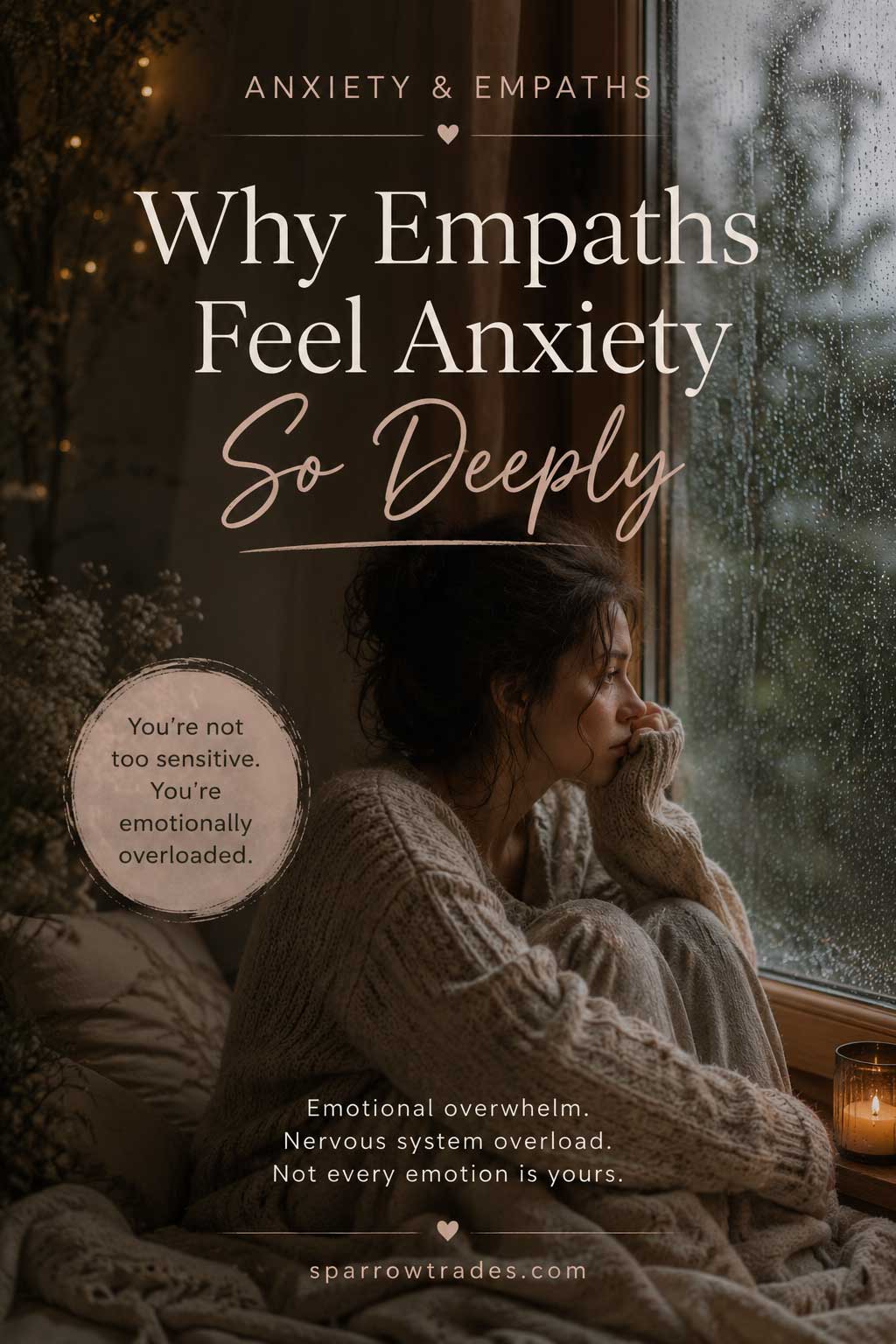

Where softness, self-awareness, and emotional healing are allowed to coexist. Through reflective writing, grounding rituals, and intentional beauty, Sparrow Trades offers gentle support for sensitive souls learning to reconnect with themselves.




2 Comments
This was a fascinating read. The relationship between empathy, emotional sensitivity, and anxiety is something that deserves more attention. I appreciated the balanced approach and practical insights. Thank you for creating content that helps readers better understand themselves.
Thank you, Umar. I’m glad you found the article helpful. I appreciate your comment!