
There are moments when you walk into a room and feel the temperature change before anyone says a word. Someone’s smile feels tight. A silence feels too loud. A casual comment lands with more weight than it was meant to carry. You may not know what happened, but your body knows something shifted.
For many empaths, this is familiar territory. You sense tension quickly. You notice micro-changes in tone, posture, eye contact, and emotional availability. You may pick up on sadness before someone admits they are sad, resentment before it becomes an argument, or discomfort before anyone names it. This sensitivity can feel like care. It can also feel like confusion, especially when other people react strongly to you and you are left wondering what you did wrong.
The truth is, sometimes your presence may stir something in people without you meaning to. Not because you are dangerous. Not because you are “too much.” Not because sensitivity is a flaw. But because emotional awareness can act like a mirror. When you are attuned to what is unspoken, people who are used to hiding, performing, suppressing, or controlling their feelings may feel exposed around you.
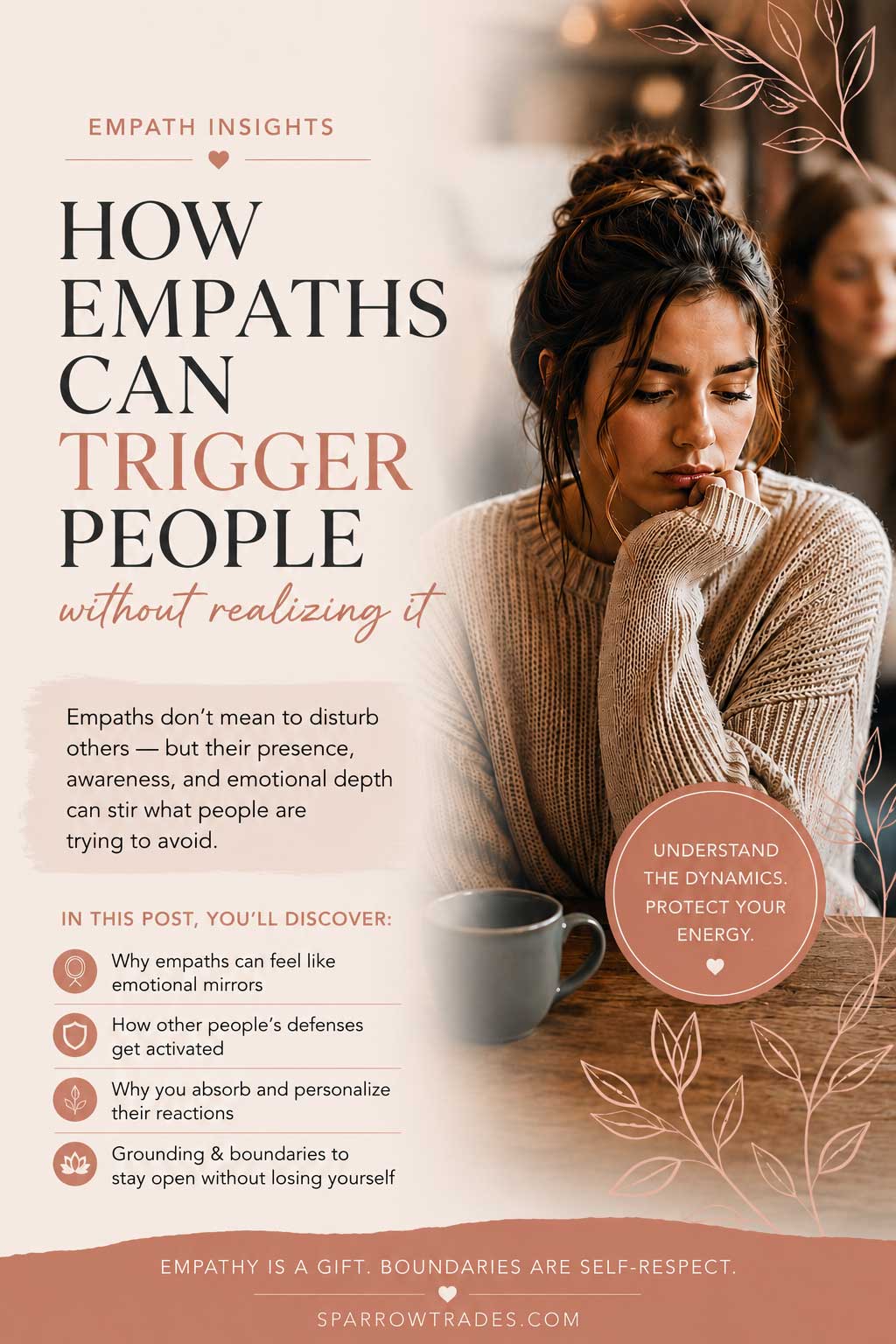
This is one way how empaths can trigger people becomes such a tender topic. It is not about blaming empaths for other people’s reactions. It is about understanding the emotional dynamics that can happen when one person is deeply receptive and another person is not ready to be seen.
If you have spent years trying to be easy to love, easy to manage, or easy to be around, this can be painful to accept. You may assume that if someone becomes defensive, withdrawn, irritated, or overwhelmed around you, you must have failed somehow. You may try to soften your voice, shrink your needs, explain yourself better, or absorb the entire emotional atmosphere so no one else has to feel uncomfortable.
But emotional sensitivity is not the same as emotional responsibility. Your nervous system may notice what others avoid, but that does not mean you caused it. Your empathy may illuminate a truth in the room, but illumination is not an attack.
Part of healing is learning the difference between presence and pressure. You can be deeply feeling without becoming responsible for every reaction that rises around you. You can understand what it means to be an empath without turning your sensitivity into a lifelong apology.

Why Empaths Can Feel Like Emotional Mirrors
Some people are not used to being emotionally perceived. They may be used to moving through relationships with a carefully managed surface: the agreeable version, the successful version, the calm version, the untouchable version. When an empath senses the feeling beneath that surface, even quietly, the other person may feel vulnerable without understanding why.
You may not say, “I can tell you’re upset.” You may simply pause, soften, ask if they are okay, or respond to the tension you feel. But to someone who has built safety around denial, even gentle noticing can feel intrusive. They may experience your awareness as pressure, even when your intention is care.
This is where triggering often becomes confusing. You are not forcing someone to reveal themselves. Yet your presence may make it harder for them to stay fully disconnected from what they feel. They may become irritated because they feel seen. They may become cold because closeness feels threatening. They may accuse you of being dramatic because your sensitivity touches something they have worked hard not to feel.
For an empath, this can create a painful loop. You feel their discomfort, then you feel responsible for it, then you try to fix it. Before long, you are no longer grounded in yourself. You are managing the room, editing your personality, and trying to make your own emotional clarity less visible.
This is why emotional boundaries matter so much. Boundaries are not walls against compassion. They are the place where you stop confusing someone else’s discomfort with your wrongdoing.
A person may feel unsettled around you because your presence disrupts their emotional avoidance. That does not mean you need to become less perceptive. It means you need enough inner steadiness to let their reaction belong to them.
You are allowed to be warm without rescuing. You are allowed to notice without interrogating. You are allowed to feel the room without becoming the room.
When Emotional Sensitivity Touches Someone’s Defenses
People often defend against feelings long before they understand those feelings. Defensiveness can look like sarcasm, withdrawal, impatience, criticism, intellectualizing, sudden busyness, or turning the focus back onto you. If you are empathic, you may feel this shift instantly. The person may still be smiling, but something in the connection closes.
This is especially painful when you were not trying to confront anything. Maybe you asked a caring question. Maybe you named your own feeling honestly. Maybe you quietly stopped pretending everything was fine. Suddenly, the other person reacts as if you have threatened them.
In reality, your emotional honesty may have touched a place where they are not honest with themselves. Your sadness may disturb someone who copes by staying detached. Your calm awareness may unsettle someone who relies on control. Your refusal to perform happiness may trigger someone who needs everyone around them to confirm that nothing is wrong.
This does not mean you should weaponize your sensitivity or assume you always know what others feel. Empathy can be powerful, but it is not permission to diagnose, expose, or override someone’s inner world. A trauma-informed empath learns to hold perception gently.
The work is not to stop sensing. The work is to stop merging.
When you can practice how to tell if an emotion is yours or someone else’s you create space between awareness and action. You might notice tension and still choose not to chase it. You might feel someone’s anger and still remember it is not automatically yours to soothe. You might sense grief beneath someone’s words and still let them decide whether they are ready to name it.
This kind of restraint is loving. It protects the other person’s autonomy, and it protects your nervous system from over-functioning.
Empaths often trigger people most when they unconsciously reach toward what someone is trying to hide. Not because the empath is wrong, but because uninvited emotional contact can feel intense. Sensitivity becomes safer when it is paired with consent, humility, and self-containment.
Why Some People Feel Exposed Around Empaths
To feel emotionally exposed is not always the same as being judged. Sometimes people feel exposed simply because they are near someone who is present. If they are used to relationships built on distraction, performance, or emotional avoidance, your attention may feel unusually intimate.
You may listen deeply. You may remember what they said months ago. You may notice when their energy drops. You may respond to the feeling behind their words instead of only the words themselves. To someone who longs to be seen, this can feel healing. To someone who fears being seen, it can feel overwhelming.
This is one reason why people feel exposed around empaths deserves its own space in the empath healing conversation. Exposure is not always caused by confrontation. Sometimes it is caused by presence.
If you grew up in emotionally chaotic environments, you may have learned to read people for survival. You may have become skilled at detecting mood shifts because missing them once carried consequences. As an adult, that skill can become both a gift and a burden. You may sense what is happening quickly, but your body may also brace as if every emotional shift is urgent.
This is where nervous system regulation techniques become essential. Without regulation, empathy can feel like an alarm system that never turns off. Every sigh, pause, or change in tone can feel like a signal that something must be fixed.
But not every emotional reaction is an emergency. Not every discomfort requires repair. Sometimes someone feels exposed because their own inner truth is rising closer to the surface. Your job is not to push it down for them or pull it out of them. Your job is to remain kind, grounded, and separate.
The more you regulate your own body, the less you need to manage someone else’s. You can let a room be uncomfortable without abandoning yourself inside it.
Emotional Absorption Can Make Reactions Feel Personal
Empaths often struggle not because they notice emotions, but because they absorb them. Someone becomes irritated, and suddenly your chest tightens. Someone withdraws, and suddenly you feel ashamed. Someone is anxious, and suddenly you are scanning for what went wrong.
This is how another person’s emotional state can begin to feel like evidence about you. Their discomfort becomes your guilt. Their silence becomes your failure. Their defensiveness becomes proof that you were too much.
But absorption is not truth. It is a nervous system experience.
When you do not know how to separate your emotions from the emotions around you, every interaction can become exhausting. You may leave conversations carrying feelings that did not begin in you. You may replay other people’s reactions for hours, trying to locate the exact moment you caused the shift. You may apologize for things no one accused you of because your body is already responding as if you are in trouble.
This is why how to stop absorbing other people’s emotions is such a central skill for empathic people. It is not about becoming cold. It is about returning what was never yours to carry.
Sometimes people are triggered around you because they are having their own response. Sometimes you are triggered by their trigger because your body remembers old relational danger. Two nervous systems can activate each other without either person being intentionally harmful.
That is where compassion becomes more mature. You can care about the other person’s feelings without collapsing into them. You can acknowledge tension without assuming blame. You can stay open without letting your body become a container for everyone else’s unprocessed emotion.
This is not easy at first. If you have spent years equating love with emotional labor, separation may feel selfish. But it is not selfish to know where you end. It is honest.
When Empathic Intensity Feels Overwhelming to Others
Empaths can sometimes bring a level of emotional intensity that other people are not prepared for. This does not always look dramatic. It may look like deep eye contact, careful listening, immediate concern, emotional insight, or a strong desire to process what is happening.
For someone who processes slowly, this can feel like too much too soon. For someone who avoids vulnerability, it can feel like pressure. For someone who has never learned emotional language, it can feel like being pulled into a depth they do not know how to navigate.
This is where self-awareness matters. Your empathy may be sincere, but sincerity does not automatically make timing right. Sometimes the most caring thing you can do is slow down. Not because your feelings are wrong, but because emotional pacing helps connection stay safe.
You might sense that something is wrong and still wait. You might want clarity and still allow space. You might feel the urge to ask, “Are you upset with me?” and instead first check your own body, breathe, and ask whether the moment can hold that conversation.
This is part of the power of self-awareness in emotional healing. Self-awareness helps you notice not only what others are feeling, but what your empathy is doing in the room. Are you present, or are you pursuing? Are you listening, or are you scanning for danger? Are you offering care, or are you trying to calm your own fear through someone else’s reassurance?
These questions are not meant to shame you. They are meant to bring you back to choice.
Empathic intensity becomes safer when it is grounded. You do not have to dull your sensitivity. You only have to give it roots.
Grounding Before You Respond
When you feel someone reacting to you, your first impulse may be to explain, fix, apologize, or emotionally reach for them. But if your nervous system is activated, your response may come from fear rather than clarity.
Grounding creates a pause. It gives your body a chance to understand that tension is not always danger. A person’s reaction may be uncomfortable, but discomfort does not automatically mean abandonment, rejection, or attack.
Simple grounding can look like feeling your feet, relaxing your jaw, noticing the room, taking a slow breath, or naming silently, “This feeling is here, but I do not have to become it.” These small moments help you stay with yourself while someone else has their own experience.
If the interaction has already left you flooded, grounding after emotional overload can help you come down from the intensity instead of carrying it into the rest of your day. You may need quiet. You may need water. You may need to step outside. You may need to write down what actually happened instead of what your fear says happened.
For many empaths, the deepest repair begins when the body learns that another person’s discomfort does not require immediate self-abandonment.
You can be kind and still pause. You can be compassionate and still breathe before responding. You can be emotionally available without becoming emotionally consumed.
How Empaths Can Stay Open Without Over-Explaining
When someone seems triggered by you, over-explaining can feel like safety. You may try to prove your intention, clarify your tone, soften your needs, or make yourself easier to understand. But often, the more you explain from fear, the more disconnected you feel from yourself.
There is a difference between repair and self-erasure. Repair sounds like, “I care about how that landed. I’m open to talking about it.” Self-erasure sounds like, “Let me make myself smaller until you no longer feel anything uncomfortable around me.”
Empaths often need energetic boundaries for intuitive empaths because not every emotional opening deserves full access to your inner world. Some people can receive your honesty. Some people will use your vulnerability to redirect responsibility back onto you. Some people are not trying to understand; they are trying to discharge their discomfort.
You are allowed to discern the difference.
This is especially important when empathy turns into exhaustion. If you are constantly tracking everyone’s mood, adjusting your tone, anticipating reactions, and absorbing tension, you may eventually reach when empathy becomes emotional exhaustion. At that point, your sensitivity is no longer flowing as connection. It is functioning as survival.
Staying open does not mean staying endlessly available. It means keeping your heart awake while also keeping your center intact.
A regulated empath does not need to convince everyone of their goodness. They practice honesty, kindness, accountability, and restraint. Then they allow other people to have their own reactions without turning every reaction into a personal verdict.
Frequently Asked Questions About How Empaths Can Trigger People
Can empaths really trigger other people?
Yes, empaths can trigger people, but not usually in the way they fear. It is not that empathy itself is harmful. More often, an empath’s presence, emotional honesty, or sensitivity can bring unspoken feelings closer to the surface. Someone may feel seen, exposed, challenged, or emotionally stirred without knowing how to name it.
This does not mean the empath is responsible for the other person’s reaction. It means emotional dynamics are shared, complex, and often shaped by each person’s history. If someone has learned to avoid vulnerability, being near a perceptive person may activate defensiveness. If someone is carrying shame, gentle attention may feel uncomfortable. The empath can be part of the emotional moment without being the cause of everything that happens inside it.
Why do people get defensive around empaths?
People may get defensive around empaths because they feel emotionally perceived before they feel ready. An empath may notice sadness behind anger, fear behind control, or tension beneath politeness. Even when nothing is said directly, the other person may sense that their emotional mask is not working as well as usual.
Defensiveness is often a protection response. It can arise when someone feels vulnerable, ashamed, misunderstood, or afraid of losing control. This is why why sensitive people make others defensive is such a natural part of the empath conversation. Sensitivity can touch what people are protecting, even when the sensitive person means no harm.
How do I know if I am sensing something real or projecting?
A helpful starting point is to slow down and separate sensation from story. You may truly sense tension, but your mind may add, “They hate me,” “I ruined everything,” or “I have to fix this now.” The sensation may be real; the interpretation may be old fear.
Practicing learning to trust your emotions again does not mean believing every anxious thought. It means learning to listen inwardly with steadiness. You can ask: What did I actually observe? What am I assuming? What does my body remember? Do I need clarification, or do I need regulation first?
Over time, this helps you honor your sensitivity without letting fear turn every emotional shift into certainty.
What should I do when someone is triggered by my presence?
First, pause. Let your body settle before you respond. You do not have to rush into apology, explanation, or rescue. Notice what is happening in you: fear, guilt, urgency, confusion, sadness. Then ask whether the moment calls for repair, space, or silence.
If you did cause harm, accountability matters. But if the other person is reacting to being emotionally uncomfortable, you can stay kind without taking ownership of their entire inner experience. You might say, “I can feel this got tense. I’m open to talking if you want to.” Then let there be room.
If your body feels flooded afterward, somatic self-soothing practices can help you return to yourself instead of spiraling into self-blame.
Can empathy become overwhelming in relationships?
Yes. Empathy becomes overwhelming when it loses boundaries, pacing, and self-contact. If you are constantly sensing, absorbing, interpreting, and responding to another person’s emotions, the relationship may begin to feel like emotional surveillance instead of connection.
Healthy empathy includes space. It allows the other person to have privacy, timing, and ownership of their feelings. It also allows you to have your own body, needs, limits, and perspective. This is where empath nervous system overwhelm recovery becomes important, especially if your sensitivity has been shaped by trauma, hypervigilance, or caretaking roles.
You are not meant to live as an emotional antenna with no off switch. You are allowed to rest.
How can empaths stop feeling responsible for everyone’s reactions?
Responsibility begins to soften when you learn to distinguish care from control. You can care that someone is uncomfortable without controlling whether they ever feel discomfort. You can speak gently without guaranteeing that your words will land gently. You can be honest without managing every emotional consequence.
Practices like mindfulness for anxiety can help you notice the urge to fix before you obey it. You may feel guilt rise, but you do not have to build your identity around it. You may sense someone’s discomfort, but you do not have to abandon yourself to make it disappear.
The shift is quiet but powerful: “I can be compassionate without becoming responsible for everything another person feels.”
Conclusion
Being an empath does not mean you are destined to overwhelm people, trigger defensiveness, or carry the emotional weight of every room you enter. It means your system is sensitive. It means you notice. It means you may feel what others miss, sometimes before they are ready to feel it themselves.
That sensitivity needs tenderness, not shame.
Some people will feel comforted by your presence. Some will feel challenged by it. Some will feel seen in ways they have secretly longed for. Others may feel exposed, irritated, or defensive because your emotional awareness touches places they have not yet learned to meet within themselves.
Your healing is not about becoming less empathic. It is about becoming less entangled.
You can let people have their reactions without making those reactions your identity. You can sense tension without chasing it. You can offer care without forcing closeness. You can remain emotionally open while still belonging to yourself.
And when your sensitivity feels like too much, remember this: the goal is not to become numb. The goal is to become rooted. With energetic self-care for empaths, your empathy can become less like a wound that absorbs everything and more like a lantern you carry with steadiness.
You are not here to disappear so others can stay comfortable. You are here to feel deeply, love wisely, and learn the sacred difference between being aware of someone’s emotions and being responsible for them.

Where softness, self-awareness, and emotional healing are allowed to coexist. Through reflective writing, grounding rituals, and intentional beauty, Sparrow Trades offers gentle support for sensitive souls learning to reconnect with themselves.