There are some stones that feel bright and expansive the moment you hold them, and then there are stones like rhodonite that seem to meet you where the ache already lives. Rhodonite does not usually arrive with a flashy kind of energy. It often feels steadier than that—more like a stone that sits beside grief, emotional exhaustion, self-blame, or old tenderness and says you do not have to rush your way out of what hurts. If you have ever been drawn to a pink stone that feels less dreamy than soft, less romantic than honest, rhodonite may be the one your nervous system is already noticing.
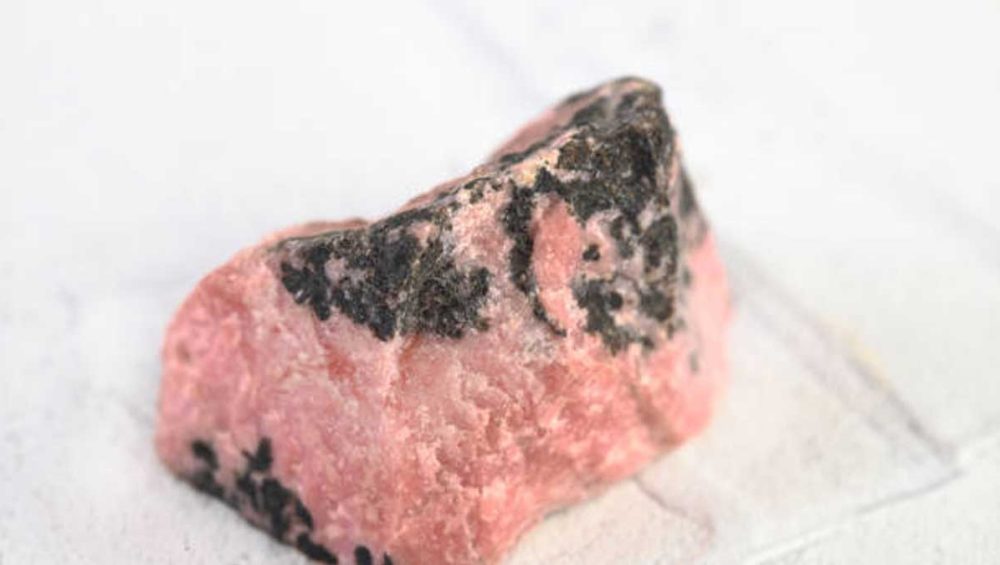
At its simplest, rhodonite is a pink to rosy-red manganese silicate mineral that often carries dark veining or black patches caused by manganese oxides. That contrast is part of what makes it so memorable. It is not a flawless pink. It is a stone where softness and shadow live beside each other, which is one reason so many people feel emotionally connected to it. In a world that often pressures healing to look polished, rhodonite feels more real. It reflects the truth that tenderness and pain can exist in the same place, and that repair is often messier—and more human—than people expect.
Within the wider world of gemstone meanings, rhodonite is often associated with emotional balance, compassion, forgiveness, and heart-centered recovery. Many people turn toward it during seasons when they are trying to come back to themselves after disappointment, conflict, heartbreak, or inner criticism. Its symbolism is not about pretending pain never happened. It is more often connected with staying open enough to process what happened without abandoning yourself in the process.
That is also why rhodonite has a meaningful place in crystal healing conversations. People are not only asking what rhodonite is made of or what color it appears to be. They are asking what it feels like to live with it, wear it, meditate with it, or keep it nearby when emotions are harder to organize. Sometimes the question behind “what is rhodonite?” is really: could this stone support me while I am trying to feel safe in my own heart again?
The answer depends on your relationship with stones, your beliefs, and the kind of support you need. Rhodonite is not a substitute for care, therapy, medical treatment, or deep relational repair. But as part of a gentler ritual life, it can act like a grounding symbol—something you return to when you want to remember that emotional healing does not have to be harsh to be real. Like many stones gathered through crystals by intention, rhodonite tends to resonate most strongly with people seeking steadiness, emotional honesty, and a kinder way of relating to their own inner wounds.
What rhodonite means spiritually and emotionally
Rhodonite is most often known as a stone of compassion, emotional repair, and heart-led resilience. Its spiritual meaning is usually tied to the idea that healing is not only about release. It is also about learning how to stay present with yourself when old feelings rise again. For people who have learned to harden, over-function, or emotionally leave their bodies in order to cope, rhodonite can symbolize a softer return.
That symbolism matters because emotional healing is rarely just mental. It is often deeply physical too. Your chest tightens. Your breath changes. Your shoulders lift before you even realize you feel unsafe. In that sense, rhodonite can feel aligned with the same slow, supportive values found in emotional wellness foundations. It reminds you that tenderness is not weakness and that a regulated life is often built through repeated moments of self-return, not one dramatic breakthrough.
Spiritually, rhodonite is often associated with forgiveness, but that idea deserves care. Forgiveness in a trauma-informed context should never mean bypassing harm, minimizing betrayal, or forcing reconciliation before your body is ready. Rhodonite’s gentler lesson is closer to this: you deserve freedom from the emotional patterns that keep turning pain inward. Sometimes that looks like releasing shame. Sometimes it looks like grieving what cannot be changed. Sometimes it looks like choosing boundaries without hatred.
This is one reason rhodonite is often mentioned beside rose quartz healing but feels distinct from it. Rose quartz is often associated with unconditional love, softness, and emotional soothing. Rhodonite, by contrast, tends to carry more of a repair-oriented energy. It is pink, but it is not delicate in a fragile way. It feels more like a stone for staying with complexity—for loving yourself while also facing what hurt, where anger lives, and what repair may require.
If you are someone who has spent years comforting others while neglecting your own inner life, rhodonite’s meaning may land especially deeply. It often resonates with people who are learning to give compassion inward instead of only outward. In that way, it can become a quiet emblem of emotional maturity: not the kind that suppresses feeling, but the kind that holds feeling with honesty and care.
Rhodonite healing properties and why people are drawn to it
When people talk about rhodonite’s healing properties, they usually mean emotional and energetic support rather than a medical effect. The stone is commonly associated with calming emotional overwhelm, supporting compassion, reducing self-judgment, and helping the heart recover after stress or disappointment. If your inner world has felt tangled, rhodonite is often described as a stone that helps you sort feeling from fear without becoming colder in the process.
Part of its appeal is that rhodonite feels emotionally sturdy. Some stones carry a very airy or expansive symbolism, but rhodonite often feels grounded enough for people who need gentleness without drift. That makes it appealing within practical crystal healing practices where the goal is not escape, but presence. You might hold it during journaling, keep it near your bed after an emotionally difficult day, or use it during intentional rest when your body feels overextended.
Many people also connect rhodonite with the heart, not only in a romantic sense but in a broader emotional one. It is often used by people who are trying to soften resentment, rebuild trust in themselves, or stop treating their own vulnerability as a problem to be managed. In that way, rhodonite’s value can overlap with the wider benefits of healing crystals people often seek: emotional focus, symbolic comfort, and a ritual object that helps them stay connected to the kind of healing they want to practice.
Because rhodonite often contains black veining, some people experience it as a stone that holds both compassion and containment. That visual contrast can feel regulating. It says healing does not have to mean becoming all softness with no boundaries. It can also mean learning when to protect your energy, when to tell the truth, and when to stop over-identifying with pain. For readers who are also drawn to stronger protective stones like black tourmaline, rhodonite can feel like a companion rather than an opposite—less about shielding, more about recovering heart space after the impact has already happened.
If you are building a personal practice with stones, rhodonite can also sit naturally beside clear quartz meaning work, especially if you want more clarity around your emotional patterns. Rhodonite does not necessarily amplify in the same way clear quartz is often said to, but it can help focus your attention on where care, grief, anger, and forgiveness are all asking to be noticed.
Rhodonite and the heart chakra
Rhodonite is most commonly linked with the heart chakra, the energetic center often associated with love, compassion, emotional balance, and relational openness. But heart-centered healing is not always warm and effortless. Sometimes it is about learning how to remain open without collapsing your boundaries. Sometimes it is about letting grief move without letting it define your identity. Rhodonite feels especially resonant here because it does not symbolize a sentimental version of the heart. It symbolizes a heart that has known impact and is still learning how to stay alive to itself.
If you are exploring chakras and energy, rhodonite can be understood as a stone that supports compassionate honesty. It is often chosen when someone wants to reconnect with feeling but does not want to be flooded by it. That distinction matters for sensitive nervous systems. Opening the heart should not mean abandoning safety. In a trauma-aware practice, energetic work needs to leave room for pacing, consent, and emotional choice.
This is where rhodonite differs from more abstract chakra language that can sometimes feel disconnected from lived experience. A heart chakra practice with rhodonite might be as simple as placing the stone nearby while breathing more slowly after a conflict, holding it while writing what you actually feel instead of what seems most acceptable, or resting with it while noticing where emotional pain sits in the body. For those who want a broader context, chakra crystals guide perspectives can help situate rhodonite among other stones used for emotional and energetic balance.
Rhodonite is also a useful reminder that the heart is not only about connection to others. It is also about your relationship with yourself. Can you stay kind to yourself when you are disappointed in how long healing is taking? Can you remain present when tenderness rises instead of immediately numbing it? That is why a future piece on rhodonite and the heart chakra would feel like a natural extension of this article: the stone has a lot to say about emotional openness that does not sacrifice inner safety.
For some people, rhodonite can also complement meditation or breath-based practices when emotional restoration feels safer through objects and ritual. Used gently, it can belong in the same emotional space as crystals for meditation, especially for readers who want a focal point that feels compassionate rather than overly stimulating.
How to use rhodonite in everyday life
One of the most comforting things about rhodonite is that it does not require a dramatic ritual to feel meaningful. If a stone is going to support you, it should be able to meet ordinary life too. That means rhodonite can be used in quiet, practical ways: kept on a desk during emotionally demanding work, held during reflection after conflict, placed near your bed when you need softness at the end of the day, or carried as a reminder not to turn every difficult feeling into self-attack.
For many people, the best use of rhodonite is as a pause object. When your mind is spiraling into blame, shame, or emotional overexertion, touching something cool, solid, and visually grounding can interrupt the momentum just enough to help you choose a gentler response. The stone itself is not “fixing” the moment. It is helping create enough space for a different relationship to the moment. That is part of why rhodonite healing properties deserves its own future article—people often want more than definitions; they want felt applications.
You might also use rhodonite in journaling rituals. Hold it before writing about resentment, heartbreak, disappointment, or the places where you feel emotionally split between compassion and anger. Let it symbolize your willingness to be truthful without becoming cruel to yourself. If you already work with softer heart stones, a future comparison like rhodonite vs rose quartz can help clarify which emotional tone you need in a given season.
Some people prefer to pair rhodonite with a more stabilizing stone when they feel especially raw. In that case, rhodonite may sit beside something more rooted, such as smoky quartz meaning, so the practice feels emotionally open without becoming untethered. Others may place it within a broader routine of self-connection, especially if their relationship with healing has become overly analytical or performance-based.
If you are just starting out, you do not need a perfect ritual. You only need a meaningful one. A few mindful breaths, a hand over the chest, a moment of noticing what hurts without collapsing into it—these are enough places for rhodonite to become personal. Over time, a fuller guide to rhodonite uses could deepen those practices, but the beginning can stay simple.
Frequently asked questions about rhodonite
What is rhodonite used for?
Rhodonite is most often used for emotional support, heart-centered reflection, and compassion-based crystal practices. People commonly turn to it during periods of grief, relationship stress, self-forgiveness work, or emotional overwhelm. In everyday life, it may be carried in a pocket, kept on a bedside table, used in journaling, or held during quiet moments when someone wants to reconnect with steadiness rather than react from pain.
Is rhodonite a heart chakra stone?
Yes, rhodonite is widely associated with the heart chakra. It is often chosen for practices related to emotional healing, compassion, forgiveness, and restoring inner balance after difficult experiences. What makes it especially resonant is that it does not only symbolize sweetness. It also symbolizes the heart’s ability to stay present with complexity, which is why it feels meaningful to people who are healing from disappointment, conflict, or old emotional wounds.
What does rhodonite look like?
Rhodonite is usually pink, rose, or rosy-red and often has black veins, patches, or matrix running through it. Those darker areas are part of what gives the stone its distinctive appearance. Unlike uniformly pink stones, rhodonite often looks like softness marked by contrast, which many people find emotionally meaningful as well as visually beautiful.
Is rhodonite the same as rose quartz?
No, rhodonite and rose quartz are different stones, even though both are often associated with the heart. Rose quartz usually carries a softer, more uniformly pink appearance and is often linked with unconditional love, soothing, and gentleness. Rhodonite tends to look more varied because of its black veining and is often associated with emotional repair, compassion, and forgiveness after pain. They can complement each other, but they do not feel identical in tone.
Can rhodonite be used with other crystals?
Yes, many people pair rhodonite with other stones depending on what kind of support they need. It can sit beside heart-centered stones for emotional tenderness, clearer stones for reflection, or more stabilizing stones when feeling emotionally exposed. If you are building your own practice, you might also notice how rhodonite fits within wider categories like best crystals for root chakra support when you want steadiness, or more reflective spaces connected with amethyst style guides if your rituals lean more meditative and intuitive.
Who is rhodonite best for?
Rhodonite often resonates with people who need emotional gentleness without emotional avoidance. It can feel especially supportive for those working through resentment, grief, relational disappointment, self-criticism, or the effort of becoming more compassionate toward themselves. It may also appeal to people who do not want spiritual tools that feel overly airy or idealized. Rhodonite tends to meet emotional reality with a steadier, more honest kind of softness.
Why rhodonite continues to matter
Rhodonite matters because so many people are trying to heal without hardening, and that is not easy work. It is one thing to protect yourself after pain. It is another thing entirely to protect yourself without losing access to your own tenderness. Rhodonite seems to speak to that middle place. It does not ask you to become endlessly open, endlessly forgiving, or endlessly positive. It asks something more sustainable: can you stay in relationship with your own heart while telling the truth about what it has carried?
That is what makes rhodonite more than a pretty pink stone. It becomes meaningful because it reflects an emotional reality many people know intimately. Healing is rarely clean. Love is rarely simple. Softness is often earned. The dark markings inside rhodonite do not ruin its beauty; they reveal the kind of beauty that can survive contact with difficulty. For readers moving through a season of inner repair, that symbolism can feel unexpectedly relieving.
Within the broader world of stones, chakra work, and ritual objects, rhodonite offers a very human kind of medicine: not certainty, not escape, but companionship. It belongs naturally beside the quieter values that make healing possible—presence, honesty, boundaries, grief, compassion, and return. If you feel drawn to it, that may be enough reason to begin. You do not need to perform a perfect spiritual identity around it. You only need to notice what happens when a stone reminds you that your heart can hold both the wound and the will to heal.
Where softness, self-awareness, and emotional healing are allowed to coexist. Through reflective writing, grounding rituals, and intentional beauty, Sparrow Trades offers gentle support for sensitive souls learning to reconnect with themselves.