

Have you ever walked away from a conversation feeling strangely uncertain about yourself? Perhaps you were sure something happened, only to be told it never did. Maybe your feelings were brushed aside so often that you stopped sharing them altogether. Over time, the warmth and affection that once made you feel valued seemed to disappear, replaced by criticism, distance, or silence. Eventually, the relationship may have ended so abruptly that you were left questioning what had changed.
Experiences like these can feel confusing because they rarely happen all at once. Instead, they often unfold gradually, making it difficult to recognize the larger pattern while you’re living through it. Many people describe feeling as though they lost confidence in their own instincts long before they realized something unhealthy was happening.
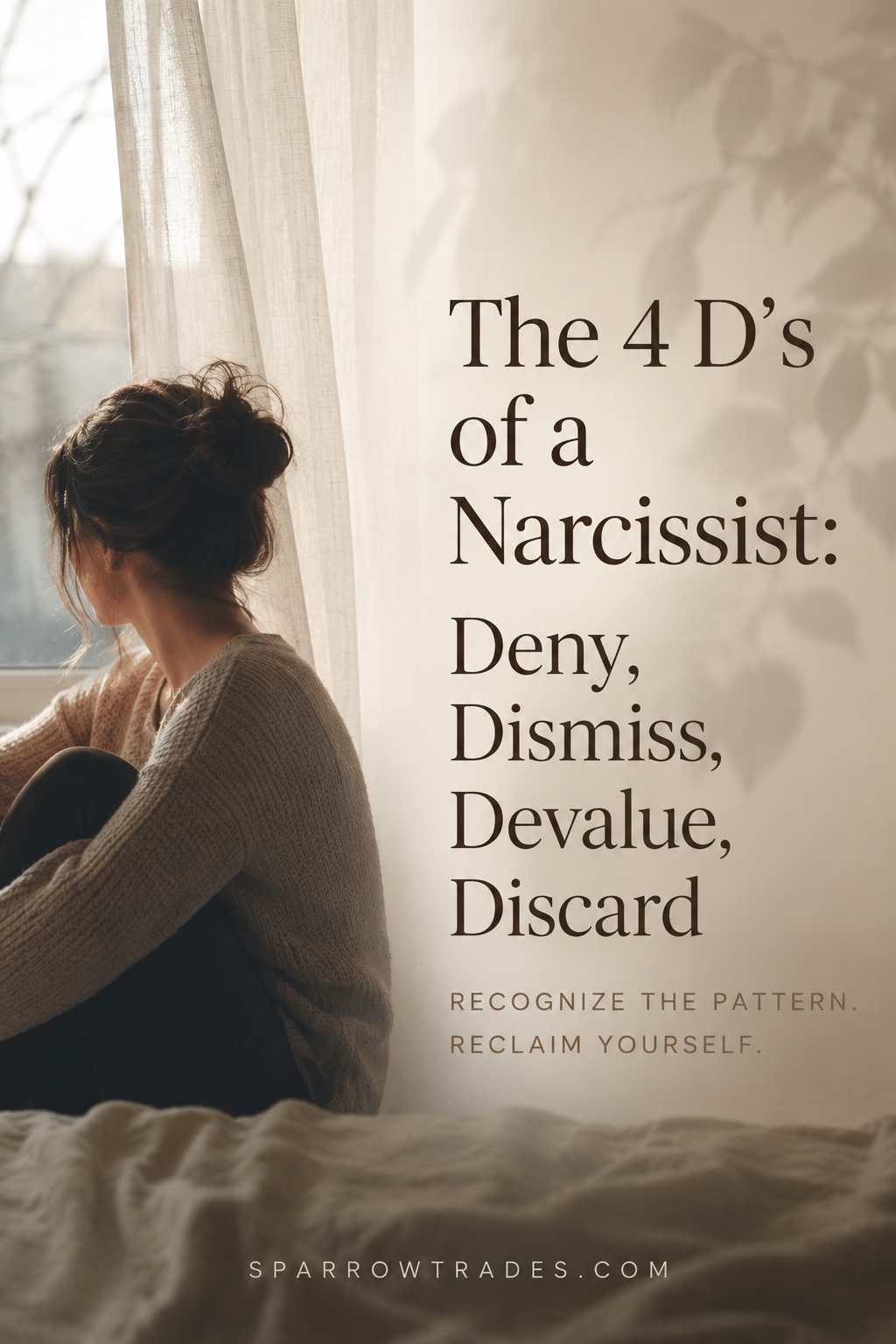
One framework that some people find helpful is known as the 4 D’s of a narcissist: deny, dismiss, devalue, and discard. While this isn’t a formal psychological model, it offers a memorable way to understand behaviors that frequently appear in emotionally manipulative relationships. Rather than viewing each interaction as an isolated incident, the Four Ds encourage you to step back and notice whether these experiences are connected.
Understanding these patterns begins with narcissism, not because every difficult relationship involves narcissistic traits, but because certain forms of emotional manipulation tend to appear together, creating patterns that are easier to recognize when viewed as a whole.
Recognizing the pattern also helps separate intentional behavior from your own emotional responses. Many people spend months—or even years—trying to find the one conversation that will finally make things better. They assume that if they explain themselves more clearly, remain patient, or become less emotional, the relationship will return to what it once was. When those efforts repeatedly fail, it’s easy to begin blaming yourself.
That self-blame is often what makes emotional manipulation so powerful.
The Four Ds aren’t meant to diagnose another person. They are a tool for increasing awareness. Whether the person in your life is a romantic partner, family member, friend, or colleague, recognizing recurring behaviors can help you make sense of experiences that once felt impossible to explain.
As you read through each stage, remember that relationships are complex. People sometimes deny mistakes, dismiss feelings, or withdraw during periods of stress without engaging in a broader pattern of manipulation. What distinguishes the Four Ds is persistence. These behaviors become part of an ongoing dynamic that gradually shifts the relationship away from mutual respect and toward control.
What Are the 4 D’s of a Narcissist?
The 4 D’s of a narcissist describe a sequence of behaviors that many people report experiencing in emotionally manipulative relationships:
- Deny — refusing responsibility, rewriting events, or insisting your experience isn’t accurate.
- Dismiss — minimizing your emotions, invalidating your concerns, or making you feel as though you’re overreacting.
- Devalue — gradually replacing affection with criticism, comparison, contempt, or emotional distance.
- Discard — emotionally or physically withdrawing from the relationship, often without accountability or meaningful closure.
These stages don’t always happen in a perfectly predictable order, and they don’t necessarily occur only once. Some relationships cycle through them repeatedly. Others linger in one stage for months before shifting into another. In many cases, moments of kindness or affection reappear between them, making the pattern even harder to recognize.
This cycle also overlaps with other forms of emotional manipulation. A person who denies reality may also engage in gaslighting, leaving you uncertain about your own memory or judgment. Someone who repeatedly dismisses your feelings may rely on emotional invalidation to discourage you from expressing your needs. Looking at these behaviors together often reveals a larger picture than examining each incident on its own.
Understanding the Four Ds isn’t about placing labels on people. It’s about noticing whether your emotional world has slowly become smaller, quieter, and increasingly shaped by someone else’s version of reality.
Deny: When Reality Is Constantly Rewritten
The first “D” is often the most disorienting because it attacks something deeply personal: your trust in your own perception.
Denial in emotionally manipulative relationships isn’t simply refusing to admit a mistake. It can involve confidently rejecting events that happened, insisting conversations never occurred, or shifting responsibility so consistently that you begin questioning your own memory. Over time, this repeated contradiction creates confusion rather than clarity.
You might hear statements like:
- “That never happened.”
- “You’re remembering it wrong.”
- “You’re too sensitive.”
- “I never said that.”
Individually, these comments may seem minor. Repeated over months or years, however, they can gradually erode confidence in your own experiences. Instead of asking whether the other person’s behavior was hurtful, you begin wondering whether you’re imagining the problem in the first place.
This is one reason denial frequently overlaps with gaslighting. Although not every denial is gaslighting, persistent efforts to distort another person’s reality can have a similar emotional effect. Instead of feeling heard, you find yourself defending memories, emotions, and experiences that once felt obvious.
Some readers also notice that narcissistic denial rarely exists by itself. When reality can no longer be convincingly denied, the pattern often shifts into minimizing your emotional response—which leads naturally into the second stage: dismissal.
Dismiss: When Your Feelings Stop Feeling Safe
If denial causes you to question what happened, dismissal causes you to question whether your feelings matter at all.
Dismissal isn’t always loud or obvious. In fact, it can sound surprisingly reasonable on the surface. Someone might tell you that you’re “making a big deal out of nothing,” insist you’re “too emotional,” or suggest that everyone else would have handled the situation differently. Instead of addressing the concern you’ve raised, the conversation shifts toward criticizing your reaction.
Over time, this can become a form of emotional invalidation. Rather than responding with curiosity or empathy, the other person repeatedly communicates—directly or indirectly—that your emotional experience is exaggerated, inconvenient, or unworthy of attention.
You may begin noticing subtle changes in yourself. Perhaps you rehearse conversations before bringing up a concern, wondering whether you’re overreacting. Maybe you apologize before expressing disappointment because you’ve come to expect criticism instead of understanding. Some people eventually stop sharing their feelings altogether, believing silence is safer than being dismissed again.
This shift can happen so gradually that it feels normal. Instead of expecting emotional support from the relationship, you begin managing your own emotions in isolation while protecting the other person from discomfort. The relationship slowly becomes less about mutual understanding and more about avoiding conflict.
Dismissal can also create a painful contradiction. The same person who once encouraged vulnerability may now criticize it. Early reassurance is replaced by impatience, eye rolls, sarcasm, or comments that make you feel childish for having emotional needs. That inconsistency often leaves people wondering what they did wrong, when the real change may have little to do with them at all.
As this pattern continues, something deeper often begins to happen. The goal is no longer simply to minimize your feelings—it becomes easier to diminish your confidence as a whole.
Devalue: When Affection Becomes Criticism
Many people describe the devaluation stage as the point where the relationship begins feeling unfamiliar.
Someone who once admired your strengths may suddenly highlight your flaws. Compliments become rare while criticism becomes frequent. The qualities that were once celebrated—your kindness, sensitivity, ambition, or independence—may now be portrayed as weaknesses or inconveniences.
This shift can feel especially confusing after periods of love bombing. The contrast between being idealized and being criticized often leaves people searching for an explanation. They may assume they caused the change and work even harder to restore the closeness that once existed.
During devaluation, criticism is not always direct. It may appear through comparisons to other people, passive-aggressive remarks, subtle humiliation, or impossible standards that constantly move out of reach. Even achievements that once brought pride may be minimized or ignored.
Over time, repeated criticism can begin shaping the way you see yourself. Confidence that once felt natural becomes fragile. Decisions require reassurance. You may start asking permission for things you previously handled independently or second-guess choices that once came easily.
One of the most painful aspects of devaluation is that moments of warmth often still appear. A thoughtful gesture, kind conversation, or affectionate weekend can briefly restore hope, making it difficult to accept that the larger pattern remains unchanged. Those intermittent moments of connection can strengthen emotional attachment even while the relationship becomes increasingly unhealthy, contributing to what many people recognize as a trauma bond dynamic.
Not every relationship follows this exact progression, but when criticism consistently replaces respect, it’s worth paying attention. Healthy relationships allow room for disagreement and growth without making one person’s worth conditional.
Some readers find it helpful to understand this period more deeply because devaluation often develops gradually rather than overnight. the devaluation phase can provide a closer look at how this stage unfolds and why it can be so difficult to recognize while you’re living through it.
Discard: When the Relationship Suddenly Changes
The final “D” is often the one people remember most vividly because it can leave behind unanswered questions that linger long after the relationship ends.
Discard doesn’t always mean a dramatic breakup or complete disappearance. Sometimes it looks like emotional withdrawal. Conversations become brief. Affection disappears. Messages go unanswered for longer periods, or the relationship begins feeling one-sided. The person who once demanded your attention now seems emotionally unavailable or indifferent.
In other situations, the ending is abrupt. A relationship that once felt deeply significant is abandoned with little explanation or accountability. Plans are canceled. Communication stops. You may be blamed for the ending while the other person moves forward as though nothing meaningful was lost.
For many people, the hardest part isn’t simply that the relationship ended—it’s that the ending feels disconnected from everything that came before. The promises, affection, and future you believed you were building together suddenly seem to vanish without acknowledgment.
That lack of closure often keeps people searching for answers long after the relationship has changed. They replay conversations, question their decisions, and wonder whether one different response could have prevented the outcome. Yet relationships built on manipulation rarely end because one conversation went wrong. They end after a pattern has slowly reshaped the emotional foundation of the relationship itself.
For those trying to make sense of this experience, the narcissistic discard phase offers a deeper exploration of why the ending often feels so confusing and emotionally unfinished.
Why the Four Ds Can Be So Difficult to Recognize
Looking at the Four Ds on paper can make the pattern seem obvious. In real life, however, it rarely feels that simple.
Emotionally manipulative relationships often include moments of genuine warmth alongside periods of confusion. A hurtful conversation may be followed by an apology, a thoughtful gift, or a few peaceful days that make you question whether things are improving. Those positive moments aren’t necessarily fake, but they can make it much harder to recognize an unhealthy pattern developing over time.
This is one reason many people stay far longer than they expected they would. They aren’t ignoring red flags because they’re weak or naïve. They’re responding to inconsistency. When kindness and criticism exist side by side, the mind naturally focuses on the possibility that the relationship can return to its earlier, happier state.
Patterns like these can also appear differently depending on the person’s behavior. Someone with covert narcissism may rely on subtle guilt, passive-aggressive comments, or quiet withdrawal instead of obvious anger or grandiosity. The manipulation can be so understated that friends and family see a completely different version of the relationship than the one experienced behind closed doors.
It’s also important to remember that the presence of one or two behaviors doesn’t automatically mean someone is narcissistic. Everyone can become defensive, dismissive, or emotionally unavailable during periods of stress. The difference lies in the consistency of the pattern and its impact over time. Healthy relationships make room for accountability, repair, and mutual respect. Unhealthy relationships repeatedly leave one person questioning their reality while the other avoids meaningful responsibility.
Recognizing the Four Ds isn’t about collecting evidence against someone else. It’s about noticing whether the relationship consistently moves you away from emotional safety and toward confusion, self-doubt, and isolation.
What Can You Do If You Recognize These Patterns?
Realizing that your relationship resembles the Four Ds can bring a mixture of relief and grief.
On one hand, you may finally have words for experiences that once felt impossible to explain. On the other, recognizing a pattern often means accepting that the relationship you’ve been hoping for may not be the relationship that’s actually unfolding.
There’s no single “right” response. Every relationship is different, and factors such as shared children, finances, family dynamics, culture, or personal safety can make decisions deeply complex. Rather than rushing toward conclusions, it can be more helpful to begin by rebuilding trust in your own perceptions.
That might mean writing down conversations soon after they happen, especially if you frequently find yourself questioning your memory later. It may involve talking with a trusted friend, therapist, or support group that can offer perspective without pressuring you toward a particular decision. Sometimes simply hearing someone respond, “That sounds painful,” can feel profoundly different from repeatedly being told your feelings don’t matter.
If you’ve found yourself reacting in ways that don’t feel like you—becoming unusually angry, anxious, or emotionally overwhelmed—you may also wonder whether you’ve somehow become the problem. Chronic emotional pressure can push people beyond their normal coping abilities. In some situations, this leads to what is sometimes called reactive abuse, where a person eventually lashes out after prolonged mistreatment. While those reactions still deserve accountability, understanding the context can help reduce unnecessary shame and encourage healthier ways of responding.
Healing often begins with small moments of clarity rather than dramatic breakthroughs. Each time you trust your own experience, set a boundary, or recognize a familiar pattern without blaming yourself, you’re strengthening your ability to respond from awareness instead of confusion.
how to break the narcissistic abuse cycle may become a meaningful next step for readers who are ready to move beyond recognizing the pattern and begin rebuilding emotional safety.
A Gentle Reality Check Ritual
Understanding a relationship intellectually is one thing. Learning to trust yourself again is another.
If the Four Ds resonate with your experience, consider setting aside ten quiet minutes with a journal—not to analyze the other person’s motives, but to reconnect with your own.
You might reflect on questions such as:
- When did I first begin doubting my own memories?
- How often do I apologize for having feelings?
- When did criticism start feeling more common than kindness?
- What would emotional safety look like for me today?
There are no perfect answers. The purpose of this practice isn’t to prove that someone else was wrong. It’s to notice what your own experiences have been trying to tell you.
Some people also find it helpful to continue learning through trusted educational resources. Books such as Adult Children of Emotionally Immature Parents by Lindsay C. Gibson and Will I Ever Be Good Enough? by Karyl McBride offer compassionate perspectives on unhealthy relationship dynamics and the process of rebuilding self-trust.
Whether your next step is journaling, speaking with a therapist, or simply allowing yourself to acknowledge what you’ve experienced, healing often grows through understanding narcissism for emotional wellness, patient self-compassion, and relationships where your experiences are met with respect instead of dismissal.
Frequently Asked Questions
Are the 4 D’s of a narcissist an official psychological model?
No. The 4 D’s of a narcissist—deny, dismiss, devalue, and discard—are not a formally recognized psychological framework or diagnostic tool. Instead, they’re a practical way of describing behaviors that many people report experiencing in emotionally manipulative relationships.
Like many educational models, the Four Ds simplify a complex topic to make recurring patterns easier to recognize. Every individual and every relationship is different, so these behaviors shouldn’t be used to diagnose someone. If you’re trying to understand a difficult relationship, it’s often more helpful to focus on consistent patterns and their impact on your emotional well-being than on assigning labels.
Does every narcissist go through all four stages?
Not necessarily.
Some people may display one or two of these behaviors without progressing through the entire pattern. Others may cycle through the Four Ds repeatedly over months or years. The sequence isn’t always predictable, and real relationships rarely follow a neat progression.
What matters most isn’t whether every stage appears. It’s whether the relationship consistently leaves you feeling confused, dismissed, criticized, or emotionally unsafe.
Can someone change these behaviors?
People are capable of change, but meaningful change usually requires genuine self-awareness, accountability, and a sustained willingness to take responsibility for harmful behavior.
Simply apologizing after repeated patterns of denial, dismissal, or devaluation isn’t the same as lasting change. Healthy relationships involve acknowledging mistakes, listening to another person’s perspective, making repairs, and consistently behaving differently over time.
If responsibility is repeatedly avoided while the same behaviors continue, it’s understandable to question whether meaningful change is actually taking place.
Is every emotionally manipulative person a narcissist?
No.
People can behave in manipulative, emotionally immature, or controlling ways without meeting the criteria for a personality disorder. Stress, insecurity, unresolved trauma, poor communication skills, and unhealthy relationship habits can all contribute to harmful behavior.
The purpose of understanding the Four Ds isn’t to diagnose someone else. It’s to recognize whether your own emotional well-being is being consistently affected by recurring patterns.
Why is it so hard to leave a relationship like this?
If you’ve asked yourself this question, you’re far from alone. Many people carry a great deal of self-criticism when trying to understand why they stayed in a relationship that caused them pain.
The answer often has less to do with weakness than with the nature of the relationship itself. When affection, criticism, hope, disappointment, and uncertainty become intertwined, the emotional bond can become incredibly difficult to untangle. You may keep waiting for the caring version of the person to return, believing that if you just say the right thing or become a little more patient, the relationship will feel safe again.
This emotional push-and-pull is one reason relationships involving manipulation can feel so confusing. Hope often keeps people invested long after the relationship has stopped feeling emotionally secure.
Can these patterns happen in families or friendships too?
Absolutely.
Although discussions about narcissistic behavior often focus on romantic relationships, the Four Ds can also appear in relationships with parents, siblings, adult children, friends, coworkers, or supervisors.
For example, a parent may repeatedly deny hurtful events from childhood, dismiss your feelings when you try to discuss them, gradually undermine your confidence, and withdraw affection whenever you establish healthy boundaries. Similarly, a friend or colleague may consistently minimize your experiences while shifting blame whenever conflict arises.
The specific relationship may change, but the emotional impact can feel remarkably similar.
Final Thoughts
Recognizing the Four Ds can be an emotional experience. For some people, it provides language they’ve been searching for after months or years of confusion. For others, it raises difficult questions about relationships they once believed were healthy. Wherever you find yourself, remember that awareness doesn’t require you to make immediate decisions. Sometimes the most important first step is simply allowing yourself to acknowledge what you’ve experienced without dismissing your own feelings.
Healing rarely happens all at once. It often begins with quiet moments of clarity—trusting your memory a little more, honoring your emotions instead of explaining them away, and recognizing that healthy relationships don’t require you to continually prove your reality. As you continue your journey, healing often grows through understanding narcissism, practicing self-compassion, and surrounding yourself with people who respond to honesty with respect rather than control.
Whether this article helped you recognize a long-standing pattern or simply offered a new perspective, you deserve relationships where your voice is heard, your experiences are respected, and your sense of self is allowed to grow instead of shrink. That kind of emotional safety isn’t asking for too much—it’s one of the foundations of a healthy relationship.

Where softness, self-awareness, and emotional healing are allowed to coexist. Through reflective writing, grounding rituals, and intentional beauty, Sparrow Trades offers gentle support for sensitive souls learning to reconnect with themselves.