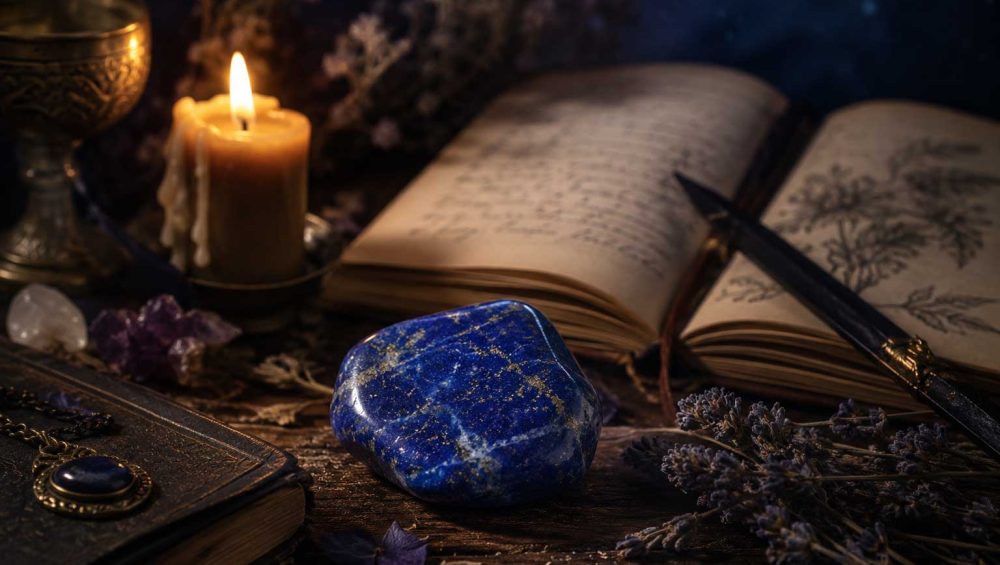
There are some stones that feel beautiful. There are others that feel meaningful. And then there are stones like lapis lazuli—stones that seem to carry a presence.
For centuries, lapis lazuli has been associated with wisdom, intuition, spiritual insight, and the search for truth. Its deep blue color, flecked with shimmering gold pyrite, has inspired mystics, healers, priests, and spiritual seekers across cultures. Long before modern crystal practices emerged, lapis was treasured as a sacred stone connected to divine knowledge and inner vision.
In witchcraft traditions, lapis lazuli is often viewed as a stone that helps illuminate what is hidden. Rather than offering comfort through avoidance, its symbolism encourages honesty, self-awareness, and deeper perception. Many people who feel drawn to lapis describe a longing to understand themselves more clearly, trust their intuition, or reconnect with a sense of spiritual direction.
This is partly why lapis remains so beloved in modern spiritual practices. It is frequently used during meditation, divination, dream work, and personal reflection. Its energy is often associated with both the third eye and throat chakras, creating a bridge between inner knowing and authentic expression. The insights we receive internally become easier to communicate externally.
For sensitive individuals, spiritual work can sometimes become overwhelming when it moves faster than the nervous system can comfortably process. Approaching crystal practices with patience, curiosity, and self-awareness often creates a more sustainable experience. Rather than forcing spiritual breakthroughs, lapis encourages gentle observation and a willingness to listen.
Many practitioners find that their relationship with lapis evolves over time. At first, it may simply feel beautiful. Later, it may become a trusted companion during journaling, meditation, or personal rituals. The stone itself does not create wisdom. Instead, it can become a symbolic reminder of the wisdom that already exists within you.
Within both ancient traditions and contemporary witchcraft, lapis lazuli is often connected to intuition, truth-seeking, spiritual protection, and self-discovery. Whether used on an altar, carried during ritual work, or incorporated into daily spiritual practices, its symbolism continues to resonate with people seeking clarity in a noisy world.
Perhaps that is why lapis has endured across thousands of years of human history. In every era, people have searched for truth, understanding, and connection. Lapis lazuli remains one of the stones most closely associated with that timeless journey inward.
The Ancient Spiritual History of Lapis Lazuli
The story of lapis lazuli begins long before modern witchcraft traditions. Archaeological discoveries reveal that lapis was treasured by some of the world’s earliest civilizations, often reserved for royalty, spiritual leaders, and sacred ceremonial objects.
In ancient Mesopotamia, lapis was considered a stone of divine favor and spiritual authority. It appeared in jewelry, amulets, and religious artifacts intended to connect individuals with higher realms of wisdom. Some ancient texts describe blue stones resembling lapis as symbols of heavenly power and cosmic order.
Ancient Egypt elevated lapis lazuli to an even greater level of reverence. The stone was associated with protection, spiritual vision, and the goddess Isis. It appeared in sacred amulets, burial masks, and ceremonial adornments. The famous funerary mask of Tutankhamun contains striking inlays of lapis lazuli, reflecting its connection to both spiritual protection and the journey beyond physical life.
Many modern practitioners are surprised to learn that lapis was also ground into pigment and used to create ultramarine, one of the most valuable artistic materials in history. Its color was considered precious because it symbolized something greater than ordinary experience—truth, divinity, and spiritual illumination.
This historical legacy continues to influence modern witchcraft. While contemporary practices differ significantly from ancient traditions, the themes remain remarkably consistent. Lapis continues to symbolize wisdom, insight, sacred knowledge, and the courage to seek truth.
For those interested in understanding the broader traditions surrounding gemstones, crystal healing can provide additional context for how stones have been used symbolically across cultures and generations.
Rather than viewing lapis as a tool that creates magic, many practitioners see it as a reminder of humanity’s enduring relationship with mystery, intuition, and spiritual exploration. Its long history invites us to slow down, reflect, and remember that the search for meaning is not new. People have been asking the same profound questions for thousands of years.
Why Lapis Lazuli Is Known as the Stone of Truth
Among the many spiritual associations connected to lapis lazuli, none is more common than its relationship with truth.
Truth can sound simple in theory, yet many people discover that honesty with ourselves is one of life’s most challenging practices. We learn to suppress emotions, ignore intuition, second-guess our perceptions, or prioritize other people’s expectations over our own inner experience. Over time, this can create a feeling of disconnection from our authentic voice.
Lapis lazuli is often viewed as a symbolic antidote to that disconnection.
In spiritual traditions, the stone is associated with both insight and expression. It encourages awareness of what is present beneath the surface while also supporting the courage required to acknowledge it. This dual symbolism is one reason lapis is frequently connected to both the third eye and throat energy centers.
The third eye relates to perception, intuition, and inner wisdom. Many practitioners use lapis during meditation or reflective practices when seeking clarity about a decision, relationship, or life transition. The stone becomes a focal point for slowing down and listening more deeply.
The throat chakra connection adds another dimension. Insight alone is not always enough. Sometimes the greater challenge lies in expressing what we know to be true. lapis lazuli throat chakra healing can help deepen this aspect of symbolic spiritual work.
Truth work is not always comfortable. Sometimes greater awareness reveals emotions we have avoided or patterns we would rather ignore. This is why trauma-informed spiritual practices emphasize gentleness and pacing. Insight should never feel forced.
When approached with patience, lapis can become a powerful companion for self-reflection. Its symbolism reminds us that clarity is rarely found through control or certainty. More often, it emerges through curiosity, honesty, and a willingness to sit with what we discover.
Magical Uses of Lapis Lazuli in Modern Witchcraft
Modern witchcraft practices often use lapis lazuli as a symbolic companion for intuition, spiritual awareness, communication, and personal insight. While every practitioner develops their own relationship with crystals, several themes appear consistently across traditions.
Divination and Intuitive Work
Lapis is commonly used during tarot readings, oracle card sessions, pendulum work, and other forms of divination. Many practitioners place the stone nearby before beginning a reading, using it as a reminder to move beyond mental chatter and listen more closely to subtle impressions.
Because lapis is strongly connected with intuition, it pairs naturally with practices that require trust in inner guidance. Some people hold the stone while shuffling cards, while others keep it on their reading table or altar.
Those interested in developing deeper intuitive awareness may find emotional continuity in third eye chakra activation practices, where self-reflection and mindfulness often become more important than seeking immediate answers.
Dream Work and Spiritual Reflection
Many practitioners place lapis near their bed or inside a dream journal pouch. The stone is frequently associated with symbolic dreams, enhanced dream recall, and meaningful reflection upon waking.
Dream work is less about predicting the future and more about creating space for the subconscious mind to communicate through imagery, emotions, and symbols. Keeping a journal nearby can help capture insights before they fade.
Communication Rituals
Lapis is often used in rituals focused on self-expression, truth-telling, and difficult conversations. Whether someone is preparing for an important discussion or exploring personal healing work, the stone can serve as a symbolic reminder to communicate with honesty and compassion.
Its connection to the throat chakra makes it particularly meaningful during periods when people feel unheard, misunderstood, or disconnected from their authentic voice. throat chakra self-expression rituals can support this kind of gentle voice-centered practice.
Spiritual Protection
While lapis is not traditionally viewed as a grounding stone in the way black tourmaline may be, many practitioners use it as part of spiritual protection practices. Rather than creating a shield through force, its symbolism focuses on awareness, discernment, and clear perception.
Sometimes seeing clearly becomes its own form of protection.
Lapis Lazuli Ritual Ideas for Intuition and Clarity
One reason lapis remains popular in witchcraft is that it works beautifully within simple rituals. These practices do not require elaborate tools or extensive experience. In many cases, the most meaningful rituals are also the most accessible.
Full Moon Clarity Ritual
On the evening of a full moon, place your lapis lazuli on a windowsill or protected outdoor space where it can rest beneath the moonlight.
Spend a few minutes journaling about an area of life where you feel uncertain or conflicted. Instead of asking for immediate answers, focus on questions.
- What am I avoiding?
- What truth am I ready to hear?
- What am I trying to force that may need patience instead?
Allow the stone to remain overnight and revisit your journal the following day. Often clarity arrives gradually rather than all at once.
Candle Ritual for Inner Wisdom
Light a blue candle and place lapis beside it.
Spend several moments focusing on your breath before asking a simple question:
What do I most need to understand right now?
Rather than searching aggressively for answers, observe what thoughts, emotions, memories, or insights arise naturally. Many people find that the ritual creates a sense of calm spaciousness where wisdom becomes easier to access.
Meditation with Lapis
A meditation practice can be surprisingly powerful when combined with intention.
Many people incorporate lapis into their meditation routine by holding it during stillness or placing it nearby as a focal point. lapis lazuli meditation techniques can encourage reflection and intuitive awareness without turning the practice into performance.
The goal is not to receive dramatic visions or extraordinary experiences. Often the deepest insights arrive quietly through moments of presence.
Affirmation Rituals
Because lapis symbolizes truth and self-expression, it works well alongside intentional affirmations.
Many practitioners create short statements centered on authenticity, trust, and self-awareness. lapis lazuli affirmations can help create consistency in a daily spiritual practice while reinforcing a deeper connection to one’s own voice.
Creating an Altar with Lapis Lazuli
For many spiritual practitioners, an altar functions as a physical reflection of inner intentions. It does not need to be elaborate. Even a small shelf, table, or quiet corner can become a meaningful space for reflection.
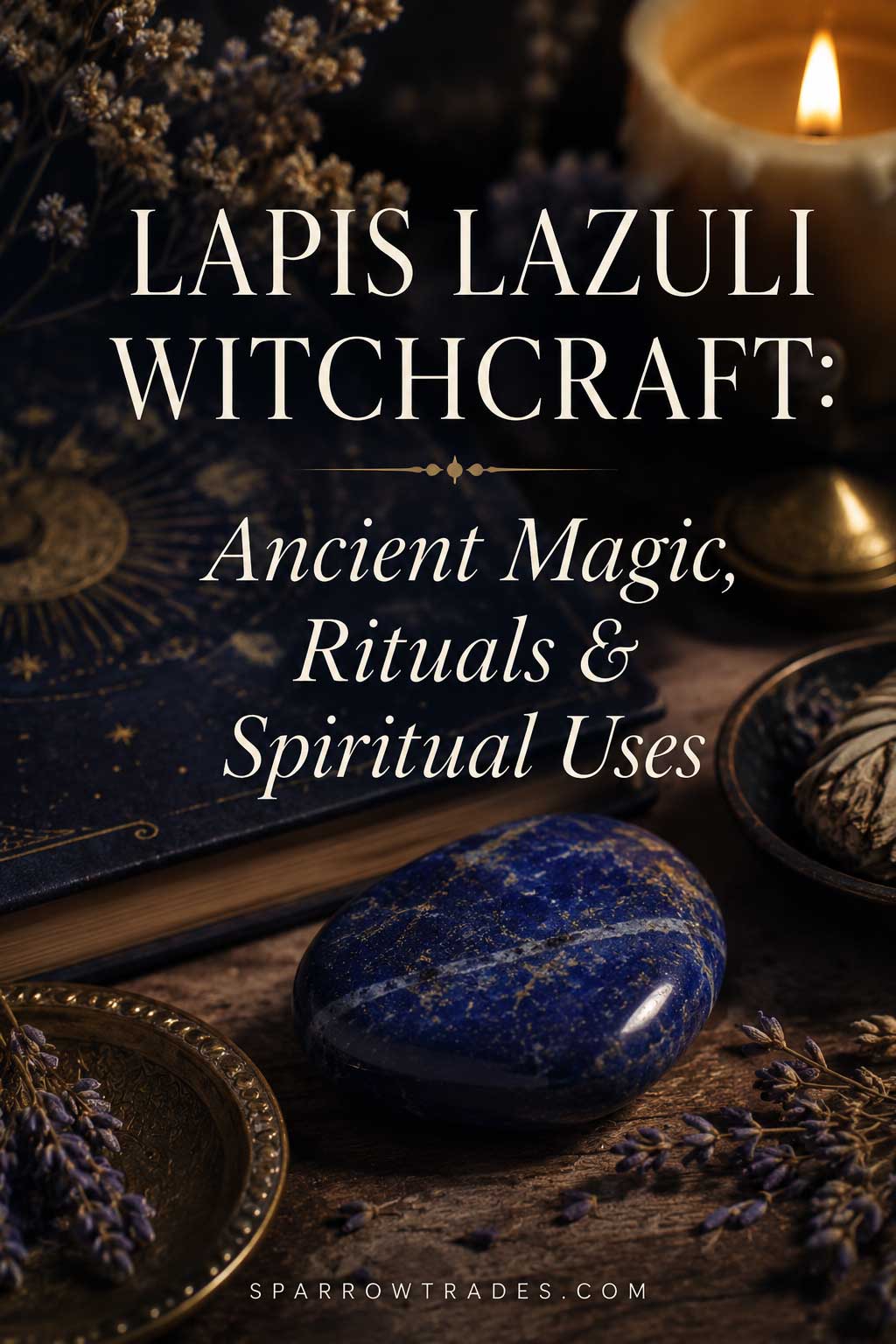
Lapis lazuli is often chosen as a centerpiece because of its strong associations with wisdom, truth, and spiritual awareness.
Many people combine lapis with candles, journals, meaningful photographs, symbolic objects, or other crystals that support intuitive work. The arrangement itself matters less than the intention behind it. A thoughtfully assembled altar can become a visual reminder of values, goals, and spiritual commitments.
Because lapis resonates strongly with communication and insight, some practitioners dedicate a portion of their altar specifically to journaling, dream work, or meditation.
Others pair lapis with stones that complement its symbolism. Broader practices around crystals for meditation or a chakra crystals guide can offer ideas for creating a more personal and emotionally grounded practice.
Ultimately, the purpose of an altar is not perfection. It is presence.
A simple arrangement that invites reflection often serves its purpose more effectively than a visually impressive setup that never gets used.
How to Cleanse and Care for Lapis Lazuli
Lapis lazuli is both energetically and physically unique. Unlike some crystals, it requires a bit more care.
Because lapis contains multiple minerals, including calcite and pyrite, prolonged exposure to water can potentially damage its appearance over time. Saltwater cleansing is generally discouraged.
Instead, many practitioners prefer gentler approaches.
Popular cleansing methods include:
- Moonlight exposure
- Smoke cleansing with herbs
- Sound cleansing using singing bowls or chimes
- Resting the stone on selenite
- Quiet meditation and intentional reflection
Some people view crystal cleansing as an energetic practice, while others see it primarily as a symbolic ritual. Both approaches can be meaningful. The value often comes from the pause itself—the act of reconnecting with intention.
For those interested in crystal care, crystal healing practices can help create routines that feel grounded and sustainable.
It is also worth remembering that spiritual tools should support well-being rather than create pressure. If cleansing rituals begin to feel like obligations, it may be helpful to simplify. Spiritual practices tend to work best when they create connection rather than perfectionism.
Frequently Asked Questions About Lapis Lazuli Witchcraft
Is lapis lazuli good for witchcraft?
Many practitioners consider lapis lazuli one of the most meaningful stones for witchcraft because of its associations with intuition, wisdom, communication, and spiritual awareness. It is frequently used during meditation, divination, dream work, and altar practices.
What chakra is associated with lapis lazuli?
Lapis is most commonly associated with both the third eye and throat chakras. These connections reflect its symbolism of insight, perception, communication, and authentic self-expression. Many people exploring chakras and energy find lapis particularly useful when working with these themes.
Can I sleep with lapis lazuli under my pillow?
Some people choose to place lapis beneath their pillow or beside their bed as part of dream work practices. Because individual experiences vary, it may be helpful to experiment gradually and notice how your nervous system responds.
How do I charge lapis lazuli?
Moonlight is one of the most popular methods for charging lapis. Many practitioners place the stone under a full moon while setting intentions related to clarity, intuition, or spiritual growth.
What crystals pair well with lapis lazuli?
Lapis is often paired with amethyst, clear quartz, selenite, and other stones associated with intuition and spiritual reflection. Pairings typically depend on personal intention rather than rigid rules.
Can beginners use lapis lazuli?
Absolutely. Despite its rich spiritual history, lapis does not require advanced experience. Beginners often find its symbolism approachable because it centers on self-awareness, reflection, and honesty rather than complex rituals.
Final Thoughts
Lapis lazuli has remained meaningful across thousands of years because it speaks to something deeply human: the desire to understand ourselves more clearly.
Its symbolism is not rooted in control, certainty, or instant answers. Instead, it invites curiosity, honesty, and reflection. Whether used during meditation, dream work, ritual practice, or quiet journaling, lapis encourages a relationship with inner wisdom that unfolds gradually over time.
For some people, that journey begins through spirituality for emotional wellness. For others, it begins through personal healing, self-awareness, or a desire to reconnect with intuition. Whatever path brings someone to lapis, the stone offers a gentle reminder that insight rarely arrives through force.
It arrives when we slow down enough to listen.
In modern witchcraft, lapis lazuli remains a symbol of truth, wisdom, and spiritual awareness. Not because it provides all the answers, but because it encourages us to ask better questions.
And sometimes, that is where the most meaningful magic begins.

Where softness, self-awareness, and emotional healing are allowed to coexist. Through reflective writing, grounding rituals, and intentional beauty, Sparrow Trades offers gentle support for sensitive souls learning to reconnect with themselves.