Some stones tell the story of slow transformation. Obsidian tells the story of sudden change.
Obsidian is one of nature’s most striking creations. With its deep black surface, glass-like shine, and razor-sharp edges, it has fascinated people for thousands of years. Unlike most gemstones, obsidian isn’t a crystal that forms slowly beneath the Earth’s surface. Instead, it is a natural volcanic glass born from intense heat and rapid cooling. That unique origin gives obsidian both its unmistakable appearance and its important place in geology, archaeology, and human history.
Many people first encounter obsidian because of its dramatic beauty. Others are drawn to the stories surrounding it, from ancient civilizations that crafted tools and ceremonial objects to modern discussions about symbolism and personal reflection. Today, obsidian is appreciated for many different reasons. Some admire it as a remarkable natural material, while others value the meaning it has come to represent in cultural and spiritual traditions.
Understanding obsidian begins with separating scientific fact from symbolic interpretation. Geologically, obsidian is created when silica-rich lava cools so quickly that crystals don’t have time to develop. Instead of forming a crystalline structure like quartz or amethyst, the molten rock hardens into smooth volcanic glass. This process produces a material that is both beautiful and surprisingly practical, explaining why ancient cultures used obsidian to make cutting tools, blades, mirrors, and decorative objects long before modern metals became widespread.
For many people, learning about gemstones becomes part of a broader curiosity about nature and the stories we attach to it. If you’ve been exploring different gemstones, or are beginning to explore gemstones for emotional wellness, obsidian offers an especially fascinating example because it challenges many assumptions about what a gemstone actually is. It reminds us that beauty can emerge through many different geological processes.
Obsidian also occupies an important place in conversations about symbolism. Throughout history, many cultures associated its reflective surface with insight, protection, honesty, or transformation. These meanings developed over centuries through tradition rather than scientific evidence, but they continue to resonate with people who appreciate gemstones as personal symbols or meaningful reminders.
Whether your interest comes from geology, history, jewelry, or personal symbolism, obsidian invites curiosity. Rather than offering simple answers, it encourages exploration—of the Earth, of ancient civilizations, and sometimes even of ourselves. If your interest in gemstones is part of a broader journey toward emotional wellness, understanding their natural origins can become just as meaningful as learning about the traditions that surround them.
What Is Obsidian?
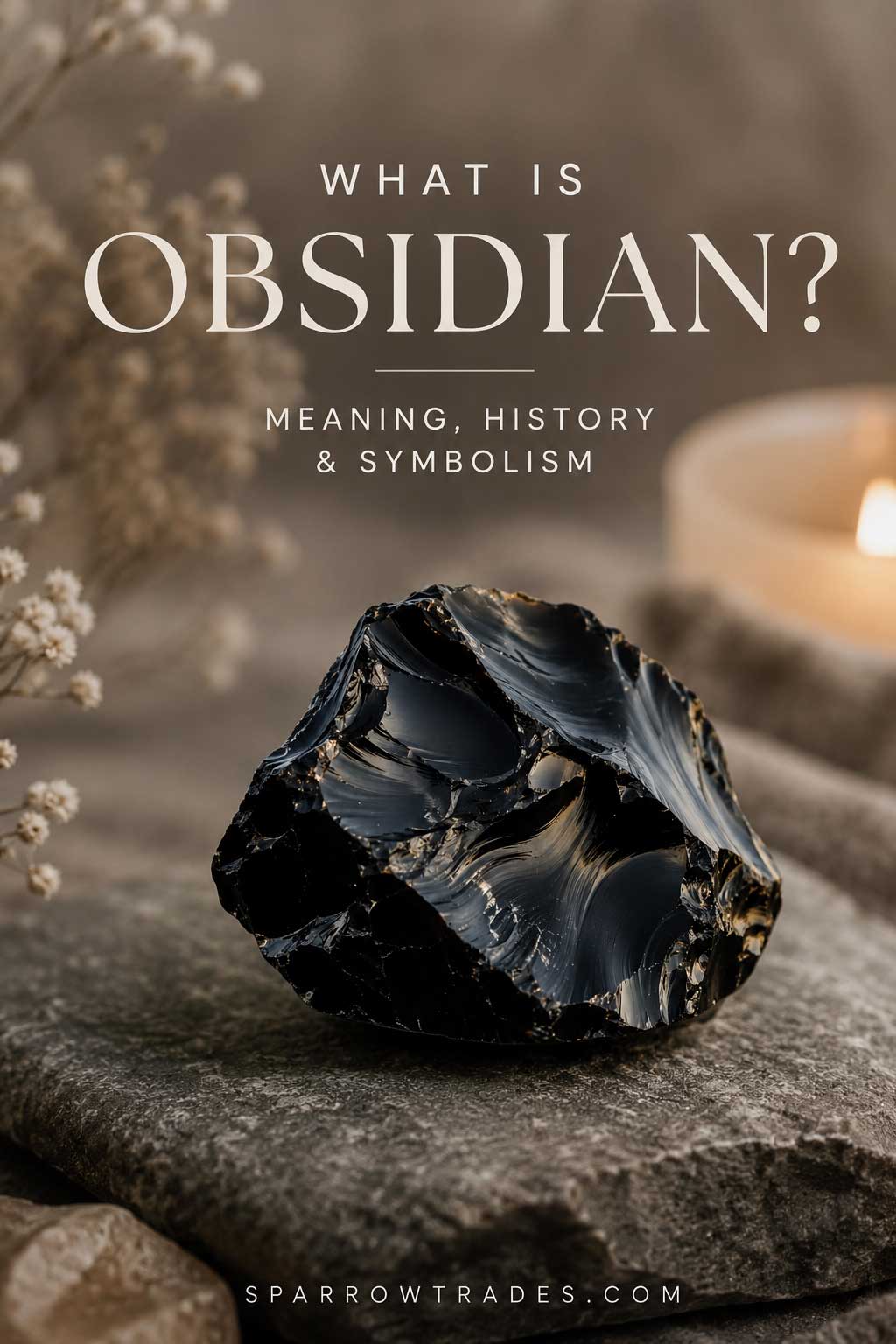
Obsidian is a naturally occurring volcanic glass formed when lava cools so rapidly that mineral crystals never have the opportunity to grow. Because of this unusually fast cooling process, obsidian develops a smooth, glass-like texture instead of the crystalline structure found in most gemstones.
Although it’s commonly grouped with gemstones because of its beauty and use in jewelry, obsidian is technically not a mineral. Minerals require an orderly internal crystal structure, while obsidian remains amorphous—its atoms are arranged randomly, much like manufactured glass. This distinction makes obsidian one of the most unique materials found in nature.
Most obsidian is black, but natural variations occur depending on trace minerals and tiny inclusions trapped during formation. You may also encounter:
- Snowflake obsidian, containing white crystal patterns
- Mahogany obsidian, with reddish-brown coloring
- Rainbow obsidian, displaying subtle iridescent bands
- Golden sheen obsidian
- Silver sheen obsidian
Despite these variations, all forms of obsidian share the same volcanic origin. Many people later become curious about how stones like obsidian fit into traditions surrounding crystal healing, even though those practices differ from geological science.
The word “obsidian” is believed to come from the Roman explorer Obsius, who reportedly discovered a similar volcanic glass in Ethiopia. Since then, the material has been found throughout volcanic regions across the world, including Mexico, Iceland, Japan, Italy, Armenia, New Zealand, and parts of the western United States.
Its distinctive appearance and natural sharpness have made obsidian both scientifically fascinating and culturally significant for thousands of years.
How Does Obsidian Form?
The story of obsidian begins deep beneath the Earth’s surface.
When volcanoes erupt, molten rock known as lava reaches the surface. Most lava cools gradually, allowing minerals to organize into crystals that eventually become igneous rocks like granite or basalt. Obsidian forms under very different conditions.
Its parent lava contains an unusually high concentration of silica. As this silica-rich lava erupts, it sometimes cools almost instantly after reaching the surface. Because the cooling happens so quickly, atoms cannot organize into repeating crystal structures. Instead, the lava solidifies into natural volcanic glass.
This rapid cooling explains many of obsidian’s defining characteristics:
- Smooth, glossy appearance
- Glass-like texture
- Extremely sharp fractured edges
- Lack of visible crystals
- Brittle but beautiful structure
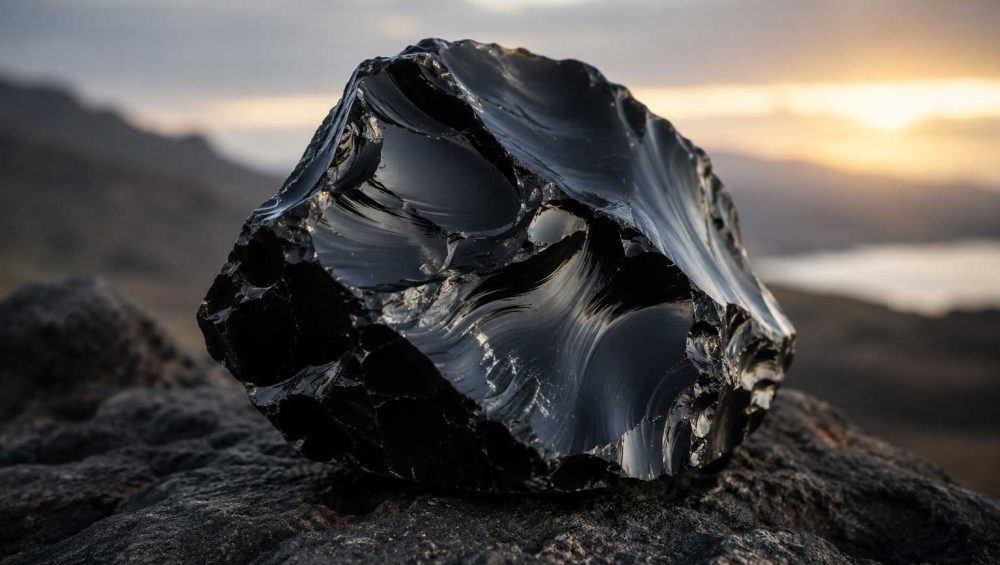
One particularly interesting feature is its conchoidal fracture. Rather than breaking into rough pieces like many rocks, obsidian fractures in curved, shell-like patterns. These fractures can create edges so sharp that they are still used today in certain specialized surgical instruments.
From a geological perspective, obsidian captures a moment in time. It preserves molten lava almost exactly as it cooled, providing scientists with valuable insight into volcanic activity and Earth’s dynamic processes.
Its origin is a reminder that some of nature’s most beautiful materials form not through slow perfection, but through moments of extraordinary change.
Is Obsidian a Gemstone or a Crystal?
This is one of the most common questions people ask about obsidian.
The answer depends on how the words “gemstone” and “crystal” are being used.
Scientifically, obsidian is not a crystal because it lacks the repeating internal atomic structure required for crystallization. Unlike quartz, amethyst, or citrine, obsidian’s atoms cooled too quickly to arrange themselves into organized patterns.
However, obsidian is widely recognized as a gemstone. The term “gemstone” refers more broadly to beautiful natural materials that can be cut, polished, and used in jewelry or decorative objects. Under that definition, obsidian easily qualifies.
This distinction often surprises people exploring gemstone meanings, since many gemstones are also crystals—but not all are.
Understanding this difference helps explain why obsidian occupies such a unique place in geology and jewelry alike. It bridges two worlds: scientific classification and human appreciation.
Whether admired as volcanic glass, collected as a geological specimen, or worn as obsidian jewelry, obsidian remains one of nature’s most recognizable and intriguing materials.
The History of Obsidian
Long before metal tools became common, obsidian shaped human civilization.
Because freshly fractured obsidian produces exceptionally sharp edges, ancient cultures quickly recognized its usefulness. Archaeologists have discovered obsidian blades, arrowheads, spear points, knives, and carving tools dating back thousands of years.
The Maya and Aztec civilizations prized obsidian for both practical and ceremonial purposes. Skilled craftsmen fashioned mirrors, sculptures, jewelry, ritual objects, and intricate blades from the volcanic glass. Today, that same timeless beauty continues to inspire artisans creating obsidian jewelry, allowing people to appreciate the stone’s natural character in everyday life.
In many regions, obsidian became an important trade commodity, traveling hundreds of miles from volcanic sources to distant communities.
Beyond the Americas, obsidian artifacts have been uncovered throughout the Middle East, Europe, Japan, and parts of Africa. These discoveries help researchers trace ancient trade routes and understand how early civilizations interacted with one another.
Its reflective surface also inspired symbolic meanings. In several cultures, polished obsidian mirrors were associated with self-reflection, prophecy, or spiritual ceremonies. While these beliefs belong to cultural and historical traditions rather than scientific evidence, they demonstrate how deeply obsidian has influenced human imagination.
Thousands of years later, obsidian continues to connect people with both Earth’s volcanic forces and humanity’s enduring appreciation for natural beauty.
Where Is Obsidian Found?
Although ancient civilizations treasured obsidian, the story begins much earlier—with the volcanic landscapes where it naturally forms.
Obsidian is found in regions where volcanic activity has occurred relatively recently in Earth’s history. Because it forms from silica-rich lava that cools rapidly, it develops only under specific geological conditions.
Some of the world’s best-known obsidian deposits are located in:
- Mexico
- Iceland
- Italy
- Japan
- Armenia
- New Zealand
- Chile
- Guatemala
- Ethiopia
- The western United States, particularly Oregon, California, Idaho, Nevada, Arizona, and New Mexico
The color and appearance of obsidian often vary slightly depending on the minerals present when it formed. Tiny inclusions of gas bubbles or mineral crystals can produce shimmering gold or silver sheen, while microscopic cristobalite crystals create the familiar “snowflake” patterns found in snowflake obsidian.
Because each volcanic region has its own geological fingerprint, archaeologists frequently analyze obsidian artifacts to determine exactly where they originated. This technique has helped researchers reconstruct ancient trade networks spanning hundreds of miles, revealing just how valuable this volcanic glass was to early civilizations.
Today, many of these same locations continue to produce obsidian for collectors, lapidary artists, museums, and jewelry makers who appreciate its natural beauty.
What Does Obsidian Symbolize?
While science explains how obsidian forms, symbolism explores the meaning people have given it over time.
Across many cultures, obsidian has become associated with themes of truth, protection, transformation, and honest self-reflection. Its dark, mirror-like surface has often inspired comparisons to looking inward rather than outward. Ancient polished obsidian mirrors were sometimes used in ceremonial practices, giving rise to traditions that connected the stone with clarity and insight.
Modern spiritual communities frequently describe obsidian as representing:
- Personal honesty
- Emotional grounding
- Letting go of what no longer serves you
- Inner strength during periods of change
- Reflection and self-awareness
These symbolic associations are rooted in cultural and spiritual traditions rather than scientific evidence. Many people enjoy gemstones as meaningful personal reminders, while others simply appreciate them for their geological beauty. Both perspectives can exist comfortably alongside one another.
If you’re interested in the symbolic relationship between gemstones and personal growth, you may find yourself naturally exploring gemstones for emotional wellness. Rather than promising specific outcomes, these traditions often encourage reflection, mindfulness, and intentional living.
For many people, obsidian’s greatest symbolism comes from its origin itself. Born from volcanic fire and rapid transformation, it serves as a powerful reminder that beauty can emerge from moments of profound change.
Is There Scientific Evidence Behind Obsidian’s Metaphysical Properties?
This question is becoming increasingly common as more people explore both science and spirituality with curiosity.
Currently, there is no scientific evidence demonstrating that obsidian possesses measurable healing energies or metaphysical abilities. Claims that obsidian can absorb negative energy, provide spiritual protection, or influence emotional states have not been verified through scientific research.
That does not necessarily explain why many people still find personal meaning in the stone.
Objects often become powerful symbols. A meaningful piece of jewelry, a treasured photograph, or a family heirloom can remind us of values, memories, or intentions. In much the same way, some individuals choose obsidian as a visual reminder of resilience, honesty, or emotional grounding.
Many people who practice crystal healing view gemstones as intentional companions for reflection rather than sources of supernatural power. Others simply enjoy collecting beautiful geological specimens without attaching any symbolic meaning at all.
Both approaches are valid expressions of personal interest.
Keeping a clear distinction between scientific understanding and cultural tradition allows readers to appreciate obsidian from multiple perspectives while making informed decisions about their own beliefs.
Obsidian in Jewelry
Whether viewed primarily through science, symbolism, or craftsmanship, obsidian continues to find a meaningful place in people’s lives today.
Obsidian’s naturally glossy surface makes it especially attractive for jewelry. Once polished, it develops a smooth, mirror-like finish that pairs beautifully with sterling silver, gold, stainless steel, and minimalist contemporary designs.
Because obsidian is softer than many traditional gemstones, it should be worn with a bit of care. It can scratch or chip if struck against harder materials, making thoughtful storage and gentle handling important for preserving its finish.
Today, you’ll commonly find obsidian crafted into:
- Necklaces
- Bracelets
- Pendants
- Earrings
- Rings
- Carved talismans
- Worry stones
Many people choose obsidian jewelry simply because they love its dramatic appearance. Others appreciate the symbolic traditions associated with the stone or enjoy wearing natural materials that reflect the Earth’s remarkable geological processes.
Whether chosen for beauty, history, or personal significance, obsidian offers a timeless aesthetic that has remained popular for thousands of years.
If You’re Drawn to Obsidian
Sometimes a particular stone simply captures your attention.
That doesn’t necessarily mean it possesses hidden powers or that you’re meant to interpret the experience in a specific way. Often, people are drawn to colors, textures, stories, or symbols that resonate with where they are in life.
If obsidian’s volcanic origins and themes of reflection speak to you, you might also find yourself exploring ideas connected with grounding. Grounding practices generally focus on helping people reconnect with the present moment through awareness, movement, nature, breathing, or intentional routines.
Likewise, readers interested in broader conversations about emotional resilience often continue into grounding for emotional wellness, where the emphasis remains on practical habits that support everyday well-being rather than extraordinary claims.
For those who simply appreciate natural beauty, obsidian stands as a remarkable reminder of Earth’s creative forces. Every piece began as molten lava before cooling into the smooth volcanic glass we recognize today—a transformation that continues to inspire curiosity across science, history, and art.
Explore Obsidian Jewelry
If you’re interested in wearing obsidian rather than simply learning about it, thoughtfully crafted jewelry allows you to appreciate this remarkable volcanic glass every day.
Whether you’re drawn to its sleek appearance, its fascinating geological story, or the symbolism that many cultures have associated with it over time, obsidian jewelry offers a beautiful way to carry a small piece of Earth’s volcanic history with you.
Many people also enjoy exploring gemstone jewelry, where different stones reflect a wide variety of colors, origins, and symbolic traditions. Rather than searching for the “right” gemstone, it can be meaningful to simply notice which natural materials resonate most with your curiosity and personal style.
Each gemstone tells its own story. Obsidian’s story begins with fire, transformation, and the extraordinary forces that continue shaping our planet today.
Frequently Asked Questions
What is obsidian made of?
Obsidian is made from silica-rich lava that cools extremely quickly after a volcanic eruption. Because the lava solidifies so rapidly, minerals don’t have time to form crystals. Instead, the material hardens into natural volcanic glass with a smooth, glossy appearance.
Unlike manufactured glass, obsidian is entirely natural. Its composition varies slightly depending on the volcanic environment in which it formed, which is why different varieties—such as snowflake, mahogany, and rainbow obsidian—exist.
Is obsidian a crystal?
Scientifically, no.
Although obsidian is commonly displayed alongside crystals and sold in crystal collections, it does not meet the geological definition of a crystal because it lacks an organized internal crystal structure.
However, obsidian is widely accepted as a gemstone because it is a naturally occurring material that is cut, polished, and used in jewelry and decorative objects.
Is obsidian a gemstone?
Yes.
Obsidian is considered a gemstone because of its natural beauty, durability for jewelry, and long history of decorative use. It has been fashioned into beads, pendants, carvings, and ornamental objects for thousands of years.
Its classification as a gemstone reflects how people use and value it rather than its internal mineral structure.
What color is obsidian?
Most obsidian is deep black, but several naturally occurring varieties display different colors or visual effects.
These include:
- Snowflake obsidian with white mineral patterns
- Mahogany obsidian with reddish-brown coloring
- Rainbow obsidian with subtle iridescent bands
- Golden sheen obsidian
- Silver sheen obsidian
These differences result from tiny mineral inclusions or microscopic structures trapped as the lava cooled.
Where is obsidian found?
Obsidian forms in volcanic regions around the world.
Major deposits are found in:
- Mexico
- Iceland
- Italy
- Japan
- Armenia
- Ethiopia
- New Zealand
- Chile
- Guatemala
- The western United States
Because obsidian forms only under specific volcanic conditions, it is closely associated with areas that have experienced relatively recent volcanic activity.
What was obsidian used for in ancient times?
Ancient civilizations valued obsidian because it fractures into incredibly sharp edges.
People used it to create:
- Arrowheads
- Spear points
- Knives
- Cutting tools
- Ceremonial blades
- Mirrors
- Jewelry
- Sculptures
The Maya, Aztec, and many earlier cultures traded obsidian across vast distances, making it one of the most important natural materials of the ancient world.
Does obsidian have healing properties?
There is no scientific evidence demonstrating that obsidian has measurable healing or metaphysical properties.
Many cultural and spiritual traditions associate obsidian with protection, grounding, honesty, or self-reflection. These symbolic meanings can hold personal significance for individuals, but they should not be considered medical or scientific claims.
If you’re interested in how gemstones are incorporated into personal reflection or intentional practices, you might also enjoy exploring crystal healing, which discusses these traditions while clearly distinguishing symbolism from scientific evidence.
Can obsidian be used in jewelry?
Absolutely.
Its smooth polish and dramatic appearance make it a popular choice for necklaces, bracelets, earrings, rings, and pendants.
Although obsidian is durable enough for everyday wear, it is softer and more brittle than many crystalline gemstones. Avoid dropping it or storing it alongside harder stones that could scratch or chip its surface.
Those interested in wearing volcanic glass can browse thoughtfully designed obsidian jewelry in a variety of styles.
Conclusion
Obsidian is a remarkable reminder that some of nature’s most beautiful creations emerge through moments of extraordinary transformation. Formed from rapidly cooling volcanic lava, it occupies a unique place between geology, archaeology, craftsmanship, and cultural history.
Its scientific story is fascinating on its own. Unlike crystalline minerals, obsidian captures an instant in Earth’s geological processes, preserving molten lava before crystals ever have a chance to form. That singular origin has made it valuable not only to geologists but also to archaeologists seeking to better understand ancient trade routes, civilizations, and technological innovation.
Alongside its geological significance, obsidian has accumulated layers of symbolism through centuries of human experience. Across cultures, it has represented reflection, honesty, resilience, and transformation. While these meanings belong to cultural traditions rather than scientific evidence, they continue to inspire people who appreciate gemstones as meaningful reminders of personal values and life experiences.
Whether you’re fascinated by volcanoes, intrigued by ancient history, drawn to symbolic traditions, or simply captivated by its elegant appearance, obsidian offers many ways to deepen your appreciation of the natural world.
If your curiosity continues, exploring gemstones for emotional wellness can provide additional context for how different stones have been understood across history and culture. And if you’d like to carry a piece of this distinctive volcanic glass with you, thoughtfully crafted obsidian jewelry offers a timeless way to celebrate one of Earth’s most unique natural materials.
Every piece of obsidian carries the memory of fire transformed into stillness—a quiet reminder that some of nature’s most extraordinary creations emerge through moments of profound change.

Where softness, self-awareness, and emotional healing are allowed to coexist. Through reflective writing, grounding rituals, and intentional beauty, Sparrow Trades offers gentle support for sensitive souls learning to reconnect with themselves.