If you’ve ever found yourself craving quiet—not silence, exactly, but the kind of calm where your thoughts soften and your body stops bracing—you may already understand the pull of blue lace agate. Many people don’t “choose” it in a shopping-cart way. They find it during seasons when communication feels strained, when anxiety sits in the throat and chest, or when the nervous system has spent too long on alert. The stone doesn’t arrive with intensity or urgency. It arrives softly, almost unnoticed, and that’s part of why it can feel so deeply supportive.
Blue lace agate is often described as a calming stone, but that phrase barely captures the lived experience of working with it. Its energy doesn’t push, cleanse, or demand. It doesn’t feel like a spotlight. It feels like a hand on the shoulder that doesn’t require anything from you. For people who have learned to stay quiet to stay safe—or who feel flooded when emotions rise too quickly—that kind of non-demanding presence matters. It can be the difference between “I should say something” and “I can stay with myself long enough to say it gently.”
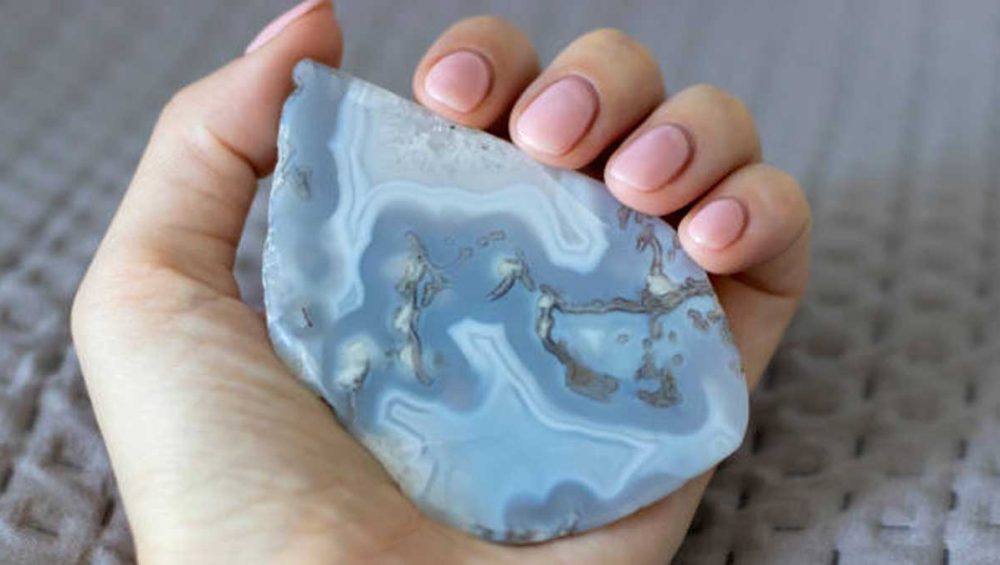
At a physical level, blue lace agate is a banded variety of chalcedony, recognizable by its pale blue to blue-gray color and lace-like white striping. But its significance goes far beyond mineral classification. Within the wider world of gemstone meanings blue lace agate holds a distinct place as a stone associated with gentleness, reassurance, and emotional steadiness. It’s often drawn to people who don’t need more stimulation—they need relief.
Trauma-informed support is rarely about “going faster.” It’s about building enough inner safety that emotions can move without overwhelming the body. That’s why blue lace agate is frequently included in trauma-informed crystal care as a stone that can support regulation without forcing release. It doesn’t ask you to process everything at once. It simply stays present, like a steady baseline when your internal world feels loud.
People often encounter blue lace agate during times when speaking feels difficult—when words catch in the throat, or when expressing needs has historically led to conflict or dismissal. Over time, this can condition the nervous system to associate expression with danger. The soft, steady quality of this stone can feel like a counterweight to that conditioning, offering a different embodied experience of communication—one that feels slower, safer, and less reactive.
This article explores what blue lace agate is, how its energy is commonly experienced, and why it’s often associated with calm communication and emotional soothing. Rather than presenting it as a cure or a quick fix, we’ll approach it as a companion—something that can support inner steadiness without overwhelming the system. If you’re curious about stones that meet you where you are instead of pushing you where you’re not ready to go, blue lace agate is worth understanding.
What Blue Lace Agate Is and How It’s Formed
Blue lace agate is a variety of banded chalcedony, which is a form of microcrystalline quartz. What sets it apart visually is its soft blue coloring paired with delicate, lace-like white bands that often resemble gentle waves or clouds. These patterns form naturally over time as silica deposits layer within volcanic rock cavities, creating the stone’s characteristic striping. That slow layering is part of why the stone can feel “steady” to so many people—it looks like patience in mineral form.
Geologically speaking, blue lace agate is not the most common agate variety, which contributes to its sense of quiet preciousness. It is most famously sourced from Namibia, though smaller deposits have been found elsewhere. Its color is typically pale rather than saturated, and that subtlety is part of what makes it visually soothing. There’s nothing sharp or jarring about it—no harsh contrast, no loud hue. Even the banding often feels like it’s moving at a gentle pace.
In everyday language, people sometimes use “agate” as a catch-all term for banded stones. But blue lace agate tends to stand out because it feels tender rather than intense. Many stones are chosen because they make you feel stronger or more protected. Blue lace agate is often chosen because it helps you feel less clenched. That distinction becomes especially clear when you place it in the context of a broader crystals by intention approach, where the goal is less about collecting and more about matching the stone’s tone to what your body actually needs.
Because it’s chalcedony, blue lace agate is often described as having a smooth, nurturing energy. People frequently report that simply holding it brings a sense of easing, particularly in areas associated with held breath—jaw, throat, upper chest. It doesn’t create fireworks. It creates space. And for someone who has lived through a lot of emotional tension, space can feel like a miracle.
If you’re drawn to understanding the stone’s energetic identity more deeply, you may also feel a natural pull toward blue lace agate crystal meaning as a next layer of exploration. But even at the “what is it?” level, one truth stands out: this is a stone people often reach for when they want softness, not stimulation.
The Emotional and Energetic Meaning of Blue Lace Agate
The meaning of blue lace agate is closely tied to the experience of calm communication. Not the kind of communication that requires charisma or perfect wording, but the kind that feels honest without being overwhelming. For people who struggle to express emotions without becoming flooded—or who default to silence as a form of self-protection—this distinction matters. It’s the difference between “I’m fine” and “I’m scared, and I want to say it without being punished for it.”
Emotionally, blue lace agate is often associated with reassurance. It doesn’t carry the charge of “fixing” or “transforming.” Instead, it can feel like a steady companion while emotions settle. Many people describe it as supportive when anxiety shows up physically—tightness in the chest, shallow breathing, a throat that feels constricted, or a mind that goes blank the moment conflict appears. In those moments, the body doesn’t need more insight. It needs safety.
This is where blue lace agate pairs beautifully with practices rooted in the body, especially nervous system regulation techniques that help bring you out of fight-or-flight and back into a steadier baseline. When your nervous system is running hot, even supportive conversations can feel like threats. Blue lace agate is often experienced as a softener—a reminder to slow down enough that your voice can come through without force.
For some people, this stone resonates during a season of rebuilding trust with their own inner signals. If you’ve learned to second-guess your emotions, or you’ve been taught that your feelings are “too much,” communicating can become an internal battlefield. In that kind of landscape, it can be grounding to return to learning to trust your emotions again as a lived practice—one small honest moment at a time. Blue lace agate can support that honesty without amplifying emotional intensity.
It’s also a stone many people choose when they’re practicing boundaries in a way that doesn’t spike their nervous system. Boundaries aren’t just sentences; they’re sensations. For someone who has a history of people-pleasing, the act of stating a need can trigger fear, guilt, or collapse. When that happens, it helps to have language and frameworks that honor the body, like how to set emotional boundaries without feeling guilty—and it can also help to have a gentle physical anchor in your hand, pocket, or on your body while you practice.
Blue Lace Agate, the Throat, and the Nervous System
Blue lace agate is commonly linked with the throat center—communication, truth, self-expression—but it’s helpful to name what that really looks like in lived experience. Sometimes “throat chakra” language can feel abstract, especially if you’ve grown up in environments where emotions were dismissed or punished. In real life, throat restriction can show up as a tight neck, a clenched jaw, chronic swallowing, a shaky voice, or the feeling that your mind goes blank when you need words most. It can also show up as over-explaining—talking fast, talking too much, trying to talk your way into safety.
In a nervous-system-aware lens, many communication struggles aren’t a personality flaw. They’re a protection strategy. If speaking up once led to conflict, ridicule, or withdrawal of love, your system may have learned that silence is safer. That learning can linger even after the danger is gone. This is why blue lace agate can feel so relevant: it doesn’t try to rip the protection away. It offers a calmer internal environment so the body can experiment with expression again.
Within the framework of chakras and energy the throat center is less about “talking more” and more about alignment between inner experience and outward expression. When that alignment is disrupted, communication can feel unsafe or exhausting. Blue lace agate is often chosen in moments when rebuilding that alignment needs to happen slowly, with kindness toward the parts of you that learned to stay small.
This stone also pairs well with breath, because breath is one of the fastest ways we communicate safety to the body. Many people find that gentle practices—especially conscious breathing nervous system regulation—help soften the throat and chest enough for words to arrive. If you tend to hold your breath while talking, or you feel your chest lock up in difficult conversations, even a small return to breath can be a profound shift.
When you want something even simpler, a longer exhale can be surprisingly supportive. The exhale is often where the body finally lets go of bracing. If that resonates, a practice like extended exhale breathing can pair gently with blue lace agate—especially before a call, a hard conversation, or a moment where you need to speak from your truth without escalating your own system.
How People Use Blue Lace Agate in Daily Life
Because blue lace agate’s energy is subtle, it’s often incorporated into everyday life rather than reserved for formal ritual. Many people keep it nearby during activities that require calm presence—work calls, journaling, meditation, parenting, or moments of emotional processing. Its presence can act like a soft cue to slow down. Not “slow down so you can be productive,” but slow down so you can stay connected to yourself.
Some people hold blue lace agate during conversations that feel tender. Others keep it in a pocket as a quiet reminder to breathe and speak slowly. If you notice that you tend to abandon your own experience in order to keep the peace, that little reminder can be grounding. It can also help to pair the stone with a broader set of practices that support safety, like grounding rituals for emotional safety—especially if your body moves quickly into fight, flight, or freeze.
Many people choose to wear blue lace agate as jewelry, particularly during seasons when communication feels fragile or when they’re practicing gentler self-expression. Wearing it close to the throat or chest can feel supportive, especially when navigating emotionally charged environments. This is why it often appears in collections of calming jewelry—pieces meant to support emotional ease rather than amplify intensity.
Others prefer to work with the stone in stillness—holding it during breathwork, placing it on a bedside table, or keeping it nearby while resting. For those who want a simple, approachable ritual, pairing it with the structure of breathwork 101 can help you find a starting point that doesn’t feel overwhelming. The goal isn’t to “do it perfectly.” The goal is to create a moment where your system feels safe enough to soften.
As interest deepens, some people explore more specific ways this stone shows up in practice, such as blue lace agate uses as a focused topic. But for many, the first and most meaningful use is simple: keeping something gentle close when life feels loud.
Caring for Blue Lace Agate Without Turning It Into a Chore
When you’re drawn to a stone like blue lace agate, it often means you’re already carrying a lot. So crystal care should never become another task that makes you feel behind. In a nervous-system-aware approach, care is less about rigid rules and more about attunement—learning what feels supportive, what feels draining, and what helps you stay connected to the stone without pressure.
Many people like to cleanse their stones occasionally, especially if they’ve been using them during stressful periods. If you’re not comfortable with water or you prefer gentler methods, crystal cleansing without water can offer options that feel simple and respectful. The point isn’t to “purify” yourself. It’s to reset the relationship, the same way you might tidy a space when you want your mind to feel clearer.
It can also help to normalize the idea that stones can be set down for a while. If you’ve been using blue lace agate through a heavy season, you might feel a moment where you simply don’t want to hold it anymore. That doesn’t mean the stone “stopped working.” It might mean your system needs a different kind of support—or simply needs rest. If that resonates, signs your crystal needs rest can be a validating lens, especially for people who feel guilty taking breaks from anything that once helped.
For some, rest becomes a small ritual of respect—placing the stone somewhere soft, giving it space, and letting the relationship breathe. This is the heart of resting crystals intentionally as a practice: a reminder that support doesn’t have to be constant to be real. Sometimes the most trauma-informed thing you can do is stop trying to optimize every tool and simply let things be gentle.
If you prefer structure, you might also appreciate a calmer rhythm around maintenance, like how often to cleanse crystals—not as a rulebook, but as permission to keep it simple. With blue lace agate, “simple” is often the most aligned choice.
When Blue Lace Agate Feels Especially Supportive
Blue lace agate tends to shine in moments where you’re trying to stay regulated while being real. That could be a difficult conversation, a season of anxiety, a return to dating after heartbreak, or the quiet work of learning to speak without over-explaining. Sometimes it supports you in obvious ways—slower breath, softer voice. Sometimes it’s subtler: you notice you’re less harsh with yourself after you say the thing you were afraid to say.
It can be especially supportive if you’re recovering from emotional invalidation—when your feelings were dismissed, minimized, or framed as “too much.” That kind of experience can train you to doubt your own inner reality. In those moments, the work isn’t just speaking; it’s believing yourself enough to speak. If that’s your landscape, healing after being emotionally invalidated can be a meaningful companion topic, because healing often requires rebuilding both voice and self-trust.
Blue lace agate is also a gentle match for reflective writing. When emotions feel hard to name, writing can help you find the thread without forcing it. If you like prompts that are stabilizing rather than intense, journaling prompts for emotional stability can pair beautifully with the stone—especially if you’re practicing communication with yourself before practicing it with anyone else.
And sometimes, the most supportive use is simply wearing it while you move through your day. That’s where many people become curious about the broader emotional impact—how it feels in the body over time, what shifts in your tone, what changes in your willingness to express. If that curiosity is alive, blue lace agate benefits can be a natural next step, because “benefits” in this context often means felt experience: steadier breath, gentler words, less internal bracing.
Frequently Asked Questions About Blue Lace Agate
Is blue lace agate good for anxiety?
Many people turn to blue lace agate during anxious seasons because its energy is often experienced as calming and non-stimulating. It’s not a replacement for therapy or medical care, but it can feel supportive when anxiety shows up as throat tightness, shallow breath, or emotional overwhelm. For some, holding it becomes a cue to slow down and come back to the body.
What chakra is blue lace agate associated with?
Blue lace agate is most commonly associated with the throat center, connected with communication, expression, and truth-telling. People often reach for it when they want to speak gently but clearly, especially if their voice feels tight, shaky, or prone to shutting down under stress.
Can blue lace agate help with communication?
Many people experience blue lace agate as supportive during difficult conversations because it can feel steadying rather than activating. Instead of pushing you to say more, it can help you stay calmer while you speak—especially when you’re practicing honesty without escalating your nervous system.
Is blue lace agate a birthstone?
Blue lace agate is not considered a traditional modern birthstone, but some people choose it as a symbolic gift for its calming and communication-centered qualities. In that way, it can function more like an “emotional birthstone”—chosen for what someone needs rather than what a calendar assigns.
How is blue lace agate different from other blue stones?
Blue lace agate is known for its softness—both in color and in the way people often experience its energy. Compared to more intense blue stones, it tends to feel gentle, reassuring, and less activating, which can be especially appealing for sensitive nervous systems.
Can blue lace agate be worn every day?
Yes, many people wear blue lace agate regularly, especially during emotionally demanding periods. Its gentle tone makes it well-suited for daily wear. If you’re curious about the symbolic side of wearing it, blue lace agate jewelry meaning can help you explore what daily contact can represent emotionally.
Conclusion: Why Blue Lace Agate Resonates So Deeply
Blue lace agate doesn’t demand attention. It doesn’t promise dramatic transformation or instant breakthroughs. Instead, it offers something quieter—and often more needed: steadiness. For people who have spent years adapting to emotional environments that felt unsafe, steadiness can feel like relief. Not because it erases pain, but because it gives your body a chance to stop bracing long enough to feel what’s true.
Understanding what blue lace agate is means understanding its pace. It doesn’t rush healing or force expression. It supports the moments in between—the pauses where the nervous system recalibrates and the body remembers that softness is allowed. In a world that often rewards urgency and intensity, this kind of support can feel like a return to something you didn’t realize you were missing: gentleness that doesn’t require you to earn it.
Whether you’re drawn to its pale blue banding, its calming presence, or its relationship to communication, blue lace agate tends to meet people where they are. Over time, many find themselves curious about its deeper layers—how it’s used, how it’s worn, how its meaning unfolds as life changes. The point isn’t to become someone new. The point is to create enough inner safety to be who you already are—softly, honestly, and without force.

Where softness, self-awareness, and emotional healing are allowed to coexist. Through reflective writing, grounding rituals, and intentional beauty, Sparrow Trades offers gentle support for sensitive souls learning to reconnect with themselves.