
There are moments when being emotionally sensitive stops feeling beautiful and starts feeling exhausting.
You walk into a room and immediately feel tension that nobody has spoken out loud. A conversation lingers in your nervous system for hours after it ends. Someone else’s sadness settles inside your chest like it belongs there. Even when life looks calm from the outside, your inner world can feel crowded with emotional noise that never fully quiets down.
For many emotionally sensitive people, meditation becomes appealing for one simple reason: they want relief.
Not enlightenment.
Not perfection.
Not a spiritual performance.
Just relief.
The problem is that traditional meditation advice often feels overwhelming for empaths. Sitting silently for long periods can sometimes intensify emotional flooding instead of calming it. Trying to “empty the mind” can create more anxiety. And certain spiritual spaces unintentionally encourage emotionally open people to stay energetically exposed rather than emotionally protected.
That is why meditation for empaths has to be approached differently.
Sensitive nervous systems do not need force. They need safety.
Many empaths spend years believing something is wrong with them before realizing their nervous system has simply been carrying too much emotional input for too long. There is often a deep exhaustion underneath the sensitivity itself. Beneath the emotional overwhelm, many people are quietly longing for rest, quiet, and the feeling of finally coming back home to themselves.
Sometimes meditation becomes the first place where that homecoming begins.
Not because it suddenly erases sensitivity, but because it slowly teaches the body that it does not have to absorb every emotion in the environment to remain connected or compassionate.
People who resonate with empath identity often struggle with the invisible pressure to stay emotionally available at all times. Over time, this constant openness can create deep fatigue that settles into the body, the breath, and the nervous system itself.
That exhaustion becomes easier to understand when viewed through the lens of emotional wellness foundations. Emotional safety is not just psychological. It is physiological. The body keeps score of emotional overstimulation, even when the mind tries to push through it.
Meditation can help create small moments of internal quiet where emotional sensitivity no longer feels like an emergency.
But gentle meditation matters.
Slow meditation matters.
Grounded meditation matters.
For empaths, meditation is often less about transcending reality and more about reconnecting to the self beneath the emotional static.
Sometimes that reconnection begins with something surprisingly simple.
A softer breath.
A slower exhale.
A moment where your emotions finally stop colliding with everyone else’s.
Why Traditional Meditation Advice Can Feel Overwhelming for Empaths
A lot of meditation advice unintentionally assumes the nervous system already feels safe.
For emotionally sensitive people, that is often not true.
Many empaths are already living in a state of subtle hypervigilance without realizing it. The body stays alert to emotional shifts, facial expressions, changes in tone, unspoken tension, and environmental energy. Even rest can feel difficult because the nervous system never fully stops scanning.
This is why meditation sometimes feels strangely uncomfortable at first.
The silence becomes loud.
The body suddenly notices emotions it had been suppressing.
Stillness creates space for exhaustion to surface.
Some people interpret this reaction as failure, but it is often the opposite. It may simply mean the nervous system is finally slowing down enough to reveal what it has been carrying.
People navigating empath nervous system overwhelm recovery frequently discover that emotional burnout is not always dramatic. Sometimes it looks like numbness, irritability, emotional fog, or the inability to fully relax even during quiet moments.
Meditation should never become another performance where sensitive people pressure themselves to “do healing correctly.”
That pressure often mirrors the same emotional overextension many empaths already experience in relationships.
Creating emotional safety matters more than creating perfect focus.
That is why many empaths feel more supported by grounding-based practices instead of rigid meditation structures. Approaches connected to grounding practices tend to help the body feel anchored before asking the mind to become still.
Even a few minutes of regulated breathing can begin calming emotional overload. Practices connected to conscious breathing nervous system regulation can help sensitive people transition out of emotional overstimulation without forcing emotional shutdown.
Meditation for empaths works best when it allows emotional experiences to move gently instead of demanding immediate silence.
Some days, meditation may feel peaceful.
Other days, it may reveal grief, exhaustion, or emotional depletion that has been hidden beneath constant caregiving and emotional attunement.
Both experiences are valid.
Healing is not always quiet.
Sometimes healing sounds like finally hearing yourself underneath everyone else.
Gentle Meditation Practices That Help Sensitive Nervous Systems Feel Safe
Empaths often need meditation practices that feel emotionally protective instead of emotionally exposing.
Gentleness matters.
So does pacing.
The nervous system cannot heal through force.
One of the most supportive shifts sensitive people can make is moving away from the belief that meditation has to look a certain way. Sitting perfectly still for an hour is not more spiritually meaningful than lying on the floor while focusing on slow breathing.
The body responds to safety, not performance.
This is where practices connected to nervous system regulation techniques become especially important. Emotional regulation is not about suppressing feelings. It is about helping the body recognize that it is no longer trapped in constant emotional threat.
Many empaths benefit from beginning meditation with physical grounding first.
Feeling both feet on the floor.
Holding a warm cup of tea.
Resting a hand over the chest.
Listening to slow ambient sounds.
These small sensory anchors help the body remain connected to the present moment instead of drifting into emotional overwhelm.
Practices tied to somatic self-soothing practices can create emotional stability before deeper meditation even begins. Sometimes the safest meditation is simply noticing the body without trying to change it.
Breath-focused meditation can also feel more accessible for highly sensitive people because it gives the nervous system something rhythmic and predictable to follow.
People drawn toward grounding with air and breath often discover that slow breathing creates a feeling of emotional spaciousness inside the body.
Longer exhales are especially calming.
The body naturally interprets extended exhalation as a signal that danger is passing.
That is one reason practices related to extended exhale breathing can feel deeply soothing during periods of emotional overload.
Meditation for empaths does not have to remove emotion.
It simply creates enough stillness for emotions to stop flooding the entire internal world.
Even five gentle minutes can change the emotional tone of an entire day.
Emotional Boundaries Matter During Meditation Too
Many empaths assume meditation means becoming more emotionally open.
But openness without boundaries can become emotional exhaustion.
Sensitive people often spend years absorbing emotions automatically because they learned that emotional awareness was tied to love, safety, or belonging. Over time, the nervous system begins treating emotional merging as normal.
Meditation can unintentionally intensify that pattern if emotional boundaries are ignored.
This is why emotionally safe meditation is not just about relaxation. It is also about discernment.
Learning where you end and someone else begins.
Learning that compassion does not require emotional self-erasure.
Learning that presence does not require emotional absorption.
Practices connected to how to stop absorbing other people's emotions often become transformative for empaths because they interrupt the belief that sensitivity means emotional ownership.
Meditation can become a place where emotionally sensitive people finally experience separation without guilt.
That separation is healthy.
It creates breathing room inside relationships.
It creates nervous system recovery.
It creates emotional clarity.
People exploring emotional boundaries often discover that boundaries are not emotional walls. They are emotional stabilizers.
Meditation becomes more restorative when the body no longer feels responsible for emotionally carrying everyone else.
This is also why many empaths benefit from visual grounding during meditation.
Some imagine roots extending into the earth.
Others picture warm protective light around the body.
Some focus entirely on physical sensations instead of spiritual imagery.
There is no universally correct approach.
The goal is not detachment.
The goal is emotional steadiness.
Practices connected to grounding boundaries for empaths can help meditation feel emotionally containing instead of emotionally exposing.
Over time, this changes how emotional sensitivity itself is experienced.
Instead of feeling consumed by emotional intensity, many empaths begin noticing something quieter underneath it.
Presence.
Awareness.
Stillness.
Not emptiness.
Just enough space to finally hear themselves again.
Meditation Can Help Empaths Reconnect With Their Own Emotions
One of the hardest parts of being emotionally sensitive is realizing how often your emotions become tangled with everyone else’s.
Many empaths become so accustomed to emotional attunement that they lose connection to their own internal signals.
They feel everything.
Which eventually makes it difficult to identify what actually belongs to them.
Meditation creates opportunities for emotional untangling.
Not instantly.
Not perfectly.
But gradually.
Quietly.
People working through how to tell if an emotion is yours or someone else's often describe an important shift beginning to happen during moments of stillness. Emotions that once felt fused together slowly become easier to recognize individually.
The body begins communicating more clearly.
The nervous system becomes less reactive.
Emotional intuition becomes more grounded instead of emotionally flooded.
Meditation can support this process by slowing emotional momentum.
Instead of immediately reacting to feelings, the body learns how to witness them.
That witnessing changes everything.
There is less panic.
Less emotional urgency.
Less fear of emotional intensity.
Practices related to emotional window of tolerance can help sensitive people stay emotionally present without becoming overwhelmed by internal sensations.
This is especially important for people whose emotional sensitivity has been shaped by trauma, chronic stress, or emotionally unpredictable environments.
Sometimes meditation reveals how long the body has been surviving instead of resting.
That realization can feel emotional.
Grief may surface.
Fatigue may surface.
Loneliness may surface.
But so can relief.
Because underneath the overwhelm, many empaths are simply exhausted from living too far away from themselves.
Meditation becomes healing when it allows emotionally sensitive people to return inward without fear.
Not to escape reality.
But to finally feel emotionally present inside it.
Meditation, Grounding, and Emotional Recovery After Overload
Emotional overload can linger in the body long after stressful experiences end.
Many empaths notice this physically.
Tight shoulders.
Mental fog.
Emotional heaviness.
Difficulty sleeping.
A nervous system that refuses to fully settle.
Meditation can support emotional recovery, but grounding often has to come first.
When the body feels emotionally overstimulated, deep inward focus may feel too activating initially. Grounding helps create stability before emotional processing begins.
This is why many sensitive people naturally gravitate toward grounding after emotional overload during emotionally intense periods.
Grounding reminds the body that it exists in the present moment, not inside emotional chaos.
Even small rituals matter.
Feeling sunlight on the skin.
Walking barefoot outside.
Holding something textured.
Listening to steady sounds.
Creating slow routines.
These experiences may seem simple, but they communicate safety directly to the nervous system.
People exploring trauma-informed grounding practices often realize that healing is not about forcing emotional intensity to disappear. It is about increasing the body’s capacity to remain present without collapsing into overwhelm.
Meditation becomes far more restorative when paired with grounding rituals that help the nervous system stay anchored.
That is why short grounding-based meditations are often more effective for empaths than long spiritually intense sessions.
Gentle consistency matters more than emotional intensity.
Even practices connected to 5-minute grounding rituals can create emotional regulation when repeated consistently.
Over time, meditation may begin feeling less like emotional work and more like emotional shelter.
A place where the nervous system no longer has to brace itself.
A place where sensitivity can soften instead of harden.
A place where emotional awareness no longer feels like drowning.
Frequently Asked Questions About Meditation for Empaths
Can meditation make emotional sensitivity stronger?
Sometimes meditation increases emotional awareness temporarily, especially in the beginning.
For empaths, this does not necessarily mean sensitivity is becoming worse. Often the nervous system is simply slowing down enough to notice emotions that were already present beneath constant stimulation.
Gentle pacing matters.
Meditation should help the body feel safer over time, not emotionally flooded. Practices connected to grounding rituals for emotional safety can help emotionally sensitive people stay regulated while building a meditation practice.
What type of meditation works best for empaths?
Most empaths respond well to grounding-focused meditation instead of highly stimulating spiritual practices.
Slow breathing, body scans, nature-based meditation, guided grounding, and sensory awareness practices often feel more supportive than intense visualization or emotionally activating techniques.
People exploring beginners guide to somatic check-ins often discover that body awareness creates emotional stability before deeper meditation becomes comfortable.
Why do I cry during meditation?
Crying during meditation is incredibly common for emotionally sensitive people.
Stillness sometimes allows the nervous system to release emotions that have been suppressed for long periods of time. Tears do not always mean something is wrong. Sometimes they reflect emotional decompression.
Meditation can gently lower emotional defenses that the body has maintained for survival.
This is especially true for people carrying chronic emotional stress, emotional invalidation, or empath burnout.
Can meditation help with emotional absorption?
Yes, especially when meditation is combined with grounding and emotional boundary work.
Many empaths unintentionally absorb emotions automatically because the nervous system has become conditioned to emotional hyper-attunement. Meditation can help slow that automatic emotional merging.
People drawn toward energetic boundaries for intuitive empaths often notice that emotional clarity improves when the body learns it does not need to emotionally carry every environment it enters.
How long should empaths meditate?
Shorter sessions are often more supportive in the beginning.
Five to fifteen minutes of emotionally safe meditation can be more regulating than forcing long sessions that overwhelm the nervous system.
Sensitive people frequently benefit from consistency over duration.
Meditation should feel sustainable.
The goal is emotional steadiness, not endurance.
Can crystals support meditation for empaths?
Some empaths feel emotionally comforted by grounding or calming crystals during meditation.
Practices connected to crystals for calm and clarity or best crystals for beginners in meditation may help create emotional ritual and intentionality.
For many people, the comfort comes less from perfection and more from creating a consistent emotional environment where the nervous system feels supported.
Meditation for Empaths Is About Returning to Yourself
Many emotionally sensitive people spend years trying to become less affected by the world.
Less emotional.
Less reactive.
Less overwhelmed.
But healing often begins in a different place entirely.
Not by becoming less sensitive.
But by becoming more supported.
Meditation for empaths is not about disconnecting from emotion.
It is about learning how to stay connected to yourself while emotions move through your life.
That distinction changes everything.
When the nervous system finally experiences enough safety, emotional sensitivity often begins softening naturally. The body no longer needs to stay emotionally overextended at all times.
There is more room for stillness.
More room for discernment.
More room for breath.
Meditation becomes less about escaping the world and more about creating an inner relationship strong enough to return to after emotional overwhelm.
For some empaths, that journey may include gentle practices connected to vagus nerve exercises, emotionally restorative rituals, or even future explorations like grounding meditations for emotional absorption that deepen emotional regulation through grounding-focused stillness.
Others may eventually find comfort in emotionally restorative spaces like restorative meditation after emotional burnout where healing is approached gently instead of forcefully.
No matter what the path looks like, meditation does not need to become another place where you pressure yourself to heal perfectly.
Sometimes the most healing moment is simply realizing you no longer have to abandon yourself to remain compassionate.
And sometimes that realization begins quietly.
One breath at a time.
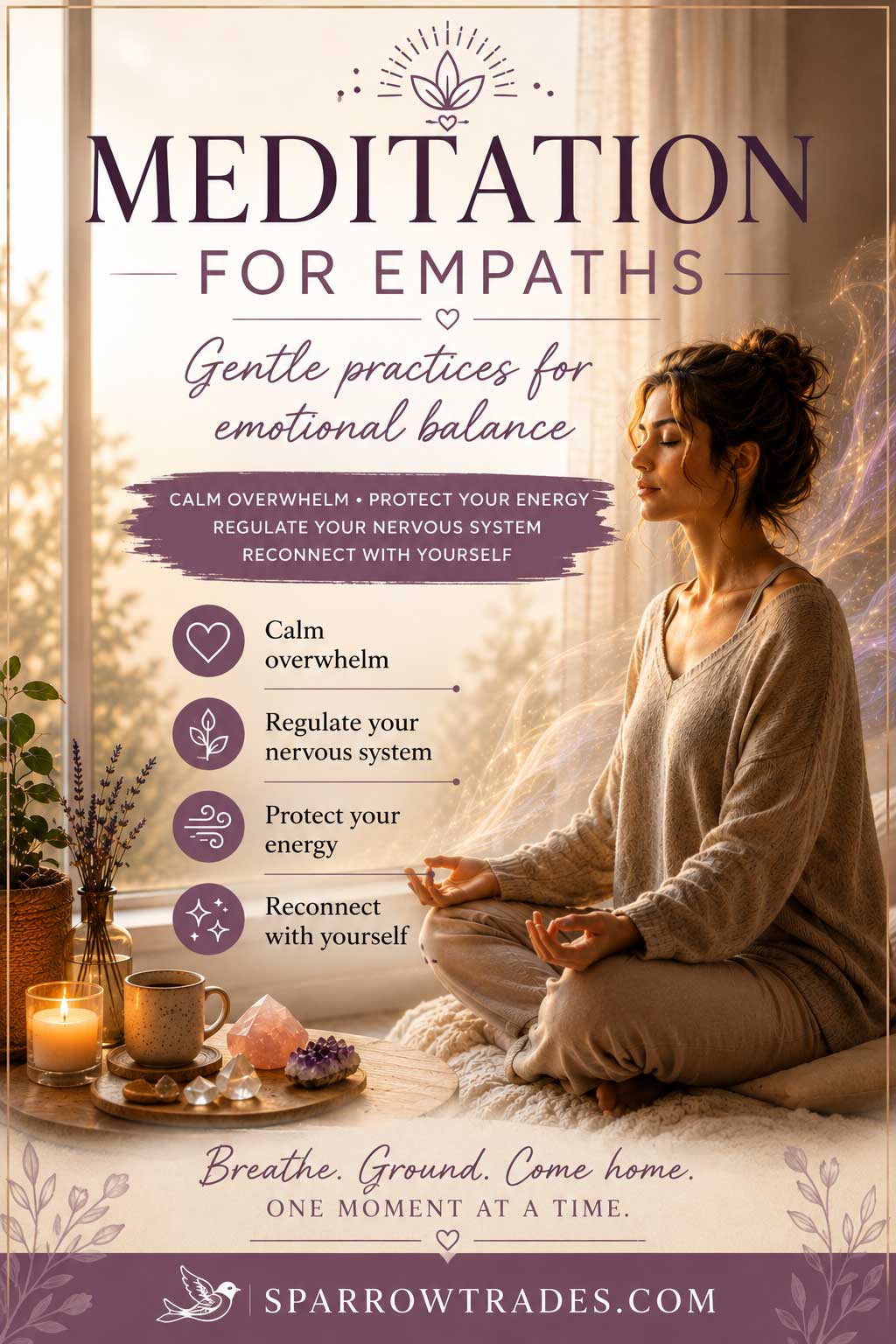

Where softness, self-awareness, and emotional healing are allowed to coexist. Through reflective writing, grounding rituals, and intentional beauty, Sparrow Trades offers gentle support for sensitive souls learning to reconnect with themselves.