There are symbols that you learn about, and there are symbols that you feel. The Flower of Life belongs to the second category. Long before you understand its geometry, something in your nervous system recognizes it. The pattern feels ancient, familiar, almost cellular — like something you’ve seen before in dreams, in nature, or in the quiet spaces of your own awareness.
If you’ve ever wondered what is the flower of life, you’re not alone. Many people encounter it through meditation spaces, crystal grids, jewelry, or sacred art. Some discover it during seasons of healing, when their inner world begins asking deeper questions about connection, purpose, and the structure of reality itself.
The Flower of Life is more than overlapping circles arranged in perfect symmetry. It is a visual language of interconnectedness. It is a reminder that nothing exists in isolation — not your thoughts, not your body, not your experiences. Every circle touches another. Every center becomes a perimeter. Every boundary becomes shared space.
For people moving through emotional repair or identity shifts, symbols like this can become grounding anchors. Just as someone exploring crystal healing guide may begin noticing how energy patterns influence their sense of safety, the Flower of Life often appears when we are ready to see ourselves as part of something larger.
Its structure is mathematical, yet its impact is emotional. It invites stillness without demanding belief. It offers pattern where there has been chaos. And for trauma-sensitive nervous systems, pattern can mean safety.
You don’t need to adopt mystical language to appreciate it. Even from a psychological lens, the Flower of Life mirrors what we understand about relational reality — that human beings are wired for connection. The pattern visually expresses the same truth explored in the psychology of interconnectedness — that our experiences ripple outward, touching others in visible and invisible ways.
The Flower of Life does not promise miracles. It does not override your lived experience. Instead, it quietly suggests: you are part of a larger design. And sometimes, especially during periods of emotional fragmentation, that reminder alone is regulating.
The Geometry Behind the Symbol
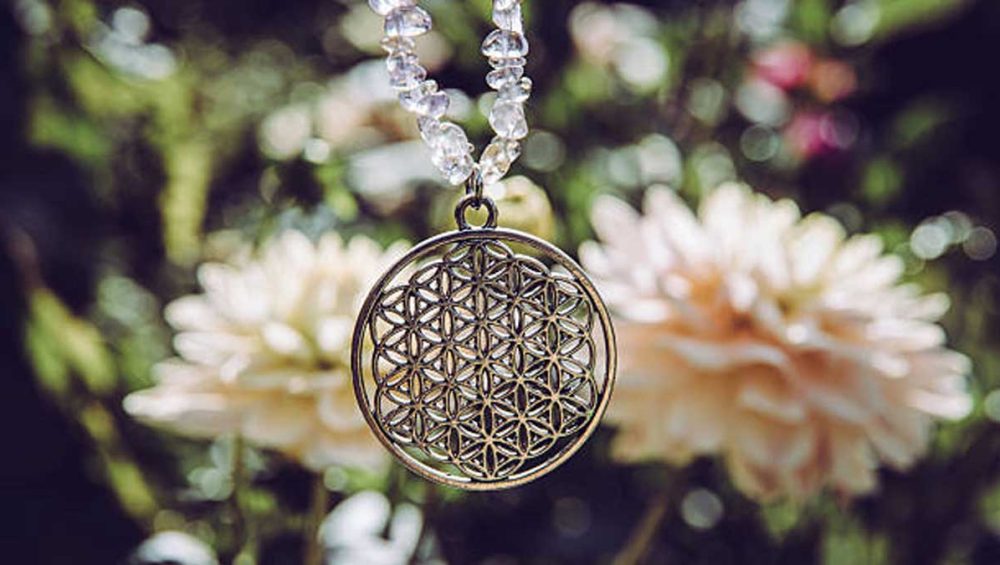
At its most literal level, the Flower of Life is composed of evenly spaced, overlapping circles arranged in a hexagonal pattern. Each circle’s center sits on the circumference of another. The pattern expands infinitely outward, meaning there is no fixed edge — only repetition and continuity.
Sacred geometry traditions view this design as a foundational blueprint. From this structure, other geometric forms can be derived: the Seed of Life, the Tree of Life, Metatron’s Cube. The suggestion is not merely artistic but symbolic — that complex systems arise from simple, repeating patterns.
When people begin exploring sacred geometry in crystal grids they often notice how specific arrangements feel stabilizing or activating. The Flower of Life pattern is frequently used as a base because it visually communicates balance. Every circle holds its own center while sharing space with others. There is individuality and union at the same time.
This geometry mirrors how energy systems are described in chakras & energy 101 — where the body is understood as layered centers of awareness, each influencing the whole. Whether you interpret chakras metaphorically or spiritually, the concept parallels the Flower of Life: interconnected systems forming a cohesive field.
For sensitive nervous systems, symmetry can be soothing. Predictable repetition can signal safety. Trauma often disrupts a person’s sense of pattern; life can begin to feel random and unpredictable. The Flower of Life, by contrast, visually reinforces continuity. It suggests that beneath surface chaos, structure still exists.
It is not about forcing meaning onto geometry. It is about noticing how structure itself can regulate the body. Pattern tells the brain: there is order here. There is coherence.
And sometimes, that is enough.
Spiritual Meaning and Symbolism
Spiritually, the Flower of Life is often described as a symbol of creation, unity, and universal life force. It appears in ancient temples, manuscripts, and sacred architecture across multiple cultures. While interpretations vary, a common theme remains: everything is connected.
But symbolism becomes powerful not because it is ancient — it becomes powerful because it resonates. When someone is healing from fragmentation, loss, or identity confusion, the idea of unity can feel deeply stabilizing.
The Flower of Life gently suggests that separation may not be as absolute as it feels. The same energy that animates one circle flows through all of them. The same life force moves through different expressions.
This perspective aligns closely with what many discover through crystal healing practices — that intention, awareness, and energy are relational rather than isolated. You are not a closed system. Your emotions, your thoughts, your healing process all exist within larger relational fields.
For those who resonate with chakra systems, the pattern can also symbolize energetic coherence. As described in the chakra crystals guide, balance does not mean perfection; it means alignment. The Flower of Life visually expresses alignment through repetition and symmetry.
Importantly, you do not need to believe in metaphysical claims to benefit from symbolic reflection. Even viewed psychologically, the Flower of Life mirrors the concept explored in understanding consciousness and the nature of reality — that perception shapes experience, and interconnected awareness expands how we interpret existence.
In seasons where you feel disconnected from yourself, the symbol does not demand transcendence. It simply invites integration.
The Flower of Life in Crystal Grids and Energy Work
In practical spiritual contexts, the Flower of Life frequently appears as a foundation for crystal grids. The grid is placed beneath stones to create a coherent energetic pattern. The geometry acts as a stabilizing structure while the crystals amplify intention.
When someone is moving through emotional overwhelm, intention-setting can feel abstract or unsafe. Having a physical layout — a base pattern — offers containment. The structure becomes a quiet boundary.
Many practitioners integrate the symbol into crystal grid activation rituals because the design visually reinforces unity of intention. Each stone placed on the grid becomes part of a larger pattern rather than a separate object.
The specific relationship between the geometry and the stones is explored in flower of life crystal grid meaning, where the emphasis is not on superstition but on coherence. The grid becomes a visual meditation on interdependence.
Even in simple practices like gentle intention-setting practices, the Flower of Life can function as a stabilizing backdrop. You do not have to perform elaborate rituals. Sometimes placing a stone at the center and breathing is enough.
The body responds to safety. Symmetry can help generate that safety. When intention meets structure, the nervous system often softens.
The Psychological and Emotional Layer
Beyond spiritual frameworks, the Flower of Life can be understood through emotional integration. Humans are relational beings. Our sense of identity forms through connection — with caregivers, communities, environments.
When those connections rupture, fragmentation occurs. Trauma can create the feeling of being separate from oneself or from others. Rebuilding that sense of continuity takes time and regulation.
Practices such as mindfulness for beginners invite present-moment awareness without overwhelm. The Flower of Life mirrors this process visually: noticing each circle without losing sight of the whole.
Similarly, in nervous system regulation techniques the emphasis is on restoring rhythm and predictability. The pattern’s repetition resembles rhythmic breathing — expansion and contraction in harmony.
For empaths or highly sensitive individuals, boundaries can feel blurred. The Flower of Life demonstrates shared space without collapse. Each circle maintains its integrity while overlapping with others. This mirrors lessons found in energetic boundaries for intuitive empaths — connection does not require erasure.
In this way, the symbol becomes less about mysticism and more about emotional architecture. It offers a visual model of healthy interdependence.
Frequently Asked Questions About the Flower of Life
Is the Flower of Life religious?
The Flower of Life appears in multiple cultures and spiritual traditions, but it is not owned by any single religion. Its presence in temples and sacred spaces reflects its symbolic resonance rather than doctrinal alignment.
For some, it represents divine creation. For others, it simply represents geometric harmony. The symbol can exist within spiritual, secular, or psychological frameworks without conflict.
What does the Flower of Life symbolize spiritually?
Spiritually, it often symbolizes unity, creation, and interconnectedness. The overlapping circles represent how life flows through different forms without losing its source.
This symbolism aligns with many crystal-based practices. In benefits of healing crystals the idea of energetic coherence echoes the Flower of Life’s visual message: everything interacts within a shared field.
Why is the Flower of Life used in crystal grids?
The pattern creates structural symmetry, which many practitioners find grounding. Within crystals by intention the emphasis is on focused energy. The Flower of Life provides a stable template for that focus.
The geometry does not “create” energy on its own; rather, it visually organizes intention in a way that feels coherent.
Can the Flower of Life help with emotional healing?
Symbols do not replace therapy or regulation practices. However, they can support reflection. Just as somatic self-soothing practices help restore body awareness, visual symbols can anchor cognitive integration.
The Flower of Life reminds the mind that fragmentation can coexist within a larger pattern of wholeness.
Is the Flower of Life scientifically proven?
There is no scientific evidence that the Flower of Life emits measurable energy. Its impact is symbolic and psychological rather than biochemical.
However, humans respond to pattern and symmetry. Studies in neuroscience show that predictable visual structures can create calm responses. In this way, its effect may be more about perception than mysticism.
Is wearing the Flower of Life meaningful?
For some people, wearing the symbol functions as a tactile reminder of interconnectedness. Jewelry often carries symbolic meaning beyond aesthetics.
When exploring protective jewelry meaning you’ll notice that symbols can serve as emotional anchors. The Flower of Life can operate similarly — not as armor, but as reminder.
Conclusion
So, what is the flower of life?
It is a geometric pattern composed of overlapping circles. It is a symbol found across cultures. It is used in sacred geometry, crystal grids, and contemplative art. But beyond definitions, it is a mirror.
It mirrors how individual identity and collective existence overlap. It reflects how boundaries can exist without isolation. It visually represents the possibility that your life — even in its fragmented moments — belongs to a larger structure.
You do not need to assign mystical powers to it. You do not need to believe it governs reality. You can simply allow it to remind you that repetition creates pattern, that connection creates meaning, and that wholeness is often hidden within overlap.
In seasons of healing, especially when rebuilding trust in your own nervous system, symbols can become gentle companions. They do not fix. They do not override. They witness.
And sometimes, being witnessed — even by geometry — is enough.
Where softness, self-awareness, and emotional healing are allowed to coexist. Through reflective writing, grounding rituals, and intentional beauty, Sparrow Trades offers gentle support for sensitive souls learning to reconnect with themselves.