
Introduction (Why This Question Feels So Personal)
If you’ve ever found yourself staring at a grounding bracelet online—hovering over the “add to cart” button while your chest feels tight and your mind won’t stop spinning—you’re not alone. For a lot of people, this isn’t a casual shopping question. It’s a hope question.
Because when your nervous system is fried, when your thoughts race faster than you can catch them, when you feel unsteady in your own body… you don’t just want jewelry. You want relief. You want something you can carry with you into the grocery store, the family gathering, the workday, the hard conversation. Something that doesn’t require a perfect meditation routine or an hour of quiet time you don’t have.
So the real question underneath “do grounding bracelets work?” is often something like:
- Will this help me feel safe again?
- Will this stop the spiraling?
- Will this keep me from getting emotionally flooded?
- Will this help me feel like myself in my own skin?
And that’s not silly. That’s survival.
A grounding bracelet can feel like a small promise: a steady point you can touch when everything inside you feels loud. For some people, it becomes a powerful emotional anchor. For others, it feels like a beautiful object that doesn’t change much beyond being… beautiful.
So let’s talk about it honestly, without cynicism and without magical claims.
Yes, grounding bracelets can “work.”
But how they work matters.
Some people mean grounding in the energetic sense—protection, stability, root chakra support, absorbing negativity, calming the aura. Others mean grounding in the nervous-system sense—reducing anxiety, regulating emotions, interrupting panic, returning to the present moment.
This article is going to hold space for both perspectives in a grounded, trauma-informed way.
We’ll explore what grounding bracelets are believed to do, what science can and can’t say about them, why they feel effective for so many people, and how to use them in a way that supports your nervous system without turning the bracelet into a pressure-filled “fix.”
Because the most important thing isn’t whether a bracelet is “real” enough.
The most important thing is whether you feel more regulated, more present, and more supported in your life—and whether the tool you’re using is helping you build trust with yourself, not dependence on something outside you.
Let’s begin there.
What Grounding Bracelets Are (And What People Mean When They Say “Grounding”)
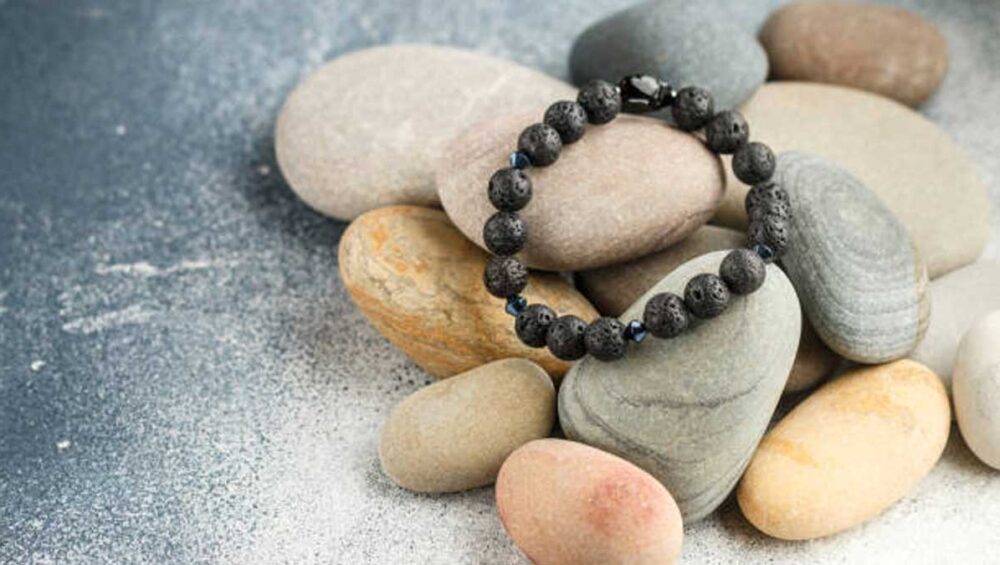
A grounding bracelet is usually a bracelet made with stones or materials traditionally associated with steadiness, protection, and stabilizing energy. In crystal traditions, “grounding” often refers to bringing your energy back down into your body, helping you feel rooted instead of scattered. grounding
Common stones used in grounding bracelets include:
- Black tourmaline (often associated with protection and energetic boundaries)
- Hematite (linked with stability and strength)
- Obsidian (frequently used for emotional protection and clearing)
- Smoky quartz (often tied to calming and transmuting heaviness)
- Lava stone (associated with resilience, strength, and steady energy)
But grounding isn’t just a spiritual concept—it’s also a human need.
In nervous system terms, grounding is about returning to the present moment through the body. It’s what helps you shift from:
- panic → breath
- numbness → sensation
- overwhelm → “I’m here”
- spiraling thoughts → a slower internal pace
For trauma survivors and emotionally sensitive people, grounding can be the difference between getting pulled under and finding the edge of the shore again.
And this is where grounding bracelets become emotionally meaningful: they’re wearable. They’re close. They can be touched discreetly in public. They don’t require anyone else to know you’re having a hard moment.
A grounding bracelet can become a small, private ritual of self-support—something that quietly supports nervous system regulation techniques when you’re trying to stay present inside a day that feels like too much.
That said, it’s also important to name something gently: sometimes people reach for grounding tools when they’re desperate, and desperation can create unrealistic expectations.
A bracelet isn’t a replacement for therapy, medication, boundaries, rest, or support. It isn’t an instant cure for trauma responses, anxiety disorders, or chronic stress.
But it can be something else.
It can be a bridge.
A “small enough” support that helps you get through the next hour.
And sometimes, the next hour is everything.
Do Grounding Bracelets Work? The Honest Answer (Yes… But Not Like a Switch)
If you’re hoping for a clean yes-or-no answer, here it is:
Grounding bracelets can work—if they help you feel steadier, safer, and more present.
But they don’t work like flipping a switch. And they don’t work the same way for everyone.
For one person, a grounding bracelet might feel like:
- a calming weight on the wrist
- a reminder to breathe
- a boundary between “me” and “everything”
- a ritual of protection before entering a hard day
For someone else, it might feel like:
- a pretty accessory
- an “I want to believe” purchase
- something that doesn’t noticeably change anything
Both experiences are valid.
What makes grounding bracelets complicated is that there are two different questions hidden inside the same sentence:
1) Do grounding bracelets work spiritually or energetically?
That depends on your beliefs, spiritual practice, and personal experiences. Many people feel a real energetic shift when wearing grounding stones—especially if they’re intentional with them.
2) Do grounding bracelets work psychologically or physically?
They can, but usually through mechanisms like:
- sensory grounding (touch, texture, weight)
- attention redirection (“I notice the bracelet”)
- pattern interruption (“I stop spiraling for a second”)
- association (“this means I’m safe”)
- ritual and meaning (the nervous system often responds to symbols)
What’s important here is not to dismiss any of these as “just placebo.”
Because in trauma recovery, placebo isn’t an insult—it’s a doorway.
If your nervous system calms down because your brain recognizes a cue of safety, that’s not fake.
That’s your body learning a new pathway—one that becomes easier to access the more you build stability through emotional wellness foundations instead of relying on a single tool to carry everything for you.
A grounding bracelet “works” best when it becomes part of a larger ecosystem of support, not the only thing you’re clinging to.
Think of it like a handrail on a steep staircase.
It doesn’t remove the stairs.
But it can help you move more safely.
Why Grounding Bracelets Can Feel So Effective (Especially for Anxiety, Overwhelm, and Trauma Responses)
If you’ve ever been anxious and someone told you “just take deep breaths,” you may have wanted to scream. Not because breathing is useless—but because when you’re activated, your body often can’t access calm on command.
Grounding bracelets can help because they’re physical and immediate.
Here are a few reasons they can genuinely feel powerful:
They give your body something to hold onto
When emotions are intense, your body often searches for stability. Touching a bracelet gives your senses something real:
- bead texture
- coolness or warmth
- weight against skin
- the motion of rolling beads between fingers
This can gently pull you out of dissociation, rumination, or panic thinking—and that tiny shift matters more than people realize when you’re living inside a nervous system that’s still learning what safety feels like.
They create a “micro-ritual” of safety
Trauma makes people feel unsafe even when nothing is happening. A grounding bracelet can become a ritual cue:
- “I’m protected.”
- “I can handle this.”
- “I’m here.”
- “This is now, not then.”
Your nervous system learns through repetition. A bracelet can become a repeating safety signal—especially when you pair it with small actions like 5-minute grounding rituals that don’t demand perfection, only presence.
They support nervous system regulation through meaning
Humans are meaning-making creatures. We respond to symbols. We respond to objects that represent care, intention, and support.
If you wear a grounding bracelet and you believe it helps you feel steady, your body may start to respond before you even touch it—because your brain associates it with regulation.
They help you interrupt the spiral early
One of the hardest parts of anxiety is that it gains momentum. Grounding tools work best early.
A bracelet is always there—so it’s easier to catch the moment when your system starts tipping, and return to something stabilizing like mindfulness for anxiety without needing to overhaul your entire day.
They are discreet in public
This matters more than people admit.
Not everyone has the privilege of a safe space to regulate. Not everyone can step outside, cry, or do breathing exercises without being watched.
But you can touch a bracelet quietly.
You can ground yourself without explanation.
And that dignity matters.
What Science Says (And Doesn’t Say) About Grounding Jewelry
Let’s be careful and honest here.
There isn’t strong scientific evidence proving that gemstone bracelets “emit” a measurable grounding energy that changes the nervous system in a direct, consistent way. Science tends to struggle with energetic language because it’s difficult to measure in controlled conditions.
But that doesn’t mean grounding bracelets are meaningless.
Science does support several related realities:
1) Touch and sensory input can regulate the nervous system
Your body responds to sensory cues. Texture, pressure, and repetitive touch can be calming—similar to why some people rub their hands, tap their feet, use fidget tools, or hold soft objects.
A bracelet can function as a wearable sensory anchor, especially if you already respond well to somatic self-soothing practices that help you come back to your body without forcing your mind to “think” its way out of panic.
2) Ritual reduces stress
Rituals—even small ones—can create predictability and emotional safety. For anxious brains, predictability is soothing. A grounding bracelet can become part of a ritual: putting it on, setting an intention, taking a breath.
3) Belief and expectation affect the body
The mind-body connection is real. If you believe something helps you, your system often shifts accordingly.
This isn’t weakness. It’s biology.
Your body responds to cues—internal and external.
4) “Working” can mean “supportive,” not “medically curative”
A grounding bracelet doesn’t need to cure anxiety to be helpful. If it helps you feel steadier, that matters.
The danger is only when people replace real support with magical thinking or blame themselves when the bracelet doesn’t “fix” everything.
If the bracelet helps a little, that little is worth something.
How to Use a Grounding Bracelet in a Trauma-Informed Way (Without Turning It Into Pressure)
This is where grounding bracelets become either deeply supportive… or quietly stressful.
Because sometimes people buy these tools with the energy of:
“If this doesn’t work, I’m never going to feel okay.”
That’s not intention. That’s a threat.
And your nervous system can feel the difference.
Here’s a trauma-informed way to use grounding jewelry that supports emotional continuity instead of performance.
Use it as a reminder, not a requirement
Instead of “this must calm me down,” try:
- “This can remind me to return.”
- “This can be a support.”
- “This can be something gentle.”
Pressure activates the nervous system. Gentleness settles it.
Pair it with one simple body cue
You don’t need a whole routine. Just one cue:
- one slow exhale
- relaxing your jaw
- feeling your feet
- unclenching your hands
- lowering your shoulders
Touch bracelet → exhale once.
That’s enough to build a pattern.
If you want something that feels steadier than “try to relax,” anchoring it to how to reset your nervous system after stress can help you return to yourself in a way that’s simple, not performative.
Let it be imperfect
Some days it will help. Some days it won’t.
This doesn’t mean you’re broken. It means you’re human.
Sometimes your nervous system needs more than one tool.
Use it for emotional boundaries, not emotional suppression
Grounding doesn’t mean “stop feeling.”
It means “I can feel this without drowning in it.”
A grounding bracelet can support that inner stance:
- “I’m allowed to feel.”
- “I’m allowed to come back.”
- “I don’t have to abandon myself.”
Build a relationship with it slowly
Trauma healing is often slow because trust is slow.
So instead of expecting an instant transformation, allow the bracelet to become familiar. Let it become associated with safety through repetition, not intensity.
It’s okay if it’s subtle.
Subtle is still real.
What Stones Are Best for Grounding Bracelets? (And Why “Best” Is Personal)
You’ll see a lot of lists online that claim one stone is “the strongest” or “the most powerful.”
But trauma-informed grounding doesn’t work well with rigid hierarchies.
Because what calms you down isn’t always what calms someone else down.
That said, here are common grounding stones and the kind of emotional support people often connect with them:
Black tourmaline
Often chosen for protection and boundaries. Many people like it when they feel emotionally porous—like other people’s moods stick to them.
If you’re drawn to this stone, you might also connect with crystals for grounding in a way that feels less like “fixing yourself” and more like protecting your softness.
Hematite
Sometimes associated with mental steadiness, strength, and focus. People often reach for it when they feel scattered or “unglued.”
Obsidian
Frequently linked to shadow work and emotional protection. Some people find it comforting. Others find it intense.
If you’re tender and raw, you might prefer something gentler.
Smoky quartz
Often associated with soft grounding and emotional clearing. Many people find it stabilizing without feeling heavy.
Lava stone
Lava stone has a porous texture that many people find sensory-soothing. It’s also often used for resilience themes—“I have survived.”
How to choose if you don’t know what you need
If you’re overwhelmed, choose based on this question:
When I’m dysregulated, what am I trying to come back to?
- Safety → black tourmaline, smoky quartz
- Steadiness → hematite, lava stone
- Protection → black tourmaline, obsidian
- Gentleness → smoky quartz, softer-feeling stones
And also: choose what you’re drawn to.
Sometimes the body knows before the mind does.
If you’d like more clarity without it feeling overwhelming, best grounding gemstones can help you name what you’re seeking without turning it into a high-pressure decision.
Signs a Grounding Bracelet Is Helping You (Even If It’s Not Dramatic)
Not all progress looks like a miracle.
Sometimes grounding looks like:
- You still feel anxious, but you don’t spiral as far
- You catch yourself before you snap at someone
- You breathe once instead of holding your breath for an hour
- You feel less emotionally “soaked” after being around people
- You come back to your body faster after spacing out
- You feel comforted just seeing it on your wrist
These are not small things.
These are nervous system wins.
And if you’ve lived in survival mode, small wins are how you build a new life.
Sometimes those wins show up as simple as choosing to reach for vagus nerve exercises instead of abandoning yourself in the moment you start slipping into panic.
When a Grounding Bracelet Might Not Help (And What That Doesn’t Mean)
Let’s also normalize this: sometimes grounding bracelets don’t feel like anything.
That can happen if:
- you’re expecting a dramatic shift
- your nervous system is deeply activated and needs more support
- the stone choice doesn’t feel aligned for you
- you don’t like jewelry sensory-wise (tightness, weight, texture)
- your brain is in a skeptical-protective mode (also valid)
And none of that means you failed.
It means this tool might not be your tool.
Or it might not be enough on its own, right now.
Trauma-informed healing is never “one perfect solution.”
It’s layering support until life feels livable again.
And when your body feels flooded, it can help to hold onto something like grounding safety guide so you don’t push yourself into practices that feel too intense too fast.
FAQ: Do Grounding Bracelets Work?
Do grounding bracelets work for anxiety?
They can help some people with anxiety, especially if the bracelet functions as a sensory anchor or reminder to breathe and return to the present. Anxiety often pulls you into future-focused fear, and grounding tools can help interrupt that momentum.
Sometimes it helps to have a steady emotional script nearby—something like grounding affirmations prompts that brings you back to the moment without making you feel like you have to “positive-think” your way through panic.
However, if anxiety is severe or persistent, a bracelet is best used as a supportive tool—not a replacement for deeper care or professional support.
Are grounding bracelets just placebo?
They can work through placebo-like mechanisms, but that doesn’t mean the results are fake. If your body calms down because your brain recognizes the bracelet as a cue of safety, that’s a real nervous system shift. In trauma-informed healing, the goal isn’t proving something to anyone—it’s finding what helps you feel more stable, regulated, and connected to yourself.
And if you want language that supports both tenderness and truth, crystal healing guide can help hold the bigger picture without making your experience feel like it needs to be defended.
How long does it take for a grounding bracelet to work?
Some people feel an immediate sense of comfort, while others notice benefits over time as the bracelet becomes associated with calm, protection, or steadiness. If you use it consistently—touching it during moments of stress, pairing it with a slow exhale, or setting a gentle intention—it may become more effective through repetition and emotional association.
If journaling helps you track your patterns with less self-judgment, grounding journaling during anxiety spikes can be a steady companion when you’re trying to notice what your nervous system is actually asking for.
What is the best grounding bracelet stone?
There isn’t one “best” stone for everyone. Common choices include black tourmaline, hematite, smoky quartz, obsidian, and lava stone. The best option is usually the one that makes you feel steadier when you wear it—physically, emotionally, or spiritually.
If you want to explore the crystal side more deeply, grounding with crystals daily practices can help you build a relationship with the ritual itself—without turning it into another thing you have to get “right.”
Can I sleep with a grounding bracelet on?
Some people find it comforting to sleep with grounding jewelry on, but others find it overstimulating or uncomfortable. If you choose to sleep with it, make sure it isn’t too tight and doesn’t interfere with circulation or comfort.
Trauma-informed grounding is about safety and ease—if wearing it at night creates irritation or restlessness, it may be better as a daytime tool instead.
Do grounding bracelets protect you from other people’s energy?
Many people believe grounding stones help support energetic boundaries and reduce emotional “absorption,” especially for sensitive people. From a nervous system perspective, the bracelet may also help you stay aware of your own internal state and return to yourself when you feel pulled into someone else’s mood.
If you’re trying to rebuild that sense of separation—where you end and other people begin— trauma-informed grounding practices can offer support that honors how personal and body-based this process really is.
Conclusion (The Real Measure of “Works”)
So… do grounding bracelets work?
They can.
Not because they’re guaranteed to erase anxiety or heal trauma overnight. Not because you’re supposed to feel an instant wave of peace every time you put one on.
But because sometimes the smallest things—something you can touch, something you can wear, something you can return to—become anchors in the middle of a hard life.
If a grounding bracelet helps you pause before you spiral…
If it helps you breathe once more than you would have…
If it helps you feel protected, steadier, less porous, more present…
Then yes.
It’s working.
And if it doesn’t?
That doesn’t mean you’re broken. It doesn’t mean you “did it wrong.” It just means this isn’t the tool that meets you best right now. Your nervous system deserves support that fits your reality—not a tool you have to force yourself to believe in.
The most trauma-informed way to approach grounding jewelry is gently:
Not as a test.
Not as proof.
Not as a last hope.
But as a companion.
A quiet, wearable reminder that you can come back to yourself—again and again—until “being here” feels safe.
And if you want this to be part of a wider support system, it helps when you treat it as one piece of grounding jewelry instead of the only thing standing between you and overwhelm.

Where softness, self-awareness, and emotional healing are allowed to coexist. Through reflective writing, grounding rituals, and intentional beauty, Sparrow Trades offers gentle support for sensitive souls learning to reconnect with themselves.