

When Sensitivity Becomes a Weaponized Word
Have you ever been told you’re too sensitive after standing up for yourself? Maybe you expressed hurt over a friend’s dismissive tone or called out a partner for crossing a boundary, only to be told, “You’re overreacting.” That moment — when your genuine feelings are turned against you — is more than a misunderstanding. It’s a subtle but powerful form of emotional manipulation.
The phrase “you’re too sensitive” often disguises an attempt to silence or control emotional truth. It’s a deflection that shifts the focus from someone’s harmful behavior to your emotional response. Instead of acknowledging the disrespect, they make you question whether your feelings are valid at all.
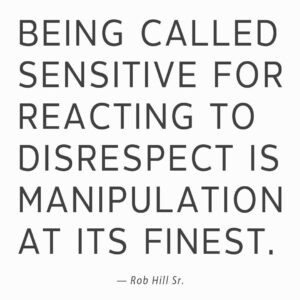
Being sensitive is not a flaw. Sensitivity is an emotional intelligence — an ability to feel deeply, connect authentically, and understand nuance. But when others use that trait to diminish your reactions, it becomes manipulation at its finest. As author Rob Dance notes, “Being called sensitive for reacting to disrespect is manipulation at its finest.”
This article builds on the foundation of understanding emotional boundaries and the psychology of respect, exploring why sensitivity is often misunderstood, how it becomes a target in manipulative dynamics, and how you can reclaim your emotional power. Let’s unpack what it really means to be called “too sensitive,” and why it says more about the other person than it does about you.
Understanding Sensitivity: The Truth Behind Deep Feelers
Sensitivity isn’t weakness — it’s awareness. Individuals who process emotions and sensory details more deeply often notice subtleties others miss — a shift in tone, a microexpression, or emotional tension in the room. Society tends to reward detachment and suppress vulnerability, which is why sensitive people are often told to “toughen up” or “stop taking things personally.” What’s missing from that narrative is that sensitivity is not an overreaction — it’s a reaction with context.
Imagine this: you’re at work, and a colleague makes a sarcastic comment about your mistake in front of others. You feel embarrassed and call it out. They respond with, “Wow, calm down — I was just joking.” That’s not humor. That’s deflection. What you experienced was disrespect disguised as playfulness, followed by gaslighting when you responded authentically.
Sensitivity means feeling more — not being fragile. It’s the courage to stay open in a world that tells you to shut down. Understanding your emotional responses isn’t indulgent; it’s self-respect. For more on how sensitivity intertwines with compassion fatigue, read when empathy becomes emotional exhaustion.
The Subtle Art of Emotional Manipulation
Emotional manipulation occurs when someone tries to influence or control your emotions for their benefit. It often hides behind seemingly harmless statements:
- “You’re imagining things.”
- “You always make a big deal out of nothing.”
- “I didn’t mean it like that — you’re just sensitive.”
Each phrase is designed to invalidate your experience and make you doubt your perception. Over time, this leads to confusion, guilt, and self-blame — hallmarks of manipulation.
One of the most common tactics is gaslighting — making you question your own reality. By labeling your reactions as “too sensitive,” manipulators shift responsibility. Instead of addressing their behavior, they make you believe you’re the problem. For a deeper understanding, explore gaslighting and trust erosion.
Manipulation thrives on imbalance. It’s about control, not connection. And often, it begins in subtle ways — through humor, passive aggression, or selective empathy. Recognizing these patterns is the first step toward emotional freedom.
How the “Sensitive” Label Shapes Self-Perception
Words shape identity. When someone repeatedly calls you “too sensitive,” you start internalizing it as a flaw. You might begin to suppress your emotions, apologize for how you feel, or second-guess every reaction. Over time, that erodes self-trust. You start thinking, Maybe I am the problem. But the truth is, emotional responsiveness is not the enemy — emotional invalidation is.
Consider this: a sensitive child who grows up being told they “cry too much” learns to hide their emotions. As an adult, that same person might struggle to express needs in relationships for fear of rejection. The cycle repeats until awareness breaks it. If this resonates, you may find insight in the psychology of over-apologizing and people-pleasing.
Reclaiming your sensitivity starts with reframing it. Sensitivity means perception, compassion, and presence — qualities that make relationships authentic and human. It’s time to stop apologizing for feeling deeply and start seeing it as emotional intelligence in motion.
Recognizing Manipulation in Relationships
Manipulation in relationships rarely starts loudly. It begins with small dismissals — laughter at your emotions, twisting your words, or guilt-tripping you into compliance.
- When you express a boundary, they say, “You’re being dramatic.”
- When you show disappointment, they reply, “You always take things personally.”
- When you call out inconsiderate behavior, they insist, “You’re sensitive — I can’t say anything around you.”
Each comment chips away at your confidence, making you question your right to feel. Emotional manipulators rely on that uncertainty. The more you doubt yourself, the easier it is for them to control the narrative. Healthy relationships, by contrast, create space for emotion. They sound like: “I didn’t realize that hurt you. I’ll do better.” That’s accountability — not blame. Recognizing this difference is key to protecting your emotional well-being. If you’re rebuilding trust in yourself after such experiences, see learning to trust your emotions again.
Empathy and Boundaries: The Sensitive Person’s Balancing Act
Empathy is a gift — but without boundaries, it becomes a burden. Highly sensitive individuals often absorb others’ emotions, mistaking responsibility for compassion. Manipulators exploit this by framing your empathy as obligation.
They might say, “If you really cared, you’d forgive me,” or “You’re hurting me by being upset.” In truth, your feelings are valid even when someone else is uncomfortable.
Setting boundaries doesn’t make you less caring — it makes your care sustainable. It’s saying, “I can love you and still say no,” or “I can understand your perspective without accepting your disrespect.” Learn how to begin setting emotional boundaries without guilt or fear. True empathy honors both sides. It listens, but it doesn’t lose itself.
How to Respond When Someone Calls You “Too Sensitive”
When confronted with that phrase, remember: your emotions are data, not drama. Here’s how to respond effectively:
- Pause before reacting. Ground yourself. The goal isn’t to defend your feelings but to understand your boundaries.
- Reframe with confidence. “Yes, I’m sensitive — it means I care deeply about respect.”
- Communicate clearly. “When you call me sensitive, it feels dismissive. I’d appreciate if you addressed what I’m saying instead.”
- Set boundaries. If the pattern continues, distance may be necessary.
- Validate yourself. You don’t need external approval to know your emotions are real.
FAQs About Being Called Sensitive and Emotional Manipulation
These common questions can help you identify manipulation, build boundaries, and reclaim your emotional power.
What does it really mean when someone calls me sensitive?
It often means you express emotions openly — but some people use the term to deflect accountability. Being sensitive isn’t a flaw; it’s awareness.
How do I know if someone is manipulating me emotionally?
Watch for consistent invalidation, shifting blame, or guilt-tripping. If you often feel confused or “crazy” after expressing your feelings, manipulation may be occurring.
Can sensitivity and strength coexist?
Absolutely. True strength lies in authenticity — the courage to feel deeply and stand by your emotions, even when they’re misunderstood.
How do I set boundaries without feeling guilty?
Start small. Clearly communicate what behavior isn’t acceptable and remind yourself that boundaries protect your peace — not push people away.
Why do manipulators target sensitive people?
Because sensitive individuals are empathetic and responsive, making them easier to influence emotionally. Awareness and boundaries protect against this dynamic.
How can I heal from being emotionally manipulated?
Healing starts with acknowledgment. Therapy, journaling, and reconnecting with supportive people help rebuild trust in your perceptions and emotions. You might also explore healing after emotional invalidation for practical guidance.
Conclusion: Embracing Sensitivity as Strength
In a world that glorifies emotional control, being sensitive is a quiet act of rebellion. It means choosing empathy over apathy, truth over denial. When someone calls you “too sensitive,” they’re revealing their discomfort with emotional honesty — not your weakness. Sensitivity, at its core, is your ability to feel, understand, and connect deeply.
For more self-empowerment insights, explore emotional self-awareness and healing. Embrace it. Celebrate it. Protect it with boundaries. Because being called sensitive isn’t your shame — it’s your superpower.

Where softness, self-awareness, and emotional healing are allowed to coexist. Through reflective writing, grounding rituals, and intentional beauty, Sparrow Trades offers gentle support for sensitive souls learning to reconnect with themselves.