
There are some people who walk into a room and immediately feel the emotional atmosphere before anyone says a word. They notice tension that others ignore. They feel heaviness in conversations that seem “normal” on the surface. They absorb moods, emotional shifts, and subtle reactions so deeply that it becomes difficult to tell where their own emotions end and someone else’s begin.
For many medium empaths, this sensitivity does not feel mystical at first. It feels exhausting.
You may find yourself emotionally drained after spending time around certain people, even if nothing openly upsetting happened. You may carry emotions home that do not fully feel like yours. Crowded spaces might leave your nervous system overstimulated for hours afterward. Relationships can become emotionally confusing because you instinctively feel what other people are feeling before they even express it directly.
This experience often creates self-doubt. Some medium empaths grow up being told they are “too emotional,” overly sensitive, dramatic, or reactive. Others become caretakers without realizing it, constantly monitoring emotional environments to keep conflict from escalating. Over time, emotional awareness turns into emotional hypervigilance.
That is why many people begin searching for answers about empath identity long before they fully understand the deeper patterns shaping their emotional life.
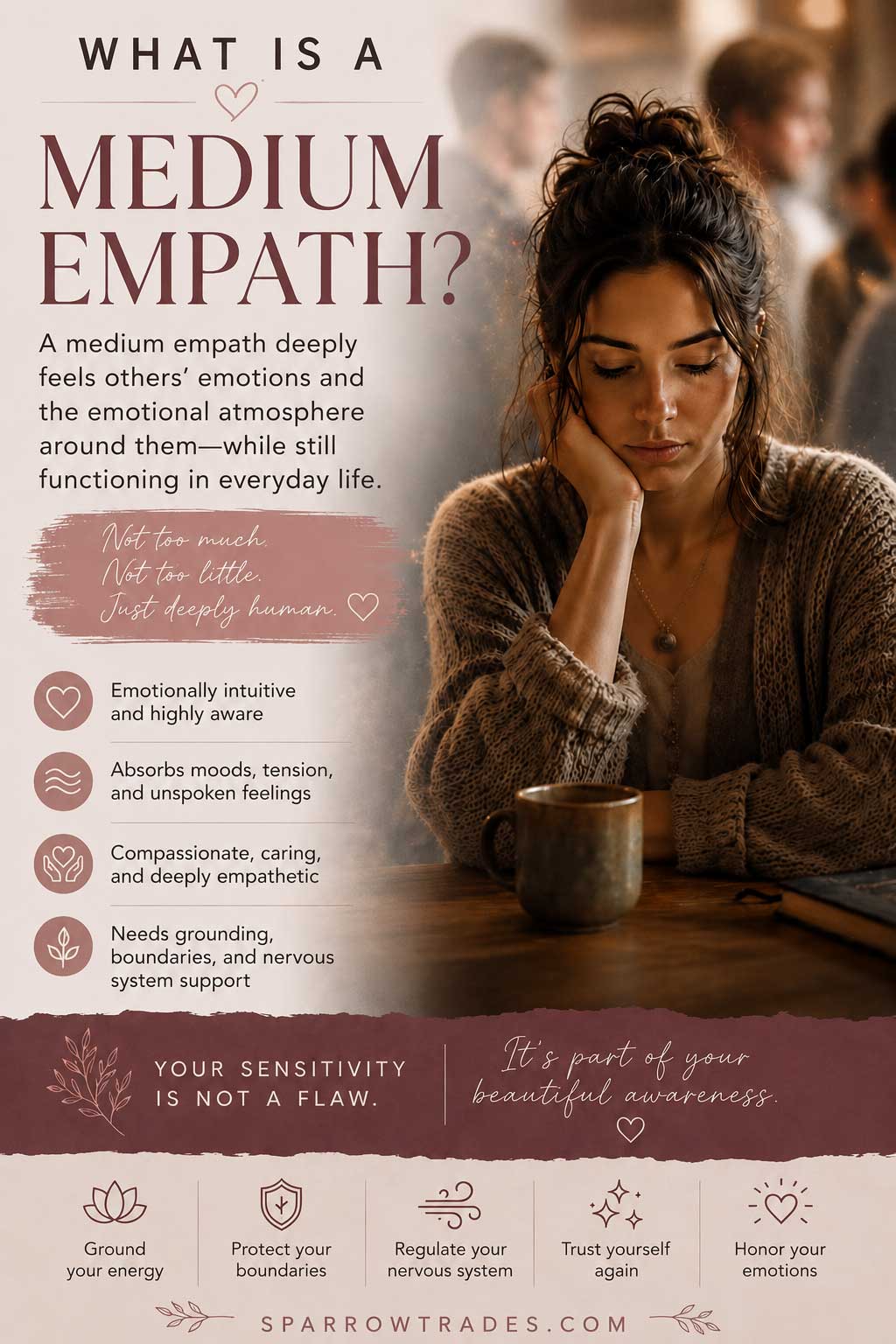
A medium empath is typically someone who experiences emotional sensitivity strongly enough to absorb emotional energy from other people, while still remaining grounded enough to function within everyday life. Unlike highly extreme empath portrayals often seen online, medium empaths usually exist somewhere in the middle. They are emotionally intuitive, emotionally absorbent, and deeply aware of subtle emotional shifts, but they may not always realize how much their nervous system is processing until overwhelm begins building internally.
This emotional awareness can create beautiful qualities. Medium empaths are often compassionate listeners, emotionally perceptive friends, and people who naturally notice emotional pain in others. They may offer comfort without needing explanations. They can sense emotional distance, loneliness, shame, or tension beneath surface-level interactions. Many people feel emotionally safe around them because they feel emotionally seen.
But this sensitivity also comes with a cost when emotional boundaries are weak.
Without strong internal grounding, medium empaths can begin carrying emotional responsibility for everyone around them. They may unconsciously regulate other people’s emotions while abandoning their own needs. Emotional overload becomes normal. Fatigue becomes constant. Relationships start revolving around emotional survival rather than mutual connection.
That is why understanding your emotional sensitivity through the lens of emotional wellness foundations can feel deeply relieving. It shifts the experience away from shame and toward self-understanding.
Being a medium empath does not mean you are broken, weak, or emotionally fragile. It often means your nervous system processes emotional information more deeply than most people realize.
And once you understand that, the goal stops being emotional numbness.
The goal becomes emotional discernment.
Signs You May Be a Medium Empath
Many medium empaths spend years assuming everyone experiences emotions the same way they do. Because emotional absorption feels normal internally, it can be difficult to recognize how intensely your nervous system is responding to other people’s emotional states.
You may notice yourself becoming emotionally exhausted after social interaction even when nothing “bad” happened. A conversation that seemed casual to someone else might leave you emotionally heavy for the rest of the day. You may replay emotional interactions repeatedly, trying to process subtle shifts in tone, body language, or energy that other people barely noticed.
This emotional processing often creates the feeling of constantly scanning emotional environments for safety.
For some people, that sensitivity develops naturally. For others, it develops through survival experiences. Growing up around emotional unpredictability, criticism, emotional invalidation, or unstable relationships can train the nervous system to become hyperaware of emotional changes. Many medium empaths unknowingly developed emotional sensitivity as a protective adaptation.
That is why experiences connected to gaslighting and trust erosion can leave empathic people feeling emotionally fragmented for years afterward.
- Feeling emotionally affected by crowded environments
- Absorbing tension between other people
- Becoming emotionally overwhelmed during conflict
- Struggling to separate your emotions from others’
- Feeling emotionally responsible for other people’s comfort
- Needing solitude after social interaction
- Becoming emotionally drained around emotionally intense individuals
- Feeling deeply affected by harsh tones, criticism, or emotional disconnection
- Experiencing emotional exhaustion after caregiving roles
Medium empaths also tend to internalize emotional energy physically. Emotional overwhelm may appear as fatigue, headaches, nervous system dysregulation, tension in the chest, stomach discomfort, dissociation, or emotional numbness after overstimulation.
For many people, this becomes closely tied to when empathy becomes emotional exhaustion because the nervous system rarely receives enough emotional recovery time.
You may also notice that certain people immediately drain your energy while others feel calming or emotionally grounding. Medium empaths are often highly sensitive to emotional congruence. When someone’s words do not match their emotional state, the empathic nervous system frequently notices the mismatch immediately.
This is why many emotionally sensitive people become deeply interested in intuitive empaths sensing unspoken emotions without realizing how strongly they already live that experience themselves.
Why Medium Empaths Become Emotionally Overwhelmed
One of the hardest parts of being a medium empath is realizing how quickly emotional absorption can become emotional depletion.
Many medium empaths spend years trying to become “less sensitive” because they believe sensitivity itself is the problem. But emotional sensitivity is not inherently unhealthy. The deeper issue is often emotional overexposure without recovery, boundaries, or nervous system regulation.
When emotionally sensitive people constantly absorb emotional energy without processing it safely, the nervous system begins living in a chronic state of emotional vigilance.
- Difficulty relaxing around emotionally unpredictable people
- Feeling emotionally tense before social interaction
- Struggling to emotionally decompress afterward
- Carrying emotional heaviness that feels difficult to explain
- Becoming emotionally overstimulated in loud or emotionally chaotic spaces
Over time, many empaths lose connection with their own emotional center entirely. They become so focused on reading others that they stop noticing their own exhaustion until burnout arrives.
That experience is deeply connected to signs of intuitive empathy burnout because emotional overwhelm rarely happens all at once. It accumulates slowly through repeated emotional overextension.
Many medium empaths also struggle with emotional guilt when setting boundaries. Saying no can feel physically uncomfortable. Creating distance from emotionally draining people may trigger shame, anxiety, or fear of hurting someone else. As a result, the empathic nervous system keeps prioritizing external emotional harmony over internal safety.
This is why healthy emotional boundaries become essential rather than optional.
Without boundaries, emotional sensitivity becomes emotionally invasive.
Without recovery, compassion becomes depletion.
Without grounding, emotional intuition becomes emotional confusion.
For many medium empaths, the turning point happens when they finally recognize they are not required to emotionally carry everyone around them in order to be loving, compassionate, or safe.
That realization often begins through practices connected to grounding boundaries for empaths because emotional stability cannot exist without nervous-system safety.
The Difference Between Emotional Awareness and Emotional Absorption
Medium empaths often confuse emotional awareness with emotional responsibility.
Feeling someone else’s sadness does not mean you must fix it.
Sensing emotional tension does not mean you caused it.
Recognizing emotional pain does not mean you are responsible for carrying it.
This distinction becomes life-changing for emotionally sensitive people.
Many medium empaths were conditioned to believe emotional attunement equals emotional caretaking. They learned to monitor emotional environments constantly in order to avoid rejection, abandonment, conflict, or emotional unpredictability. Over time, emotional awareness stopped feeling intuitive and started feeling compulsive.
That is why many empaths struggle with stopping emotional absorption from others even when they intellectually understand boundaries.
The nervous system often still interprets emotional distancing as unsafe.
Medium empaths may also feel emotionally exposed in relationships because they sense emotional undercurrents that other people avoid discussing openly. This can create loneliness, confusion, or emotional disorientation when others deny feelings the empath can clearly sense beneath the surface.
Experiences like this frequently overlap with recognizing toxic emotional energy as an empath because emotionally manipulative dynamics often rely on emotional confusion and self-doubt.
Developing emotional discernment means learning to witness emotional energy without automatically internalizing it.
This takes practice.
It also takes nervous-system regulation.
Many medium empaths benefit from reconnecting with their body through somatic self-soothing practices because emotional overwhelm often pulls awareness out of the body and into emotional scanning.
Grounding techniques can also help emotionally sensitive people recognize when emotions belong to someone else instead of automatically absorbing them internally. Practices connected to grounding after emotional overload can help restore emotional separation after intense environments or emotionally draining interactions.
The goal is not emotional detachment.
The goal is emotional clarity without self-abandonment.
How Medium Empaths Can Protect Their Emotional Energy
Many medium empaths believe emotional protection means becoming emotionally closed off. But true emotional protection is not emotional numbness. It is learning how to remain emotionally connected without emotionally collapsing.
That usually begins with nervous-system awareness.
Emotionally sensitive people often need more recovery time than they realize. Solitude, silence, grounding routines, emotional decompression, and body-based regulation are not luxuries for empaths. They are forms of emotional maintenance.
This is why practices connected to empath nervous system overwhelm recovery can feel profoundly stabilizing over time.
Many medium empaths also benefit from slowing down their emotional reactions long enough to ask:
- Is this emotion mine?
- Did this emotional shift begin internally or externally?
- Am I sensing someone else’s emotional state?
- What does my body feel like right now?
- What would emotional safety look like in this moment?
These questions gently rebuild emotional separation without disconnecting from compassion.
Breathwork can also help emotionally sensitive nervous systems regulate more safely. Gentle practices connected to conscious breathing nervous system regulation often help medium empaths interrupt emotional overwhelm before it escalates into shutdown or exhaustion.
For others, emotional grounding becomes essential. Small rituals tied to 5-minute grounding rituals can help emotionally sensitive people return to themselves after absorbing intense emotional environments throughout the day.
Medium empaths also frequently struggle with emotional self-trust. After years of second-guessing themselves, many lose confidence in their emotional perceptions entirely. Rebuilding internal trust through learning to trust your emotions again can help emotionally sensitive people reconnect with their intuition without becoming emotionally consumed by it.
Emotional sensitivity becomes much safer when compassion is balanced with discernment.
SEO-Friendly FAQ About Medium Empaths
What is a medium empath?
A medium empath is someone who experiences emotional sensitivity strongly enough to absorb emotional energy from other people while still functioning within everyday environments. They are often emotionally intuitive, highly aware of emotional atmospheres, and deeply affected by the feelings of others, especially during emotionally intense interactions.
How is a medium empath different from a highly sensitive person?
There can be overlap between medium empaths and highly sensitive people, but medium empaths often describe emotionally absorbing or internally feeling other people’s emotions more directly. Their emotional awareness tends to feel interpersonal rather than only sensory or environmental.
Why do medium empaths feel emotionally exhausted so often?
Medium empaths frequently absorb emotional stress without realizing it. Over time, emotional overstimulation, emotional caretaking, and constant emotional vigilance can overwhelm the nervous system. This is why many emotionally sensitive people eventually seek support through energetic boundaries for intuitive empaths and nervous-system regulation practices.
Can trauma make someone become a medium empath?
For some people, emotional sensitivity naturally exists early in life. For others, trauma, emotional unpredictability, or emotionally unsafe environments can increase emotional hyperawareness. Many people who experienced emotional invalidation develop strong emotional scanning patterns connected to survival and relational safety.
How do medium empaths stop absorbing other people’s emotions?
Emotional separation usually develops through grounding, boundary work, nervous-system regulation, and somatic awareness. Many empaths benefit from reconnecting with their body through beginner’s guide to somatic check-ins because emotional absorption often disconnects people from their own internal emotional center.
Are medium empaths emotionally weak?
No. Emotional sensitivity is not weakness. Many medium empaths are emotionally resilient people whose nervous systems simply process emotional information deeply. The challenge is not sensitivity itself, but learning how to protect emotional energy without disconnecting from compassion, intuition, or authentic connection.
Conclusion
Being a medium empath can feel confusing when you do not yet understand what your nervous system is carrying.
You may spend years believing you are overly emotional when you are actually emotionally overstimulated. You may think you are weak when your nervous system has simply been processing emotional environments too deeply for too long without enough recovery, grounding, or protection.
Many medium empaths learned to survive by becoming emotionally aware of everyone around them. They became caretakers, emotional monitors, peacekeepers, listeners, or emotionally responsible children long before they learned how to care for themselves emotionally.
That pattern can create profound exhaustion.
But emotional sensitivity does not have to become emotional self-erasure.
When emotionally sensitive people begin reconnecting with grounding practices, nervous-system safety, emotional discernment, and internal boundaries, empathy starts feeling less like emotional drowning and more like emotional awareness.
You do not have to stop feeling deeply in order to protect yourself.
You do not need emotional numbness to become emotionally safe.
You only need enough self-awareness to recognize when your nervous system deserves care too.
For many medium empaths, healing begins the moment they stop asking, “Why am I so sensitive?” and start asking, “What has my emotional sensitivity been trying to protect?”

Where softness, self-awareness, and emotional healing are allowed to coexist. Through reflective writing, grounding rituals, and intentional beauty, Sparrow Trades offers gentle support for sensitive souls learning to reconnect with themselves.