

Introduction: When Science Begins to Feel Personal
There are moments when science brushes up so closely against the human experience that it feels less like a lesson and more like a mirror — reflecting something ancient inside us. Quantum entanglement is one of those moments, especially when viewed through a lens that explores the nature of reality the nature of reality and how we make meaning from the unseen.
On the surface, it’s a physics concept so strange that even Einstein famously called it “spooky action at a distance.” But beneath that phrase lies something unexpectedly tender: a theory of connection. A theory that says two things — two particles, two energies, two beings — can become so deeply linked that what happens to one instantly influences the other, even if they are worlds apart.
For many, this is where curiosity awakens. Not because they want to memorize equations, but because something about entanglement feels oddly familiar on a soul level. Almost like recognizing a truth you’ve always sensed but never had words for — a truth that sits perfectly where science meets the inner journey.
Science tells us quantum entanglement is about subatomic particles sharing a single state, no matter the distance. But emotionally, it stirs a larger question:
What if connection isn’t just emotional or psychological — but a fundamental property of the universe?
Understanding entanglement doesn’t require a physics degree. You only need the willingness to imagine the unseen — the tiny world beneath our reality, where particles dance with rules unlike anything in our everyday life.
Imagine this:
You and someone you care about share a moment — a deep one. Something is exchanged, something invisible but real. And even when life moves you apart, the connection lingers. Not in a clingy way, but in the way that meaning lingers.
Quantum entanglement isn’t the same thing — but the metaphor resonates. Because we intuitively understand that connections can shape us long after the moment has passed. Much like how healing, perception, or awareness shape our internal world, themes explored in practices like mindfulness for beginners and the power of self-awareness in emotional healing.
In this guide, we’ll explore this extraordinary phenomenon through simple language, warm metaphors, and beginner-friendly analogies. You’ll learn:
- What quantum entanglement actually is
- How it works on the smallest scales
- Why scientists are so fascinated by it
- What it does not mean — and what it symbolizes
- How entanglement is being used in real technologies today
This isn’t just an article about science. It’s an invitation to explore the hidden architecture of connection — both in the universe, and perhaps within yourself.
Let’s begin at the smallest possible level, where particles whisper secrets that challenge everything we believe about space, time, and separation.
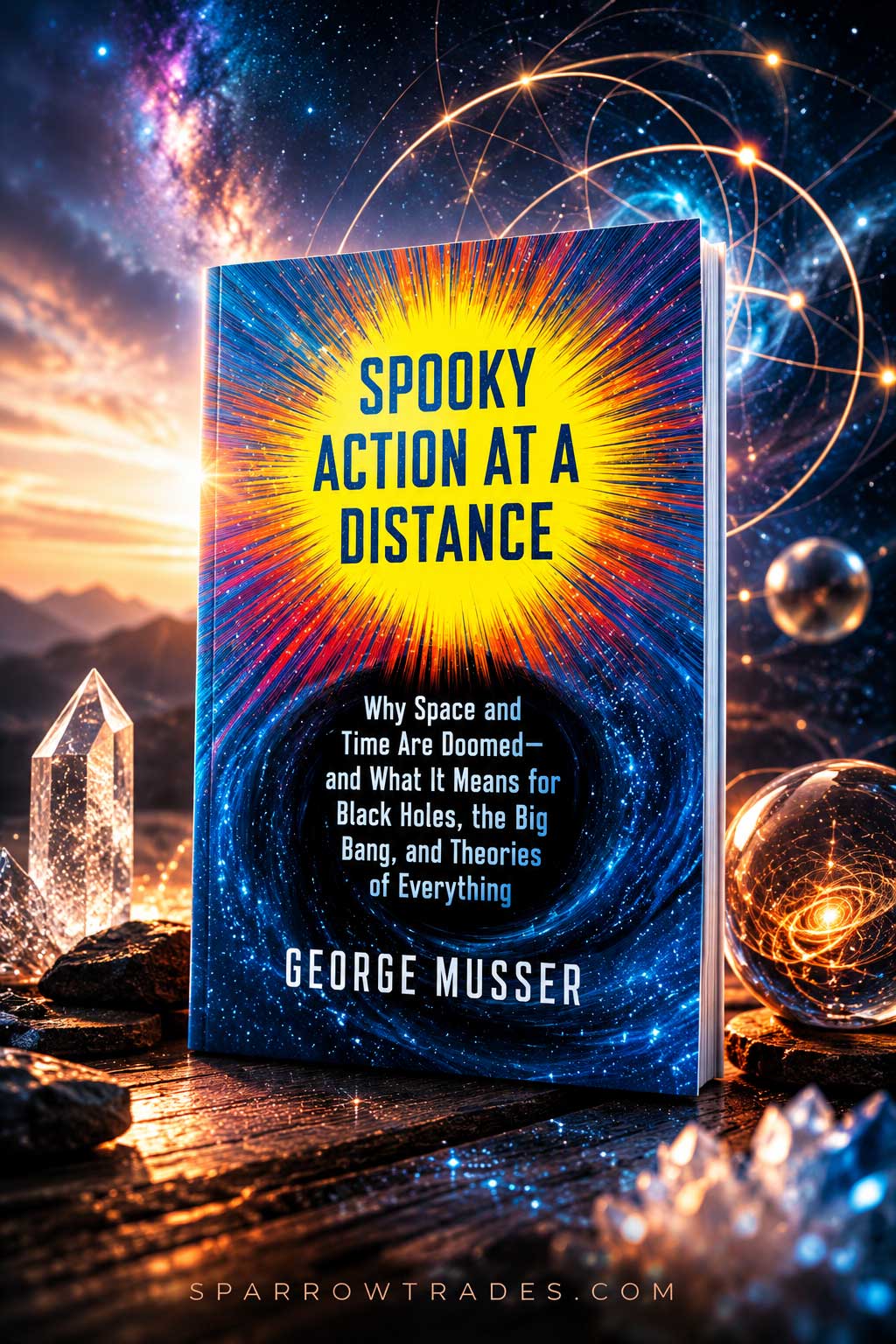
So… What Is Quantum Entanglement?
Quantum entanglement is a phenomenon where two particles become deeply and inseparably linked. Once entangled, they no longer behave as two separate objects. Instead, they behave like one system — no matter how far apart they travel.
Here’s the simplest way to imagine it:
Picture two coins that are magically connected. You flip them in two different countries. One lands on heads, and instantly the other becomes tails — without delay, without messaging, without any physical interaction.
That’s entanglement in a nutshell.
Now, the scientific version:
When particles like electrons or photons interact in specific ways, they share a single quantum state. This shared state means measuring one particle immediately affects the other. If one spins up, the other spins down. If one takes on a certain value, the other adopts the complementary one.
Distance doesn’t matter. Time doesn’t matter. The connection persists.
Einstein hated this idea. It violated everything classical physics believed about how information travels. Nothing, he argued, should influence something else faster than the speed of light. And yet, experiments have shown repeatedly — entanglement is real.
But what makes entanglement so captivating is not just the physics. It’s the metaphor:
Connection without proximity. Influence without contact. Relationship without a visible thread.
These concepts echo through inner-world work too — how we experience emotional connection, perception, and meaning — explored in reflections like learning to trust your emotions again and foundational questions like what is grounding.
In a world where so many of us long for meaningful connection, entanglement feels like the universe whispering: “Separation is not always as real as it seems.”
How Does Quantum Entanglement Actually Work?
Quantum entanglement feels magical, but it isn’t. It follows the rules of quantum mechanics — a branch of physics that describes the strange, shimmering world of subatomic particles. And in this smaller-than-small world, things behave in ways that can feel beautifully illogical.
To understand how entanglement works, imagine this:
You have two dancers who begin on the same stage. They learn a routine together — their steps synchronized, their timing perfect. Then they’re separated. One dancer goes to New York, the other to Tokyo. A thousand miles apart, they still move in the same rhythm. Not because they’re communicating, but because the routine they learned together still binds them.
Entangled particles work the same way.
They begin together, interacting in a shared quantum state — almost like learning a choreography. Once they separate, they still remain part of that shared state. This means:
- If you measure one particle’s spin, you instantly know the other’s.
- If one particle changes its measurable property, the partner’s changes in a perfectly complementary way.
- Neither particle “decides” its state until one of them is measured.
It’s as if reality itself holds them as one, even when space does not — a theme that mirrors how perception shapes connection, explored deeply in work on understanding emotional boundaries and the psychology of respect.
But here’s the truly mind-bending part:
Entanglement doesn’t involve any signal traveling between the particles. There’s no communication. No energy exchange. No secret channel.
Instead, it’s a reminder that at the quantum level, separation is often more of an assumption than a fact. In the realm of human experience, we see echoes of this through how awareness works, much like in practices for mindfulness for anxiety, where attention reveals layers of experience we don’t always see at first glance.
This is why quantum physics often sounds like philosophy. It forces us to question our assumptions:
- Is distance real?
- Is individuality fundamental?
- Can things be connected without touching?
These questions spill beautifully into the emotional world too. Think of people you’ve loved. Think of the way a thought, a song, or a memory can connect you across time or space.
Quantum entanglement isn’t about human relationships — yet it echoes a truth explored in the emerging psychology of interconnectedness psychology of interconnectedness:
Some connections don’t fade when distance appears.
Why Scientists Care: The Experiments That Changed Everything
Quantum entanglement was once just an argument on paper — a philosophical debate between Einstein and physicist Niels Bohr. But everything changed when experiments caught up with imagination.
In the 1960s, physicist John Bell proposed what’s now known as Bell’s Theorem — a mathematical way to test whether entanglement was real or if hidden variables were responsible.
If Einstein was right, entangled particles couldn’t influence each other instantly.
If Bohr was right, the universe was far stranger than classical physics believed.
When scientists ran Bell-test experiments, the results were shocking:
Bohr was right. Einstein was wrong. Entanglement was real — and stronger than any hidden-variable theory could explain.
Since then, entanglement has been confirmed repeatedly through experiments involving:
- Photons
- Electrons
- Atoms
- Even small molecules
The distances have increased too. In 2017, scientists successfully entangled photons between Earth and a satellite orbiting roughly 300 miles above. This breakthrough opened the door to quantum communication — a field with profound implications for privacy, security, and global technology.
These experiments are not merely scientific milestones. They peel back layers of our assumptions about reality. They challenge us to reconsider how we interpret information, perception, and truth — in some ways similar to the way relational experiences can distort or clarify our sense of reality, as explored in reflections on gaslighting and trust erosion and noticing the early signs of gaslighting.
Experiments force us to embrace a humbling idea:
Reality itself might be more relational than we imagined.
This isn’t poetry — it’s physics. But it resonates like poetry because it mirrors something profoundly human. Just as grounding practices help bring us back into connection with the present moment — similar to gentle practices like grounding with air and breath — entanglement reveals that even the universe seeks connection at its roots.
What Quantum Entanglement Doesn’t Mean (And Common Misconceptions)
Whenever a concept is both scientifically mysterious and emotionally evocative, misconceptions tend to follow. Quantum entanglement is no exception. It inspires curiosity, spiritual reflection, and sometimes wishful thinking — but separating truth from myth helps us appreciate the phenomenon more deeply.
Misconception 1: Entanglement lets you send messages instantly.
This is the most common misunderstanding. Even though entangled particles respond instantly, you cannot use them to send controlled information. Nothing meaningful or intentional can be transmitted by manipulating one particle. It’s an observation-based relationship, not a communication pathway.
It’s similar to how our emotional reactions can influence us without deliberate intent, much like the subtle relational patterns described in reflections about how being labeled can shape our sense of self, such as being called sensitive is manipulation.
Misconception 2: Entanglement explains emotional or spiritual connection.
While entanglement is an elegant metaphor for the bonds we feel — the lingering presence of someone we love, the intuitive sense of connection — it does not cause those experiences. Emotional, psychological, and relational dynamics are beautifully complex, but they belong to a different domain of reality.
Still, entanglement resonates because it mirrors something we already know internally: that experiences can imprint deeply, shaping our internal landscape, much like the themes explored in emotional wellness foundations.
Misconception 3: Entanglement breaks physics.
It breaks classical physics — the rules of the everyday world — but it does not break quantum physics. In fact, it is one of quantum mechanics’ most reliable and repeatable features.
Misconception 4: Entanglement lasts forever.
Most entanglement is fragile. When particles interact with outside forces (noise, heat, collisions), they lose their synchronized state — a process called decoherence. The connection doesn’t disappear because it was “weak,” but because the system has been disturbed.
Misconception 5: Entanglement proves supernatural forces.
Entanglement is mysterious, but it isn’t mystical. It reveals that reality behaves in ways our intuition cannot grasp. Still, the wonder it evokes often leads people to explore larger questions — questions that will be explored more deeply in future work on how quantum physics challenges our perception of reality.
By clearing away misconceptions, we make room for a richer appreciation of what entanglement actually is: a natural phenomenon that reframes how we understand connection, distance, and the very structure of the universe.
Why Entanglement Matters — In Science and In the Human Story
Quantum entanglement isn’t just a scientific curiosity. It is becoming one of the most powerful tools in technology — and beyond that, it offers a metaphor for connection that resonates through the human experience.
1. Quantum Computing
Entanglement allows quantum computers to process information in ways classical computers cannot. Qubits in an entangled state operate cooperatively, exploring many possibilities simultaneously. This is not faster computing — it is a different kind of computing.
2. Quantum Encryption
Quantum communication can rely on entanglement to create unbreakable security. Any attempt to intercept the information disrupts the entangled state instantly. This principle mirrors the importance of boundaries and noticing when something is “off,” ideas explored on the emotional level in reflections on how to set emotional boundaries without feeling guilty.
3. Ultra-Precise Scientific Instruments
Entanglement enhances the accuracy of sensors, microscopes, and measurement tools, offering scientists a new way to observe the world. It’s like giving our instruments a deeper sensitivity to the quietest signals.
4. Emotional & Symbolic Meaning
Beyond its scientific applications, entanglement speaks to something innately human: the longing to understand connection.
It reflects how experiences, relationships, and memories can remain interconnected long after physical closeness ends — a theme that sits beautifully alongside earth-based practices like grounding with earth, and the way we root ourselves in something steady.
As this content cluster grows, future articles like a Beginner’s Guide to Consciousness and Science and explorations on Meaning in the Microscopic Universe can help readers connect these scientific ideas with their inner world.
Entanglement is science. It’s also symbolism. And in many ways, it’s a bridge — between technology and philosophy, between physics and meaning, between the universe and the inner journey.
Frequently Asked Questions About Quantum Entanglement
What makes quantum entanglement so strange?
Entanglement defies everyday logic. In our normal experience, objects interact through physical forces or signals. But entangled particles behave like one unified system, even when separated by large distances. Their properties remain linked in a way that cannot be explained by classical physics alone, which makes entanglement feel almost like a riddle built into the fabric of reality.
Does entanglement mean everything in the universe is connected?
Not literally. Human beings and everyday objects are not quantum-entangled in the same sense as subatomic particles. However, the metaphor of connection often resonates with people. Entanglement can be a poetic reminder that our lives are shaped by relationships, experiences, and invisible influences — even if those bonds are emotional or psychological rather than quantum.
Can entanglement be used for teleportation?
In a limited way, yes. Scientists use entanglement for quantum teleportation, which transfers the state of a particle from one location to another. Nothing physical is moved — instead, information about the particle’s state is reconstructed elsewhere. This is very different from teleporting people or objects, which remains firmly in the realm of science fiction.
Is entanglement dangerous?
No. Entanglement is a natural and harmless feature of quantum mechanics. It affects particles at very small scales and does not send out harmful energy or radiation. It cannot be used to control minds, emotions, or bodies. Its impact is primarily in the realms of physics research and emerging technologies.
Does distance weaken entanglement?
Distance itself does not weaken entanglement. Entangled particles can, in theory, remain connected across vast distances. What does weaken or destroy entanglement is interaction with the environment — random noise, heat, or collisions that cause the particles to lose their shared quantum state. This is why many entanglement experiments are done in carefully controlled conditions.
Why is quantum entanglement important for the future?
Quantum entanglement is a cornerstone of several emerging technologies. It underlies quantum computing, which could solve certain types of problems far faster than classical computers, and quantum encryption, which promises ultra-secure communication. It also allows scientists to build more sensitive instruments for observing the universe, opening up new possibilities for discovery.
Conclusion: The Beauty of a Universe That Refuses to Stay Separate
Quantum entanglement is often framed as a scientific glitch — a strange rebellion against the rules we believe the universe should follow. But when you look closely, it becomes something far more revealing: a reminder that connection isn’t fragile, accidental, or limited by space. It’s woven into the architecture of existence itself.
Entanglement asks us to reconsider what we think we know about separation. It challenges assumptions so deeply ingrained that we rarely question them — the same way inner healing asks us to revisit habitual beliefs about ourselves, our experiences, or our identities.
For centuries, science and spirituality lived on opposite ends of the conversation. Science studied the measurable. Spirituality studied the meaningful. But every so often, a discovery comes along that blurs the boundary — not by proving mystical ideas, but by showing that reality is far stranger, softer, and more relational than we assumed.
Entanglement does exactly that.
It shows us a universe where two particles can share a state across vast distances. Where a change in one immediately reshapes the other. Where connection isn’t erased by space — only reshaped.
And while quantum entanglement cannot explain human emotion or connection, it echoes the truth that many of us feel intuitively: some connections leave marks that distance cannot dissolve.
For readers exploring awareness, perception, healing, and presence, this opens the door to a new kind of reflection — one that bridges the microscopic with the deeply personal.
Entanglement becomes not only a scientific principle, but a symbol — a bridge between how the universe behaves and how we experience meaning.
It invites us to pause. To imagine. To wonder. To soften into the idea that perhaps the world — and our place in it — is more intertwined than we ever realized.
The particles beneath our feet whisper a simple truth:
Connection is not the exception.
It is the rule.

Where softness, self-awareness, and emotional healing are allowed to coexist. Through reflective writing, grounding rituals, and intentional beauty, Sparrow Trades offers gentle support for sensitive souls learning to reconnect with themselves.