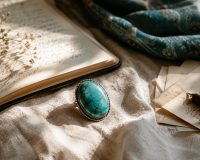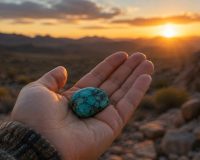
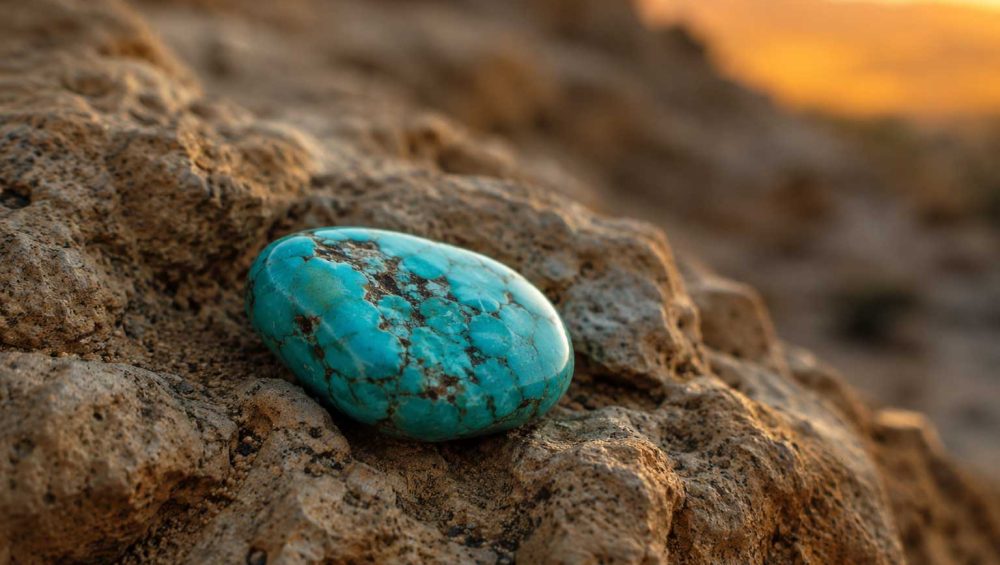
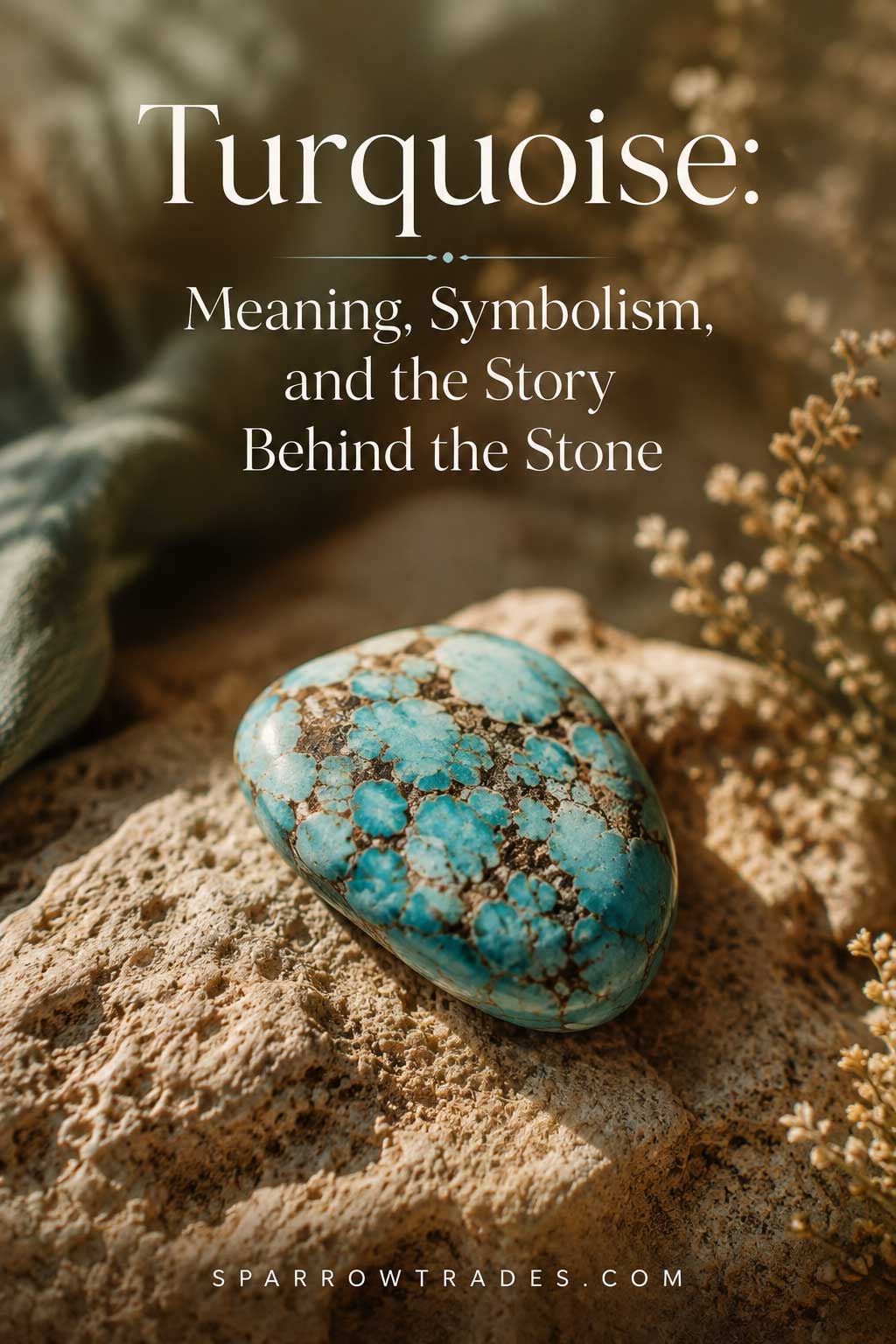
There is something unmistakable about turquoise. Its color can resemble a clear desert sky, shallow tropical water, or the blue-green patina of something shaped slowly by time. No two pieces look quite the same. Some are nearly pure blue, while others lean green or carry dark webs and fragments of the surrounding rock through their surface.
That individuality is part of what has made turquoise so compelling for thousands of years. Long before it appeared in modern jewelry collections, turquoise was carved, traded, worn, and treasured by cultures separated by enormous distances. Ancient Egyptians used it in ornamentation. Turquoise from Persia became renowned for its intense blue color. Across the American Southwest, turquoise developed enduring cultural and artistic significance among Indigenous peoples, with traditions that continue today.
But beneath all of that history and symbolism is a real mineral with an equally interesting geological story. Turquoise is an opaque, blue-to-green mineral composed primarily of hydrated copper and aluminum phosphate. It forms under particular conditions, often in dry regions where mineral-rich water moves through rock over long periods of time. Copper helps create the blues turquoise is known for, while other elements and the surrounding geology can influence its movement toward green.
Turquoise is generally considered a gemstone because it has long been cut, polished, carved, and used ornamentally. If you’ve ever wondered how stones such as turquoise come to be valued as gems, understanding gemstones provides the broader context: gemstones are not defined by beauty alone, but by a combination of natural origin, durability, rarity, cultural value, and the ways people have chosen to use them.
Perhaps that is why turquoise feels like more than a color. Its physical formation connects water, minerals, stone, and immense stretches of time, while its human history connects generations of people who saw something meaningful in the same vivid material. Understanding turquoise means looking at both stories without confusing one for the other: what the stone is, and what people have come to believe it represents.
What Is Turquoise?
Turquoise is a naturally occurring phosphate mineral whose chemical composition includes copper and aluminum. It is usually opaque and ranges from bright sky blue and robin’s-egg blue to blue-green, green, and occasionally yellowish green. Unlike transparent gems that are prized for clarity and sparkle, turquoise is valued largely for its color, texture, history, and distinctive natural character.
One of its most recognizable features is matrix—the remnants or patterns of the host rock in which the turquoise formed. Matrix may appear as brown, black, tan, or gray lines and patches running through the stone. In some turquoise, these markings create intricate web-like patterns. In other pieces, very little matrix is visible.
Matrix is not automatically a flaw. Preferences vary by tradition, source, design, and individual taste. A relatively uniform blue stone may be highly desirable in one context, while dramatic spiderweb matrix may be especially prized in another. This is one reason turquoise resists the idea that there is a single appearance a “good” stone must have.
Turquoise is also relatively porous compared with many harder gemstones. That characteristic matters because it influences how the material responds to oils, cosmetics, moisture, chemicals, and everyday wear. It also helps explain why some turquoise is stabilized or otherwise treated before being made into jewelry.
How Turquoise Forms in Nature
Turquoise tends to form in arid and semi-arid environments, where the right minerals and geological conditions come together. Rather than growing as the large transparent crystals people may picture when they hear the word crystal, turquoise commonly develops in veins, nodules, seams, or fillings within existing rock.
The process begins when water moves through mineral-bearing rock. As that water travels, it can interact with copper, aluminum, phosphorus, and other materials. Under suitable conditions, those components gradually precipitate and combine within fractures and cavities in the host rock. Over time, turquoise develops within those spaces.
This relationship with its environment explains much of the stone’s visual personality. Turquoise does not form in isolation from the rock around it. Pieces of that host material can remain intertwined with the turquoise, becoming the matrix visible after the stone is cut and polished.
Its color also reflects chemistry. Copper is primarily responsible for turquoise’s characteristic blue. Variations in composition, including the presence of iron and differences in the geological environment, can shift the color toward green. The result is a spectrum rather than one standardized “turquoise blue.”
That natural variation is worth remembering when looking at turquoise. A greener stone is not necessarily less authentic than a bright blue one, and visible matrix does not by itself indicate poor quality. Nature produces turquoise with far more variation than the simplified image of a perfectly uniform blue stone might suggest.
Where Does Turquoise Come From?
Turquoise has been mined in several parts of the world, and geography has played an important role in its history. Deposits have been associated with regions including Iran, Egypt, China, Mexico, and the southwestern United States. Different mines and geological environments can produce turquoise with recognizable tendencies in color, hardness, matrix, and appearance, although appearance alone is not always enough to establish origin.
Historically, Persian turquoise became particularly famous for clear, saturated blue material and helped shape what many people still imagine when they think of exceptionally fine turquoise. Ancient Egyptian turquoise has an even older story, with mining and decorative use reaching back thousands of years.
In North America, turquoise is deeply connected with the Southwest. Deposits in areas now known as Arizona, Nevada, New Mexico, and surrounding regions have supplied material used in jewelry and ornamentation. Indigenous relationships with turquoise, however, should not be reduced to a single universal meaning. Distinct peoples and communities have their own histories, artistic traditions, cultural practices, and relationships with the stone.
That distinction matters whenever turquoise is discussed spiritually or symbolically. Its popularity today draws from many historical threads, but those traditions are not interchangeable. Appreciating turquoise can include recognizing its beauty while respecting the cultural contexts in which particular meanings and uses developed.
Turquoise Meaning and Symbolism
Across different times and places, turquoise has been associated with ideas such as protection, good fortune, connection, friendship, communication, and well-being. Its striking color has also encouraged associations with sky and water—two elements that can carry powerful symbolic meaning in their own right.
These meanings belong to the human story of turquoise rather than its mineral composition. A stone can have profound personal or cultural significance without that significance needing to be presented as a scientifically measurable property. Keeping those two kinds of meaning distinct allows room for both.
This is also where the broader world of gemstone meanings becomes interesting. People have assigned symbolism to stones for centuries, often influenced by color, rarity, geography, religion, folklore, trade, and lived cultural traditions. Those associations can change across cultures and eras rather than forming one fixed dictionary of gemstone meaning.
For people drawn specifically to the metaphysical side of the stone, turquoise spiritual meaning and emotional healing moves more deeply into contemporary spiritual interpretations and emotional associations. Those beliefs are best approached as symbolic or spiritual practices rather than medical claims.
On a personal level, turquoise does not need to carry an ancient or prescribed meaning to matter. A piece might remind someone of a place, a relationship, a turning point, or simply a color that makes them feel more like themselves. Meaning can be inherited from tradition, but it can also develop quietly through experience.
Natural, Treated, and Imitation Turquoise
The word turquoise can describe natural mineral material, but not everything sold with a turquoise appearance has reached the marketplace in the same condition. Some turquoise is untreated, some is stabilized to improve durability, and some products may use dyed or reconstructed materials. Other stones can also be colored to resemble turquoise.
Natural untreated turquoise has not been stabilized or altered to improve its hardness or color after mining. Because turquoise can be porous and relatively soft, particularly porous material may be more vulnerable during cutting or everyday wear.
Stabilized turquoise has typically been treated with a substance such as resin to strengthen the material. Stabilization does not automatically mean a piece is fake; genuine turquoise material can be stabilized. What matters is accurate disclosure so a buyer understands what they are purchasing.
Imitation turquoise is different. Materials such as howlite or other stones may be dyed blue-green, while manufactured materials can be designed to resemble turquoise and its matrix. Visual inspection can sometimes reveal clues, but color or matrix alone cannot reliably establish authenticity.
That creates a separate question from simply understanding the gemstone: how to tell if turquoise is real. Authentication can involve examining the material, its treatment disclosures, its source, and sometimes professional testing rather than relying on a single visual trick.
Why Turquoise Has Been Worn for Thousands of Years
Turquoise lends itself naturally to ornament. Its vivid color stands out against metals, leather, wood, shell, and other stones, while its opacity allows it to be shaped into smooth cabochons, beads, carvings, and inlays rather than faceted for brilliance.
But beauty alone does not explain its longevity. Jewelry has always carried more than decorative value. People use what they wear to mark relationships, identity, belief, status, memory, belonging, and personal taste. Turquoise has moved through many of those roles across its long history.
Today, turquoise jewelry can range from understated pieces centered on a single blue-green stone to designs where matrix, metalwork, and natural irregularity are part of the appeal. Choosing between them can be less about finding a universally “best” turquoise and more about noticing which color, pattern, and character you are naturally drawn toward.
Turquoise is also frequently paired with other stones. These combinations can be chosen for color and design, for personal symbolism, or within contemporary crystal practices. Pairing it with warm amber creates a striking earth-and-sky contrast, while the amber and turquoise combination adds another symbolic layer for people who enjoy approaching jewelry through intention.
Cooler combinations create a different feeling. The jade and turquoise combination brings together two stones with long cultural histories, while combining turquoise and lapis lazuli for energy alignment reflects a more explicitly spiritual interpretation of gemstone pairing.
Turquoise and the Idea of Protection
Protection is one of the themes most often associated with turquoise, appearing in different forms within historical traditions and modern spiritual practices. What “protection” means, however, depends greatly on context. It may refer to cultural symbolism, a spiritual belief, a personal reminder, or simply the sense of reassurance someone attaches to an object they value.
A stone itself should not be treated as a substitute for practical safety, medical care, emotional boundaries, or professional support. Symbolic objects can still matter. A familiar necklace or stone can become a tangible reminder of an intention—much as a keepsake can bring someone back to a memory or a wedding ring can represent a relationship without causing that relationship to exist.
For people choosing stones specifically through a protective symbolism lens, the distinction between turquoise and darker grounding stones can become meaningful. turquoise vs. black tourmaline for protection considers that narrower comparison without requiring one stone to be universally “better” than another.
This allows turquoise to hold symbolic meaning without asking it to prove something it was never meant to prove. Its geological story remains real. Its cultural history remains real. And the personal significance someone gives it can be real to them, too.
How to Care for Turquoise
Turquoise deserves somewhat gentler care than many harder gemstones. Its relative softness and porosity mean that harsh treatment can change its appearance or damage the surface over time.
Keep turquoise away from strong household chemicals and abrasive cleaners. Cosmetics, perfumes, lotions, oils, and prolonged exposure to moisture can also affect some turquoise, particularly porous untreated material. It is generally sensible to put turquoise jewelry on after applying personal-care products rather than exposing the stone directly to them.
For routine cleaning, aggressive soaking, ultrasonic cleaners, and steam cleaning are poor default choices for turquoise. A soft, slightly damp cloth followed by careful drying is often a gentler approach, although the appropriate care can depend on whether the stone has been treated and how the jewelry itself is constructed.
Storage matters as well. Keeping turquoise away from harder jewelry helps prevent scratches. More importantly, gentle care preserves the very qualities that make turquoise appealing: its surface, color, matrix, and sense of individuality.
Frequently Asked Questions About Turquoise
Is turquoise a gemstone?
Yes. Turquoise is a naturally occurring mineral that has been used as a gemstone and ornamental material for thousands of years. It is generally opaque rather than transparent and is valued for its distinctive blue-to-green color, natural matrix patterns, history, and cultural significance.
Is turquoise a crystal?
Turquoise is a mineral with a crystalline structure, although it usually does not form as the large, visibly defined crystals people often picture when using the word “crystal.” It commonly occurs in compact masses, veins, nodules, and fillings within host rock. In contemporary spiritual language, people may also use “crystal” broadly when referring to turquoise and other minerals used in crystal practices.
Why is turquoise blue?
Turquoise’s characteristic blue color is primarily associated with copper in its chemical composition. Variations in composition and geological conditions can shift turquoise toward blue-green or green, with iron contributing to greener tones. Natural turquoise therefore occurs across a range of colors rather than one standardized shade of blue.
What is the matrix in turquoise?
Matrix is material from the host rock in which turquoise formed. After a piece is cut and polished, matrix can remain visible as brown, black, tan, gray, or other markings running through the turquoise. Some pieces have little visible matrix, while others develop distinctive web-like patterns. Matrix is a natural characteristic and is not automatically an indication of poor quality.
What does turquoise symbolize?
Turquoise has been associated with protection, good fortune, friendship, communication, well-being, sky, and water in various historical and contemporary traditions. These meanings are cultural, spiritual, and symbolic associations rather than scientifically established properties of the mineral. Turquoise can also carry entirely personal meaning based on memory, family, place, or experience.
Is green turquoise real?
Yes. Natural turquoise can range from vivid blue through blue-green and green. Differences in mineral composition and formation conditions influence its color, so a green tone does not by itself mean turquoise is artificial. At the same time, color alone cannot confirm authenticity because other materials can be dyed or manufactured to resemble turquoise.
Is stabilized turquoise real turquoise?
Stabilized turquoise can contain genuine natural turquoise that has been treated, commonly with resin, to improve its durability. Stabilized and untreated turquoise are not the same product, but stabilization does not automatically make turquoise an imitation. Clear disclosure of treatments is important because it allows buyers to understand what they are purchasing.
A Stone Shaped by Earth and Meaning
Turquoise is easy to recognize by color, but harder to reduce to a single definition. Geologically, it is a copper- and aluminum-bearing phosphate mineral formed through specific interactions between water, minerals, and rock. Visually, it can be bright blue, softly green, nearly uniform, or threaded with dramatic matrix. Historically, it has traveled through cultures, trade routes, artistic traditions, and generations of human hands.
Its symbolism adds another layer. Protection, friendship, communication, good fortune, sky, water, and emotional meaning have all become associated with turquoise in different contexts. Those traditions do not change the mineral’s physical properties, just as its chemistry does not erase the human stories attached to it.
There is room for both ways of seeing the stone. You can appreciate turquoise because its formation is an extraordinary geological process. You can value an old turquoise ring because it belonged to someone you loved. You can wear it because a particular tradition has meaning to you, or because that unmistakable blue-green simply feels beautiful against your skin.
Perhaps that is part of turquoise’s endurance. It begins as minerals moving quietly through rock and becomes something people notice, shape, exchange, protect, inherit, and interpret. Thousands of years of meaning have gathered around it, yet every piece still carries evidence of where it began: color, stone, matrix, and the slow work of the earth.

Where softness, self-awareness, and emotional healing are allowed to coexist. Through reflective writing, grounding rituals, and intentional beauty, Sparrow Trades offers gentle support for sensitive souls learning to reconnect with themselves.