

There are moments in certain relationships when an argument leaves you feeling strangely disoriented. You walk into the conversation believing you are addressing something painful that happened to you, but somehow you leave apologizing instead. Your body feels tight. Your thoughts feel scrambled. You replay the conversation for hours trying to figure out how the focus shifted so quickly from your hurt to their suffering.
This emotional reversal is often what makes manipulative dynamics so difficult to identify in real time.
Many people imagine emotional manipulation as something obvious — yelling, threats, or cruel insults. But some of the most psychologically destabilizing experiences happen quietly. They happen through confusion, blame reversal, emotional defensiveness, and subtle attacks on your reality. Over time, this can deeply erode your trust in your own emotions, especially inside relationships already shaped by gaslighting and trust erosion.
The DARVO method is one of the clearest examples of this pattern.
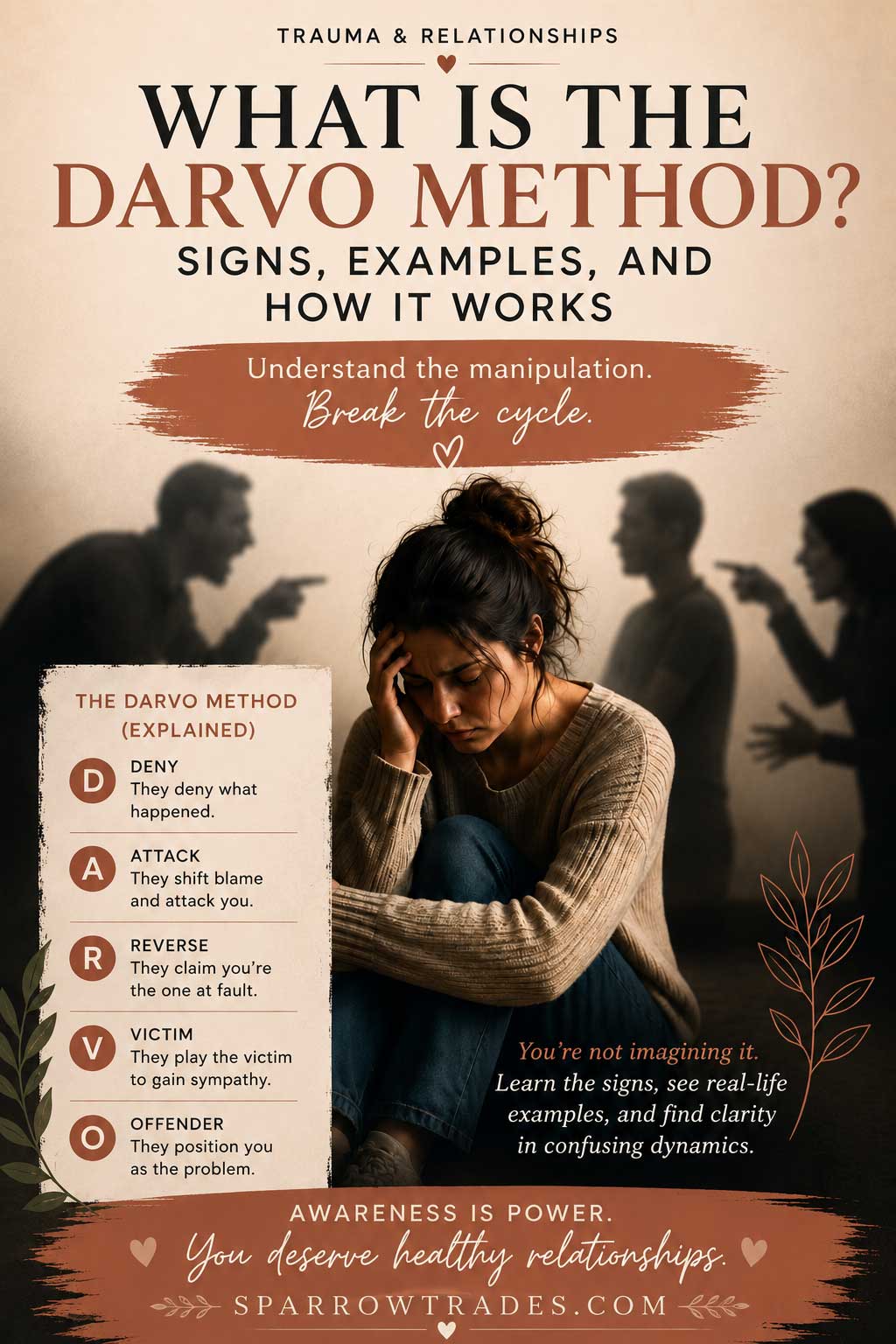
DARVO stands for Deny, Attack, and Reverse Victim and Offender. It describes a manipulation tactic where someone denies harmful behavior, attacks the person confronting them, and then positions themselves as the real victim of the situation. Instead of accountability, the conversation becomes emotionally inverted.
You may notice it after bringing up dishonesty, disrespect, emotional neglect, or manipulation. Rather than hearing empathy or responsibility, you suddenly find yourself defending your tone, your memory, your emotions, or even your character. The original issue disappears beneath confusion and emotional pressure.
For many people, this pattern becomes especially painful inside relationships shaped by emotional manipulation in relationships because the nervous system slowly learns that honesty leads to emotional punishment.
The hardest part is that DARVO often does not feel aggressive at first. Sometimes it sounds wounded. Sometimes it sounds defensive. Sometimes it sounds deeply convincing. A manipulative person may genuinely appear hurt while shifting responsibility away from themselves.
That emotional confusion is exactly what makes the experience so destabilizing.
People who repeatedly experience DARVO often begin doubting their perceptions altogether. They may minimize their pain, suppress conflict, or become hyperfocused on keeping the other person emotionally comfortable. Over time, this can disconnect someone from their own emotional instincts and create the painful internal fracture explored in learning to trust your emotions again.
Understanding DARVO is not about turning every disagreement into a psychological diagnosis. Healthy people can become defensive during difficult conversations. The difference is whether someone eventually returns to accountability, empathy, and repair — or whether blame reversal becomes a consistent survival strategy inside the relationship.
When DARVO becomes chronic, the emotional impact can feel profound. You stop feeling emotionally safe bringing up concerns. Your body braces before difficult conversations. You rehearse your words excessively. You question whether your feelings are “too much.” You begin shrinking yourself to avoid emotional retaliation.
That shrinking can quietly become its own form of self-abandonment.
What the DARVO Method Actually Looks Like in Real Life
One of the reasons DARVO is difficult to recognize is because it often unfolds quickly. The emotional shift can happen within minutes, leaving you confused about how the conversation changed direction so completely.
The first stage is denial.
Someone may insist the event never happened, claim you misunderstood their intentions, or minimize the impact of their behavior. This stage often overlaps heavily with early signs of gaslighting because both tactics create instability around memory and perception.
You might hear:
- “That never happened.”
- “You’re exaggerating.”
- “You always take things the wrong way.”
If denial alone does not shut the conversation down, the next stage often becomes attack.
Suddenly your emotions become the problem. Your delivery becomes the focus. Your character gets questioned. The manipulative person may accuse you of being controlling, cruel, dramatic, unstable, selfish, or abusive simply for bringing up harm.
This stage can feel especially painful for people who already carry wounds around being called sensitive is manipulation because the nervous system may already associate emotional honesty with shame.
Then comes the reversal.
Instead of addressing your pain, the manipulative person positions themselves as the victim of your confrontation. They may cry, withdraw, rage, accuse you of attacking them, or describe themselves as emotionally wounded by your honesty.
At that point, many people stop discussing the original issue altogether. The emotional energy shifts toward comforting the other person, calming them down, or defending yourself against accusations you never expected.
This is where chronic DARVO becomes psychologically exhausting.
The nervous system begins learning that self-expression is unsafe. Conflict no longer feels like a path toward resolution. It feels like entering emotional quicksand. Many survivors eventually develop hypervigilance, emotional shutdown, or chronic self-monitoring because their body anticipates relational reversal before conversations even begin.
This emotional exhaustion often overlaps with the deeper relational depletion explored in when empathy becomes emotional exhaustion.
Over time, DARVO can reshape the emotional atmosphere of a relationship entirely. One person becomes increasingly cautious and self-doubting while the other increasingly controls the emotional narrative.
That imbalance slowly changes how reality itself feels inside the relationship.
Why the DARVO Method Feels So Emotionally Confusing
DARVO creates confusion because it attacks emotional orientation itself.
Most people enter difficult conversations assuming honesty will lead somewhere meaningful. Even if the conversation becomes uncomfortable, there is usually an expectation that both people are working toward clarity, understanding, or repair.
DARVO interrupts that emotional logic.
Instead of movement toward understanding, the conversation bends backward. The person harmed becomes the aggressor. The person confronted becomes the victim. Emotional reality becomes distorted in a way that leaves the nervous system struggling to organize what just happened.
This confusion becomes even more destabilizing when someone already struggles with emotional invalidation from earlier life experiences.
If you grew up in environments where your emotions were minimized, punished, mocked, or reversed against you, DARVO may feel strangely familiar. Your body may instinctively move toward self-blame before your mind fully processes the manipulation happening in front of you.
That familiarity is important to understand compassionately.
Many people trapped in chronic manipulation are not “weak.” Their nervous system has simply learned that maintaining attachment sometimes required self-erasure, emotional suppression, or excessive empathy toward emotionally unsafe people.
This pattern can quietly evolve into what is self-erasure where someone gradually disconnects from their own emotional reality to preserve relational stability.
The emotional aftermath of DARVO often lingers long after the argument ends. You may replay conversations obsessively trying to identify what you did wrong. You may overexplain yourself constantly. You may begin apologizing automatically during conflict even when you were the one harmed.
Some people stop bringing up concerns altogether.
Others develop chronic anxiety before emotional conversations because their nervous system expects confusion, blame, or reversal rather than safety. This ongoing emotional tension can deeply affect nervous system regulation techniques because the body remains stuck anticipating emotional danger.
What makes healing difficult is that DARVO attacks trust from multiple directions at once:
- trust in memory
- trust in emotional perception
- trust in self-expression
- trust in conflict resolution
- trust in relational safety
That internal fragmentation is often why survivors describe feeling emotionally “foggy” after prolonged manipulation.
They are not imagining the confusion.
Their nervous system has been trained to distrust itself.
DARVO in Narcissistic and Emotionally Manipulative Relationships
While DARVO can appear in many unhealthy dynamics, it is especially common inside relationships shaped by narcissistic traits, chronic defensiveness, emotional control, or coercive manipulation.
People exploring what is a narcissist often recognize DARVO as one of the most emotionally destabilizing patterns within narcissistic relationships because accountability threatens the fragile emotional structure the manipulator depends on.
When confronted with harm, some manipulative individuals experience accountability as emotional annihilation rather than relational repair. Instead of tolerating shame, they instinctively externalize it.
That externalization becomes attack.
It becomes blame shifting.
It becomes victim reversal.
This is one reason DARVO frequently appears alongside cycles like why narcissists love-bomb and devalue you because both dynamics revolve around emotional control and narrative dominance.
In some relationships, DARVO becomes so normalized that the harmed person stops recognizing their own pain entirely. They become consumed with managing the other person’s reactions instead.
You may notice yourself:
- rehearsing conversations repeatedly
- softening every concern to avoid conflict
- apologizing before expressing hurt
- abandoning boundaries to keep peace
- feeling guilty for having emotional needs
This chronic emotional adaptation often overlaps with the psychology of over-apologizing and people-pleasing because survival inside manipulative systems frequently requires emotional self-minimization.
The emotional toll can become even more severe when DARVO occurs within families, long-term partnerships, or trauma-bonded relationships where attachment and emotional survival feel deeply intertwined.
In those situations, people often begin confusing emotional endurance with love.
They may believe compassion means tolerating confusion indefinitely.
They may believe understanding someone’s pain requires abandoning their own.
But emotional empathy without boundaries eventually becomes self-betrayal.
That is why healing from manipulation almost always involves rebuilding emotional boundaries alongside emotional clarity.
Without boundaries, reality itself becomes negotiable inside unhealthy relationships.
How to Protect Yourself When Someone Uses DARVO
Recognizing DARVO does not automatically make it emotionally easy to navigate.
Even when you intellectually understand what is happening, your nervous system may still feel pulled into defending yourself, overexplaining, apologizing, or emotionally rescuing the other person.
That reaction is human.
The goal is not becoming emotionally cold. The goal is learning how to stay connected to your own reality while someone else attempts to destabilize it.
One of the most important shifts involves noticing when the original issue disappears.
If you entered a conversation discussing harm and suddenly find yourself defending your character, sanity, tone, or emotional legitimacy, pause internally. Ask yourself: “What was the original concern I was trying to address?”
That simple question can help interrupt emotional disorientation.
It can also help support the rebuilding process explored in healing after being emotionally invalidated because validation often begins with quietly returning to your own emotional truth.
You may also need to reduce the instinct to overexplain yourself.
Many survivors believe that if they can just communicate clearly enough, calmly enough, or compassionately enough, the misunderstanding will resolve. But chronic DARVO is usually not caused by insufficient communication. It is caused by resistance to accountability.
That distinction matters deeply.
Instead of proving yourself endlessly, focus on grounding yourself emotionally. Practices connected to somatic self-soothing practices can help the nervous system remain more anchored during emotionally manipulative interactions.
This may include:
- slowing your breathing
- relaxing jaw tension
- noticing physical sensations
- taking pauses before responding
- ending conversations when confusion escalates
In some situations, protecting yourself may also involve creating firmer relational boundaries through patterns reflected in how to set emotional boundaries without feeling guilty.
Boundaries are not punishments.
They are nervous-system protection.
They are emotional clarity made visible.
And sometimes the healthiest response to repeated blame reversal is not winning the argument — it is refusing to abandon yourself inside it.
Frequently Asked Questions About the DARVO Method
Is the DARVO method the same as gaslighting?
Not exactly, though they often overlap. Gaslighting focuses primarily on making someone question their memory, reality, or perception. DARVO includes denial but also adds attack and victim reversal. Many emotionally manipulative relationships contain both patterns simultaneously, especially within dynamics shaped by how gaslighting destroys trust.
Can someone use DARVO without realizing it?
Sometimes people become defensive unconsciously during conflict, especially when shame or fear is activated. But occasional defensiveness is different from a chronic pattern of blame reversal. Healthy relationships eventually return to accountability, empathy, and repair. Persistent DARVO repeatedly redirects responsibility away from harmful behavior and onto the person expressing hurt.
Why does DARVO make me question myself so much?
DARVO creates emotional disorientation by shifting attention away from the original issue and onto your emotional response instead. Over time, this can weaken emotional self-trust and create chronic confusion around your perceptions. Many people eventually need support rebuilding emotional self-trust tracker patterns because manipulation slowly conditions self-doubt into the nervous system.
Is DARVO common in narcissistic abuse?
Yes. DARVO frequently appears inside narcissistic abuse dynamics because accountability threatens the emotional control structure many manipulative individuals rely on. This pattern also overlaps with behaviors explored in how narcissists switch personas to control you where emotional narratives shift rapidly depending on what protects the manipulator emotionally.
How do I stop getting pulled into DARVO conversations?
The first step is recognizing the emotional shift happening in real time. Notice when you stop discussing the original issue and begin defending yourself instead. Grounding techniques, emotional pauses, and nervous-system awareness can help reduce emotional spiraling during conflict, especially practices connected to how to strengthen your emotional window of tolerance.
Can healing from DARVO take a long time?
Yes. Chronic blame reversal affects emotional safety, trust, identity, and nervous-system regulation. Many people leave these relationships feeling emotionally fragmented or disconnected from themselves. Healing often involves rebuilding emotional clarity slowly through experiences of safety, validation, and self-reconnection, especially within emotional wellness foundations that restore internal stability over time.
Conclusion
One of the most painful parts of experiencing DARVO is how invisible it can feel while it is happening.
You may spend months or years believing you are simply “bad at communication,” “too emotional,” or constantly misunderstanding people. Meanwhile, your nervous system is quietly adapting to emotional reversal over and over again.
That adaptation can change how you relate to yourself.
You may become hypervigilant during conflict. You may suppress your emotions before others can dismiss them. You may lose trust in your instincts entirely. Some people become so accustomed to blame reversal that emotional confusion starts feeling normal.
But confusion is not always evidence that you are wrong.
Sometimes confusion is evidence that your reality is being emotionally redirected.
Understanding the DARVO method can become an important turning point because it gives language to experiences that once felt impossible to explain. Naming the pattern helps separate your identity from the manipulation surrounding you.
And that separation matters.
Because healing is not only about recognizing manipulation in others.
It is also about slowly reconnecting with yourself again.
That reconnection may happen through boundaries. Through nervous-system repair. Through emotional validation. Through safer relationships. Through finally allowing your emotions to exist without immediately defending them.
For many people, this journey eventually becomes part of reclaiming your voice after emotional suppression where emotional honesty no longer feels dangerous.
You do not need to become emotionally perfect to trust yourself again.
You only need enough safety to stop abandoning your own reality every time someone refuses to face theirs.

Where softness, self-awareness, and emotional healing are allowed to coexist. Through reflective writing, grounding rituals, and intentional beauty, Sparrow Trades offers gentle support for sensitive souls learning to reconnect with themselves.