
We live in a world that rarely powers down. Phones stay within arm’s reach, Wi-Fi signals hum invisibly through our homes, and screens accompany us from morning to night. For many people, this constant exposure doesn’t just feel mentally draining—it feels physically and emotionally destabilizing. You might notice subtle symptoms: restless sleep, increased irritability, difficulty concentrating, or a sense that your nervous system never fully settles. Over time, this can create a persistent feeling of being “on edge,” even when nothing is technically wrong.
This is where conversations around black tourmaline for emf protection often begin—not from fear, but from a desire for grounding, containment, and energetic stability in an overstimulated world.
Black tourmaline has long been associated with grounding and protective qualities. Across cultures and modern energy practices, it’s viewed as a stone that helps anchor scattered energy, absorb excess stimulation, and reinforce energetic boundaries. For people who feel sensitive to their environments—emotionally, energetically, or somatically—black tourmaline is often experienced as stabilizing rather than activating. It doesn’t push energy upward or outward. Instead, it draws awareness down into the body, supporting a sense of safety and presence. If you want a deeper foundation on what this means, start with grounding.
Importantly, working with black tourmaline doesn’t require believing that technology is “bad” or that EMFs are inherently dangerous. Many people who use grounding stones are not rejecting modern life—they are learning how to stay regulated within it. This distinction matters. Trauma-informed grounding is not about avoidance; it’s about capacity. It’s about giving your nervous system enough support to remain resilient in environments that demand constant attention. If you’re navigating sensitivity, it can help to review a practical grounding safety guide so your practices feel supportive rather than forced.
If you’ve ever felt depleted after hours online, overwhelmed in urban spaces, or emotionally porous after a long day of digital engagement, you’re not imagining it. Our nervous systems evolved in far quieter conditions. Black tourmaline is often chosen not because it promises a dramatic fix, but because it offers something subtler: steadiness.
This article explores how black tourmaline for emf protection is commonly used in grounding practices, how it supports energetic boundaries, and why so many people experience it as calming rather than stimulating. We’ll also look at how to work with it intentionally—without fear-based thinking, spiritual bypassing, or unrealistic claims—so it becomes a supportive tool rather than another thing you’re “supposed” to do.
What EMF Sensitivity Often Feels Like
Before discussing stones or practices, it’s important to name the lived experience many people have around EMF exposure. For most, it’s not dramatic or easily measurable—it’s cumulative.
People often describe feeling mentally “fried” after long periods on devices, emotionally dysregulated without a clear reason, or physically tense even while resting. Some notice increased anxiety, shallow breathing, headaches, or difficulty grounding back into their bodies. For trauma survivors, empaths, or highly sensitive individuals, these sensations can amplify existing nervous system overwhelm. If you notice that emotional overwhelm shows up as disconnection or “floating,” you may also benefit from emotional grounding.
What’s happening here isn’t just external stimulation—it’s internal load. Screens demand sustained attention, rapid processing, and constant micro-decisions. Even when content is enjoyable, the nervous system rarely receives cues that it’s safe to fully relax.
This is where grounding becomes essential. Grounding doesn’t mean disconnecting from reality; it means reconnecting to the body and the present moment. When people explore black tourmaline for emf protection, they’re often seeking something that helps them feel less scattered, less permeable, and more contained in their own energy.
Black tourmaline is associated with the root chakra, which relates to safety, stability, and physical presence. Energetically, it’s thought to help excess stimulation discharge downward rather than circulate endlessly in the mind. Many people report that simply holding or wearing black tourmaline creates a subtle sense of weight or anchoring—like their energy finally has somewhere to land. If you want to compare options, you can explore crystals for grounding for additional supportive stones.
This is especially meaningful for those who spend most of their day in abstract spaces: digital work, emotional labor, or intellectual processing. Grounding stones don’t replace rest, boundaries, or nervous system care—but they can act as a physical reminder to return to the body.
How Black Tourmaline Is Used for EMF Protection
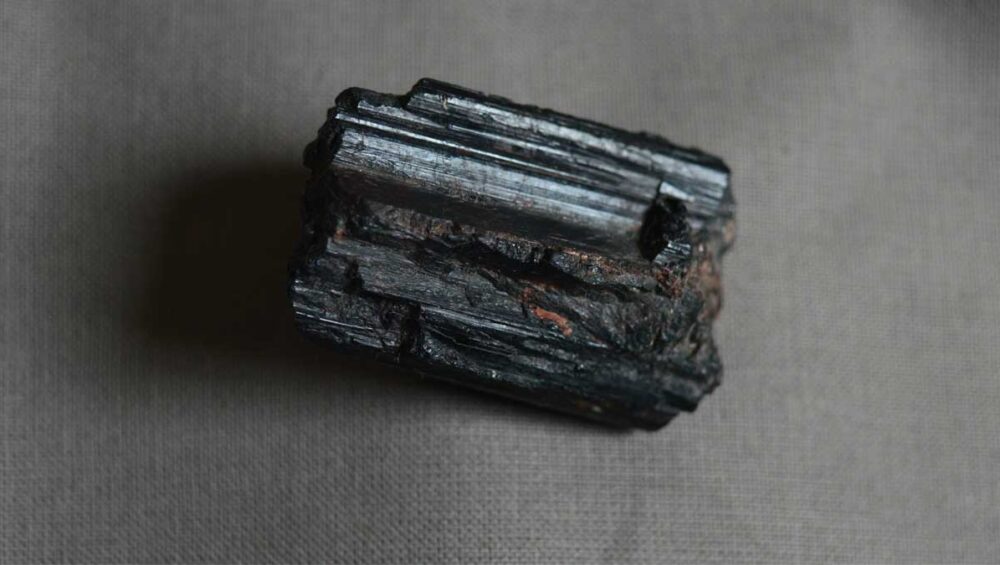
When people talk about black tourmaline for emf protection, they’re rarely describing a shield that blocks signals in a literal, mechanical sense. Instead, they’re describing an energetic relationship: how the stone influences their experience of stimulation. To understand the stone itself more fully, see black tourmaline.
Black tourmaline is believed to absorb and transmute dense or excess energy. In practical terms, this often translates to feeling less reactive, less jittery, or less emotionally porous when surrounded by electronics. It’s not about eliminating exposure—it’s about buffering the nervous system’s response.
Common ways people work with black tourmaline include placing it near workstations, wearing it as jewelry, or carrying it during travel. These practices create consistency. The stone becomes a grounding anchor—something the body associates with safety and containment. If you like structured routines, build this into grounding with crystals daily practices.
From a trauma-informed perspective, this matters. Regulation often comes from repetition and predictability. When you consistently pair black tourmaline with intentional grounding—slowing your breath, noticing your body, or setting boundaries around digital use—it becomes part of a larger nervous system ritual. If you’re building a support toolkit, grounding tools for trauma recovery can help you choose options that feel safe and stabilizing.
Many people find black tourmaline especially helpful during transitions: logging on for work, entering crowded spaces, or unwinding after long screen exposure. These are moments when the nervous system shifts states, and support is most needed. If this theme resonates, a future deep-dive on nervous system safety in a digital world would explore exactly how overstimulation accumulates and how to downshift gently.
It’s also worth noting that black tourmaline has a “quiet” energy. Unlike stones associated with activation or expansion, it doesn’t amplify emotions. This makes it particularly suitable for those recovering from emotional overload, dissociation, or chronic stress.
Emotional and Energetic Boundaries in a Digital Age
One of the most overlooked aspects of EMF-related overwhelm is boundary fatigue. Constant connectivity doesn’t just stimulate the brain—it erodes the sense of where you end and the world begins. If you’re sensitive to other people’s stress or emotional “noise,” grounding boundaries for empaths can be a helpful next step.
Black tourmaline is often used as an energetic boundary stone. People describe feeling more “contained” when working with it, as if external noise has less access to their internal world. This can be deeply regulating for those who absorb other people’s emotions, expectations, or stress without realizing it. A future, more expansive guide on energetic boundaries in modern environments could map the subtle ways modern life blurs boundaries and how to re-establish “filters” without shutting down.
Energetic boundaries are not about walls—they’re about filters. Black tourmaline supports the idea that you can be present and open without being depleted. This aligns with trauma-informed healing, which prioritizes choice, safety, and self-trust.
Wearing black tourmaline jewelry can serve as a physical reminder to check in with yourself throughout the day. Are your shoulders tense? Is your breath shallow? Are you absorbing more than you intend to? These moments of awareness are where healing happens. If you want a wearable option that stays close to the body, explore black tourmaline jewelry.
Over time, many people report that working with grounding stones helps them recognize overwhelm sooner—and respond with care rather than pushing through. If hyper-alertness is part of your pattern, grounding for hypervigilance offers targeted support. If the aftermath of overwhelm is your biggest challenge, grounding after emotional overload may feel even more relevant.
Using Black Tourmaline Intentionally
Intentional use is what transforms black tourmaline from an object into a practice. Simply owning the stone is less impactful than engaging with it consciously.
Start by choosing one consistent way to work with it—wearing it, placing it near your devices, or holding it during grounding rituals. Pair this with a simple practice: a few deep breaths, feet on the floor, or a verbal intention like, “I am grounded and protected in my energy.” If you want to create a gentle routine specifically for screen-heavy days, a future guide to grounding rituals for screen fatigue would offer a step-by-step transition practice for logging off and coming back into your body.
It’s also important to cleanse black tourmaline regularly. Because it’s associated with absorption, many people cleanse it through smoke, sound, moonlight, or placing it on natural earth. This keeps the relationship with the stone clear and intentional. For detailed methods, see how to cleanse black tourmaline.
Most importantly, black tourmaline should feel supportive—not obligatory. If it adds pressure or fear, that’s a cue to reassess. Grounding is meant to create safety, not control. If you’re choosing supportive stones for emotional steadiness, grounding stones for anxiety relief can offer additional options depending on what your body responds to best.
And if you want a simple way to weave grounding into daily life, many people start with grounding jewelry because it’s consistent and easy to remember—especially when you’re already carrying a lot.
FAQs About Black Tourmaline for EMF Protection
Does black tourmaline really protect against EMFs?
Black tourmaline is not a scientific EMF-blocking device. Instead, it’s used energetically to support grounding and reduce nervous system reactivity to stimulation. For many people, the benefit shows up as feeling less scattered, less tense, or less emotionally porous when they’re around electronics. Think of it as an energetic grounding support rather than a technological shield. If you want a dedicated framework for this specific experience, a future article on energetic grounding for digital overload would explore how grounding changes your internal response to constant stimulation.
Where should I place black tourmaline for EMF protection?
Common placements include near computers, Wi-Fi routers, bedside tables, or worn as jewelry to maintain consistent grounding throughout the day. If you work on screens for long stretches, placing black tourmaline near your workstation can function as a visual cue to pause, breathe, and return to your body. If your goal is gentle consistency, pairing it with a routine from grounding with crystals daily practices can help it feel less random and more supportive.
Can black tourmaline help with anxiety or overwhelm?
Many people experience black tourmaline as calming and stabilizing, especially during emotional or sensory overload, though it should complement—not replace—other supports. If anxiety is a primary pattern for you, exploring grounding stones for anxiety relief can help you identify other grounding options and decide what feels best in your body.
How often should black tourmaline be cleansed?
Frequency depends on use, but many people cleanse weekly or after intense emotional or environmental exposure. If you wear black tourmaline daily, or keep it in a high-stimulation area like a workspace, cleansing can help the stone feel “clear” again. For methods and safety considerations, follow how to cleanse black tourmaline so you can choose a practice that feels simple and sustainable.
Is black tourmaline safe for sensitive or trauma-healing practices?
Yes. Its grounding, non-stimulating nature makes it a common choice for trauma-informed and nervous system–focused work. That said, the most important measure of “fit” is your lived experience: if something feels activating or pressuring, it’s okay to adjust. A future, practical guide to trauma-informed grounding practices would expand on how to use grounding tools in ways that prioritize consent, pacing, and nervous system safety.
What if I’m an empath and I feel everything more intensely online?
If you identify as an empath—or you simply feel highly attuned to other people’s emotions—digital environments can amplify boundary fatigue. Black tourmaline is often used to support containment, but it works best alongside clear boundary practices. For immediate support, grounding boundaries for empaths can help. For a future standalone article that focuses specifically on stone selection for empathic sensitivity, grounding stones for empaths would be a natural expansion.
Conclusion
Black tourmaline for emf protection is less about shielding yourself from the modern world and more about learning how to stay grounded within it. In a culture of constant stimulation, grounding becomes an act of self-respect.
When used intentionally, black tourmaline supports energetic boundaries, nervous system regulation, and emotional containment. It offers steadiness—not as a cure-all, but as a companion in practices that prioritize safety and presence.
Ultimately, the most powerful protection is not avoidance, but resilience. Black tourmaline reminds us that we can remain rooted, regulated, and whole—even in a digital world that never stops buzzing.

Where softness, self-awareness, and emotional healing are allowed to coexist. Through reflective writing, grounding rituals, and intentional beauty, Sparrow Trades offers gentle support for sensitive souls learning to reconnect with themselves.